
Case Study SQR-UFO-002: The Roswell UFO Incident
SIDE QUESTS OF REALITY | SQR-UFO-002 | ROSWELL UFO INCIDENT
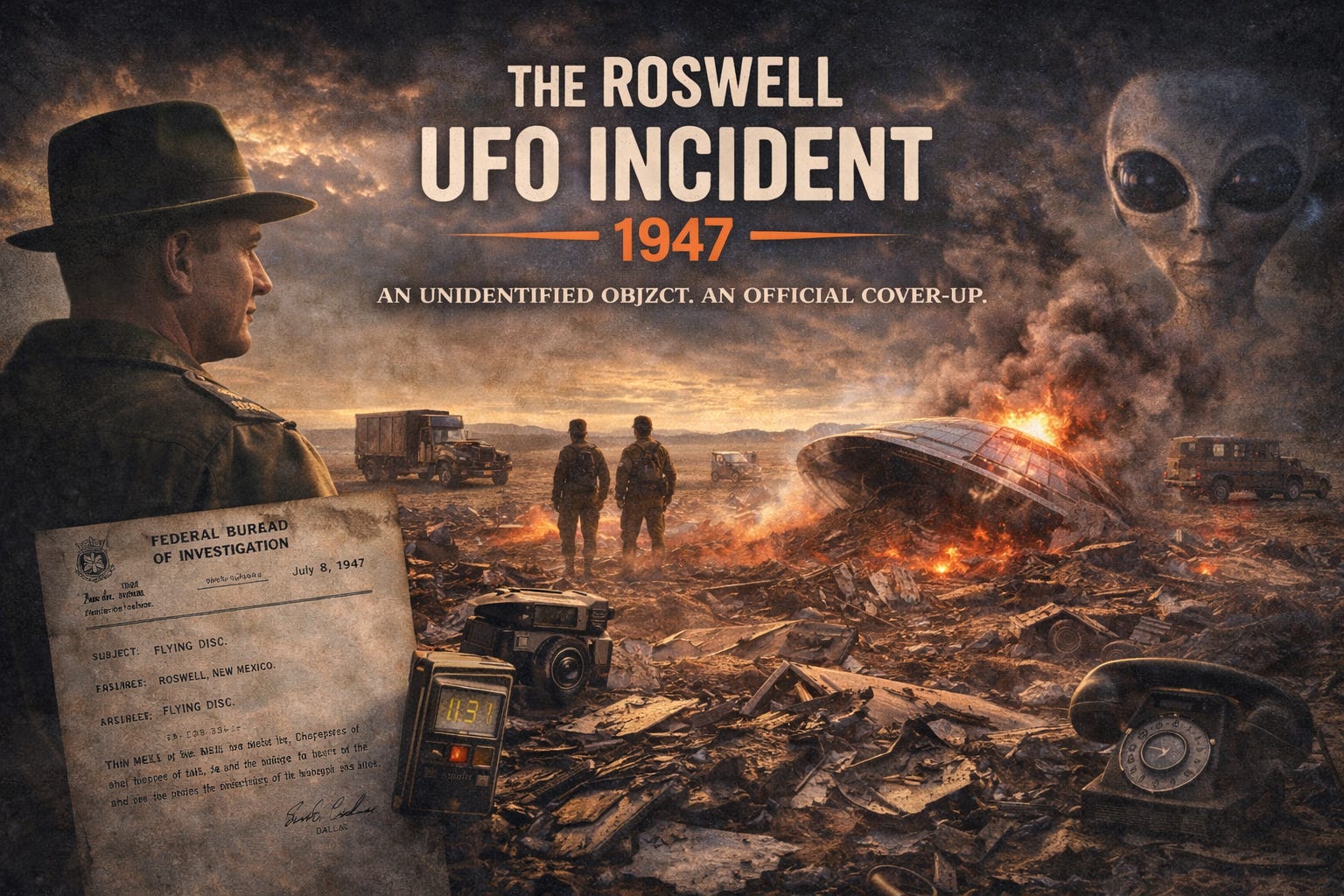
On the morning of July 8, 1947, Lieutenant Walter Haut sat down and typed a press release.
He was the public information officer at Roswell Army Air Field in New Mexico, and he was doing what public information officers do. He had been given information by his commanding officer, Colonel William Blanchard, and he was transmitting it to the press.
The press release was short. It announced that the Army Air Forces had recovered a flying disc from a ranch in the New Mexico desert.
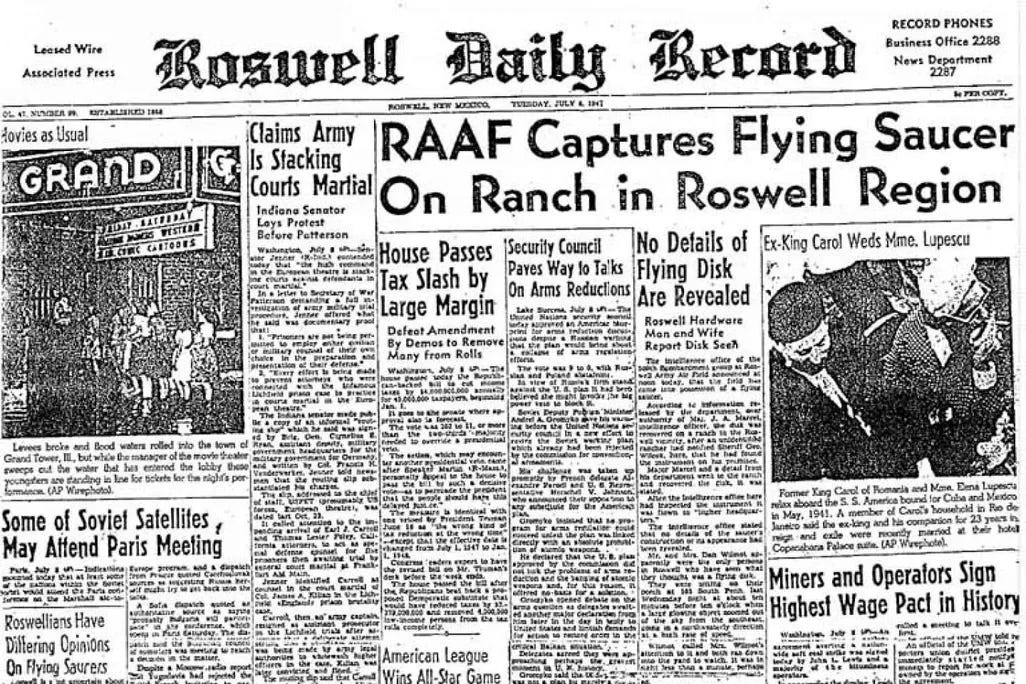
By afternoon, the story was on the wire services. By evening, it had gone around the world. Flying disc captured by Air Force. The headlines were everywhere.
Twenty-four hours later, a second press release appeared. The object was not a flying disc. It was a weather balloon. Nothing to see. Case closed.
The story disappeared from the news within days.
It did not disappear from the people who were there.
🎙️LISTEN TO THE SIDE QUESTS OF REALITY PODCAST

The Setting
Roswell Army Air Field in the summer of 1947 was not an ordinary military installation.
It was home to the 509th Bomb Group of the Eighth Air Force, the only unit at the time capable of delivering nuclear weapons. The men stationed there were among the most highly trained and security-conscious in the American military. They were not people prone to misidentification of routine objects. They were not people who panicked. They had handled the most destructive technology in human history. They knew what they were looking at.
This matters because what happened next happened to them.
The Rancher
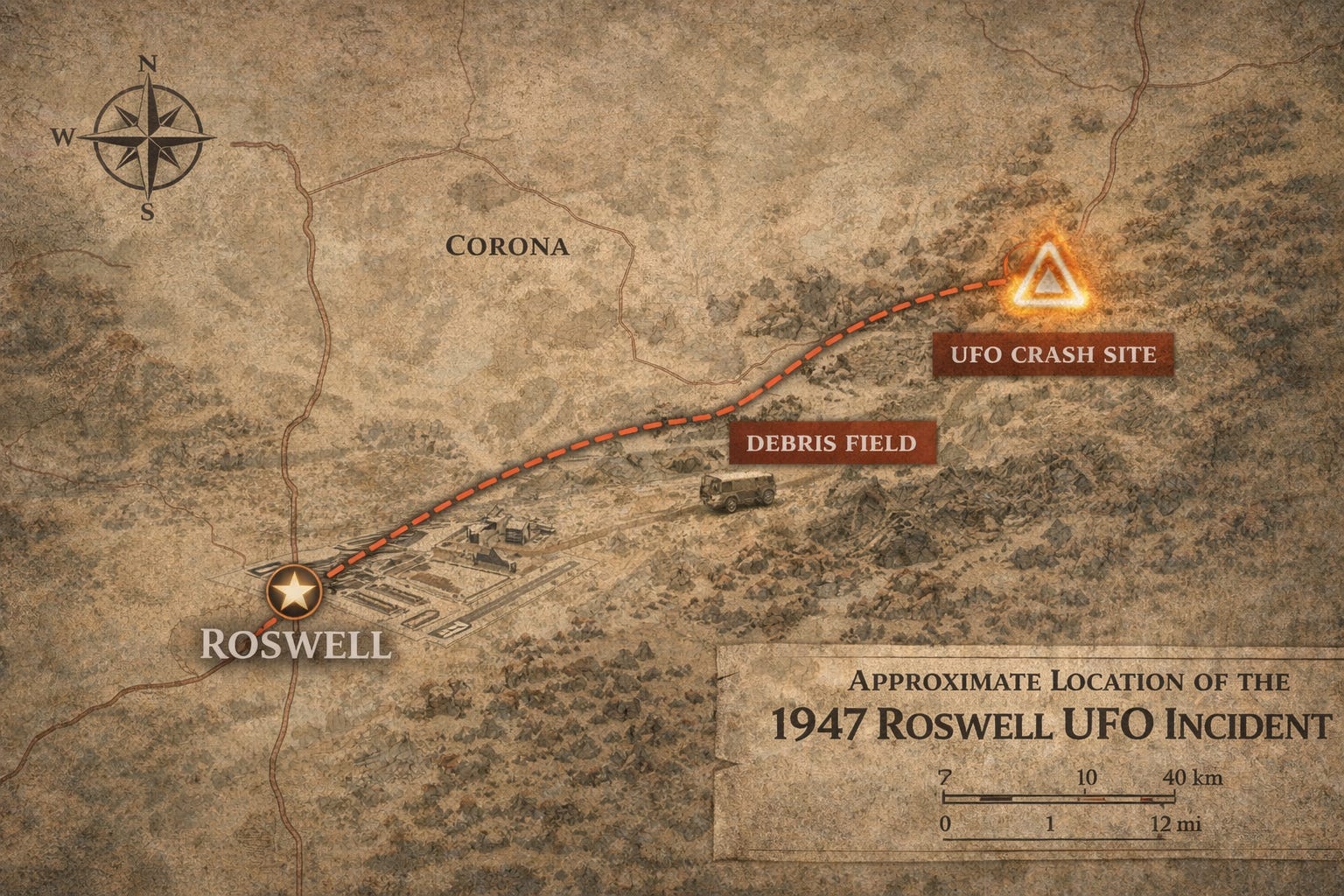
On July 7, 1947, a rancher named W.W. Mac Brazel appeared at the office of Sheriff George Wilcox in Roswell, New Mexico, and described the wreckage of a metal disk and some other materials, including tinfoil, broken wood beams, strips of rubber, and thick paper, which he had discovered a few days earlier on the Foster Ranch where he worked, about 75 miles northwest of Roswell.
Brazel had found the debris some days before and had not immediately reported it. He had seen weather balloons on the ranch before. This did not look like a weather balloon. Despite later claims that he was forced to repeat a cover story, Brazel told newspaper reporters directly: I am sure that what I found was not any weather observation balloon.
He described the field of debris as covering a large area. Pieces of it were unlike anything he had encountered before. Some had markings on them. The material had properties that did not match any conventional object he could name.
Sheriff Wilcox contacted the base. The base sent Major Jesse Marcel.
The Intelligence Officer
Major Jesse Marcel was the base intelligence officer. He was a veteran of World War Two, a man who had been present at the atomic bomb tests at Bikini Atoll, a man whose professional life was built on accurate observation and careful assessment. He went out to the ranch with Brazel and spent time in the debris field.
He collected much of the material, described as shiny wreckage including pieces of rubber, super-resistant tinfoil, wooden sticks, and what appeared to be I-beams of metallic-looking material.
On the way back to the base, he stopped at his home. He woke his wife and his eleven-year-old son, Jesse Marcel Jr., and showed them what he had found.
Jesse Marcel Jr. said that there were I-beams about 12 to 18 inches long, and the most unusual part was the symbols or writing on the inner surface. He thought at first it was like Egyptian hieroglyphics, but when he looked closer it seemed more like geometric symbols of some kind. He described it as very strange. He spent 35 years repeating this account, consistently, in interviews and affidavits, until his own death.
The next morning, Marcel took the debris to the base. Colonel Blanchard examined it. He ordered the debris site cordoned off. He then told Haut to issue a press release.
The press release said they had a flying disc.
Blanchard was the commanding officer of the only nuclear-capable unit in the United States Air Force. He was not a man who made careless public statements. He told Haut to say they had a flying disc because, on the evidence available to him, that was what he believed they had.
The Reversal
Within hours of the press release, everything changed.
The debris, or what was being presented as the debris, was flown to Fort Worth Army Air Field in Texas. A press conference was held where General Roger Ramey, his chief of staff Colonel Thomas DuBose, and weather officer Irving Newton identified the material as pieces of a weather balloon. Newton told reporters that similar radar targets were used at about 80 weather stations across the country.
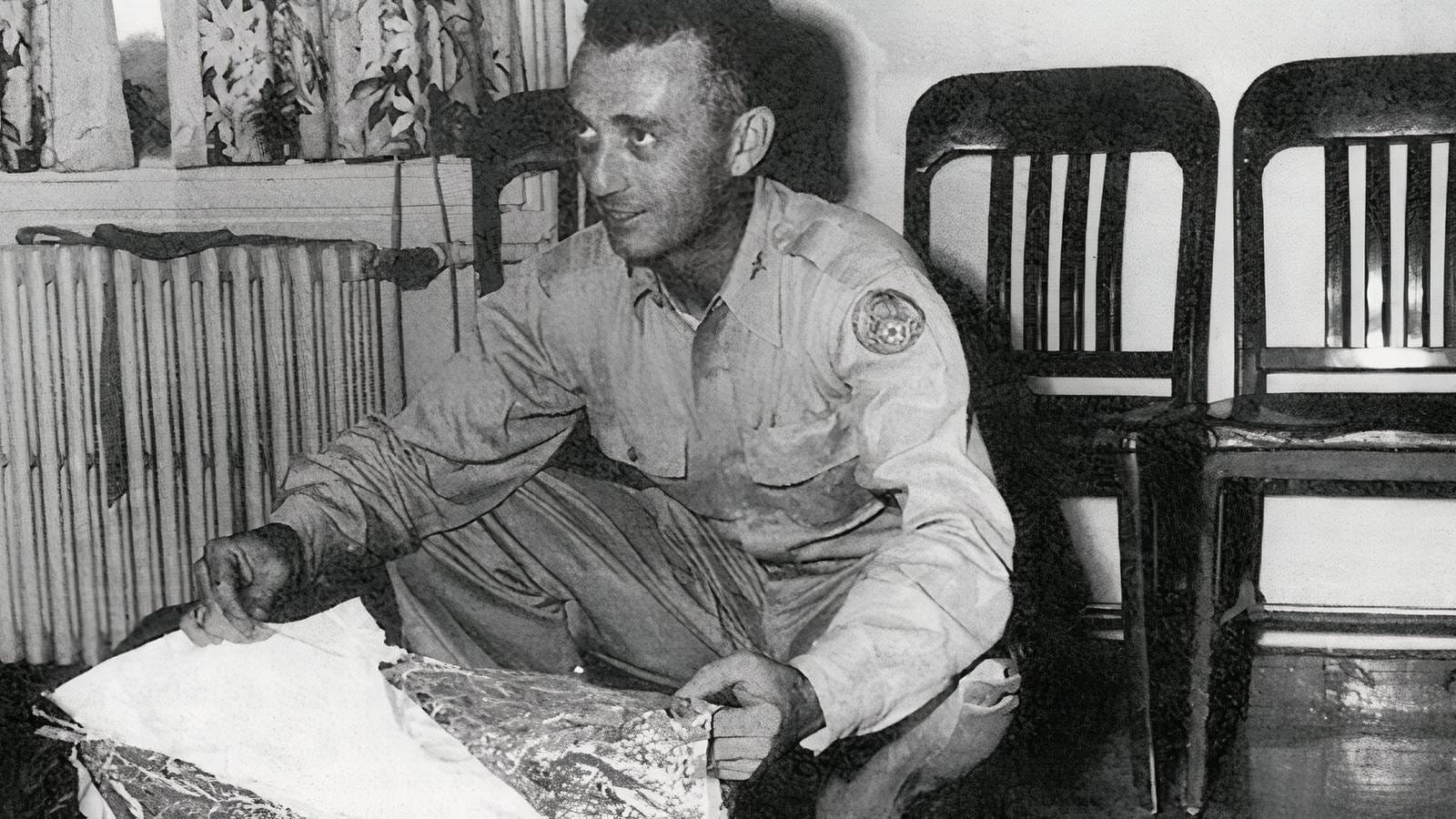
Photographs were taken of Marcel crouching with the recovered material. The photographs showed foil, sticks, and what appeared to be a radar reflector.
Marcel later said the material in those photographs was not the material he had recovered from the ranch.
In 1978, thirty years after the event, Marcel finally spoke. He said the weather balloon claim had been a cover story. He described material that could not be cut or burned. Metal as light as balsa wood and as strong as steel. Symbols on beams that no one on the base could read.
The skeptical response to Marcel has always pointed to inconsistencies in his accounts, including embellishments about his military record. These are real and worth noting. But inconsistency in peripheral details does not automatically discredit the central observation. Men who have carried secrets for thirty years and then speak do not always speak with perfect precision. What Marcel never changed, across every interview he gave until his death in 1986, was the core claim. The material was not a weather balloon. He knew what weather balloons looked like. This was not one.
The Explanation
In 1994, the United States Air Force published a report concluding that the Roswell debris came from Project Mogul.
Project Mogul sought to develop a technique capable of recording the sound of a nuclear detonation within the Soviet Union, by placing acoustic sensors on balloons that operated at a steady state within the stratosphere. The balloons were long trains of linked devices, classified, and operating in the New Mexico desert. One had been lost. It had come down on the Foster Ranch. Mac Brazel had found it.
The tape used in the construction of the radar target boxes was left over from a line of holiday items and contained gold flower-like patterns on a purple background, which accounted for the claims that the debris had hieroglyphics on it. What Marcel and others described as alien writing was manufacturer’s tape from a toy company in New York.
This explanation is coherent. The military had reason to conceal what the debris was. Project Mogul was highly classified. Admitting a Mogul balloon had crashed would have revealed the program’s existence. The weather balloon story was a deliberate misdirection designed to protect a legitimate secret.
The United States Air Force later acknowledged this explicitly. The cover-up was real. The government admitted it. They lied. They did it for reasons of Cold War security.
The question that the Project Mogul explanation does not fully close is whether what it was covering up was only Mogul.
What the Explanation Does Not Cover
The Mogul balloon explains the debris field. It explains the foil, the sticks, the tape with its flower patterns mistaken for hieroglyphics. It explains why the military responded quickly and classified everything it touched.
It does not explain the bodies.
The honest accounting here is difficult but necessary. The 1947 Roswell accounts did not mention alien bodies. None of the primary eyewitnesses at the time mentioned bodies. The claims of alien bodies came decades later, from elderly witnesses, sometimes as deathbed confessions, and they contradict each other in basic details such as the location of the crash, the number of extraterrestrials, and the description of what was found.
The body reports are late, inconsistent, and often second or third hand. They do not constitute strong evidence on their own.
But they are not nothing either.
The most significant body-related testimony belongs to Walter Haut.
The Man Who Typed the Press Release
Haut spent decades maintaining a minimal public position. He had issued the press release. That was his role. He did not claim personal knowledge of anything beyond that.
He was a man keeping a promise. He had been sworn to secrecy by Colonel Blanchard, a close personal friend, and he honored that oath for the rest of his life.
In 2002, he found a way to keep the oath and still tell the truth. He prepared a signed affidavit, notarized and sealed, to be opened only after his death.
Haut died in 2005. The affidavit was published in 2007.
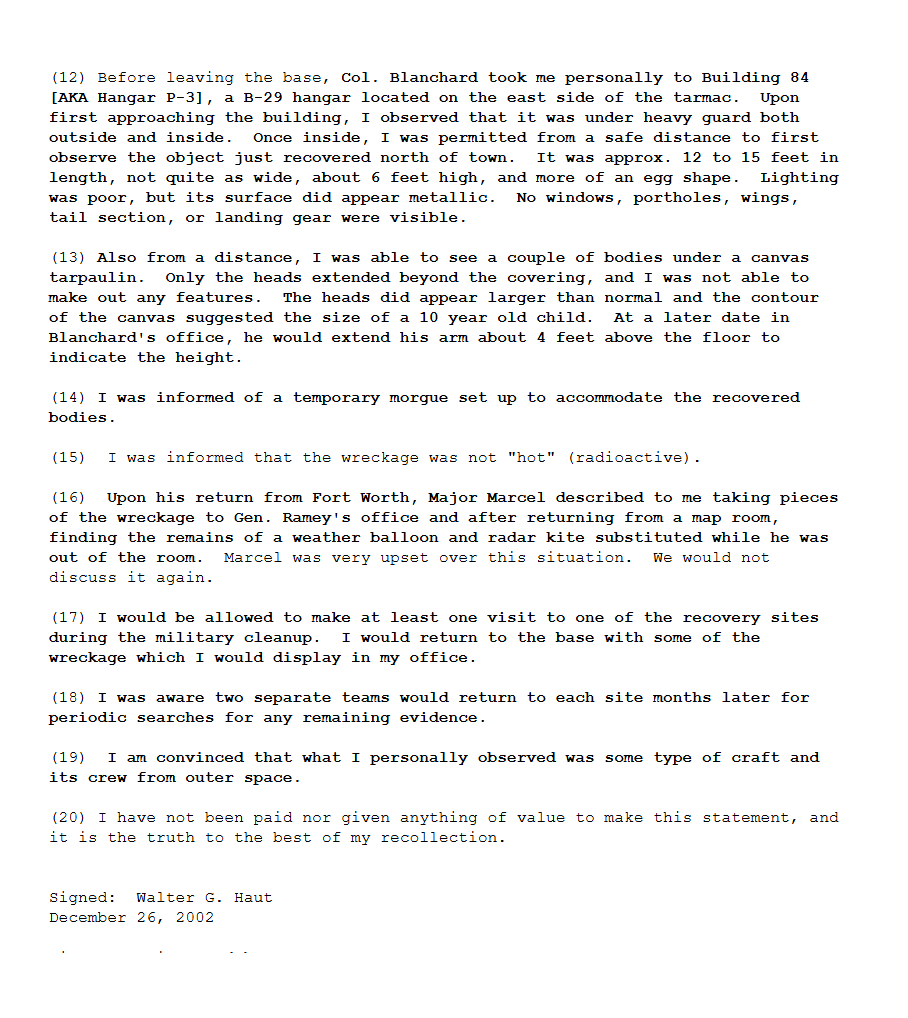
In it, he describes being taken by Colonel Blanchard personally to one of the base hangars. He describes a metallic egg-shaped object about 12 to 15 feet in length and around six feet wide, with no windows, no wings, no tail, no landing gear, no feature he could identify or name. On the floor nearby, partially covered by a tarpaulin, were two bodies. About four feet tall. Disproportionately large heads.
He also describes a morning meeting where samples of the wreckage were passed around a table. He writes that it was unlike any material he had or has ever seen in his life. Pieces which resembled metal foil, paper thin yet extremely strong, with unusual markings along their length, were handled from man to man, each voicing their opinion. No one was able to identify the crash debris.
His affidavit ends with this: I am convinced that what I personally observed was some kind of craft and its crew from outer space.
His daughter Julie said she went over the 2002 affidavit with him word by word, sentence by sentence. He was clear-minded when he signed it. He understood exactly what he was putting into the record and chose to put it there anyway.
The skeptical response is that an elderly man, reflecting across decades on events shaped by thirty years of cultural mythology about Roswell, may have absorbed and incorporated details that were not originally his. False memory is real. The human mind reconstructs the past through the filter of subsequent experience.
This is a legitimate concern. It cannot be dismissed.
It also cannot fully account for a man who spent sixty years publicly saying almost nothing, who had every opportunity to tell a dramatic story and declined, who constructed a posthumous document specifically because he felt bound by an oath he took in 1947, and who described being taken personally by his commanding officer to see what his commanding officer wanted him to see.
Blanchard showed him. That detail matters. Commanding officers of nuclear-capable units do not show their public information officers things that do not exist.
The Missing Records
The General Accounting Office conducted a search of government records related to Roswell in the mid-1990s at the request of a New Mexico congressman.
Some of the records concerning Roswell activities had been destroyed. There was no information available regarding when or by whose authority they were destroyed. Only two government records originating in 1947 were recovered regarding the incident.
Army regulations in 1947 required that air accident reports be maintained permanently. No accident report exists for the event that generated the most significant military response in the history of the Roswell base. Not classified. Not restricted. Not filed under a different name.
Gone.
This is the Roswell record’s equivalent of the missing Rendlesham files. The most significant event generates the least documentation. In both cases, what should be there is not there. In both cases, no explanation has been provided.
What Roswell Is
Roswell is the most contaminated UFO case in history.
That is the honest position. Seventy-eight years of mythology, hoax, embellishment, false witnesses, manufactured documents, commercial tourism, and cultural saturation have made it nearly impossible to separate the original 1947 events from everything layered on top of them.
The Majestic 12 documents were fabrications. The alien autopsy film of 1995 was a hoax. Numerous witnesses who came forward over the decades had no credible connection to the events they described. The sheer volume of noise makes the signal almost impossible to find.
And yet the signal is there, if you are willing to do the work of separating it from the noise.
A rancher found something he could not identify and knew was not a weather balloon. A base intelligence officer with an exemplary record collected debris with properties he had never encountered and never forgot. A base commander with the highest security clearance in the Air Force authorized a public statement calling it a flying disc. A public information officer who spent sixty years saying almost nothing signed a posthumous affidavit describing what his commanding officer personally showed him in a hangar. Government records that should exist do not exist, and no one has explained why.
These facts remain after you strip away every hoax, every embellishment, every fabricated document, every piece of manufactured mythology.
They are not enough to prove what crashed in the New Mexico desert on a night in late June or early July 1947.
They are enough to make the weather balloon the least satisfying explanation available.
Project Mogul explains the debris field and the classification and the cover-up.
It does not explain why the commanding officer of the only nuclear-capable unit in the United States military authorized a press release calling it a flying disc.
Blanchard had seen it. He had the wreckage in front of him. He had the judgment of his intelligence officer, a man he trusted professionally with nuclear security, telling him it was unlike anything he had seen. He had, presumably, already begun to understand what he was dealing with.
And his first instinct, before the reversal came from above, was to tell the truth.
He told Haut to type it up. He told him to send it out. He wanted the world to know.
By the following afternoon, someone above Blanchard had decided otherwise.
What they decided to conceal, and whether it was only a Mogul balloon, is the question that has never been answered.
It is a question that the record, stripped of everything that does not belong to it, still holds open.
This case is filed as SQR-UFO-002.
If you want to be notified when SQR-UFO-003 drops, and when the cases start talking to each other in ways that are difficult to explain, subscribe below.
That’s all this is. Careful attention. Sustained over time. Welcome to Side Quests of Reality.