

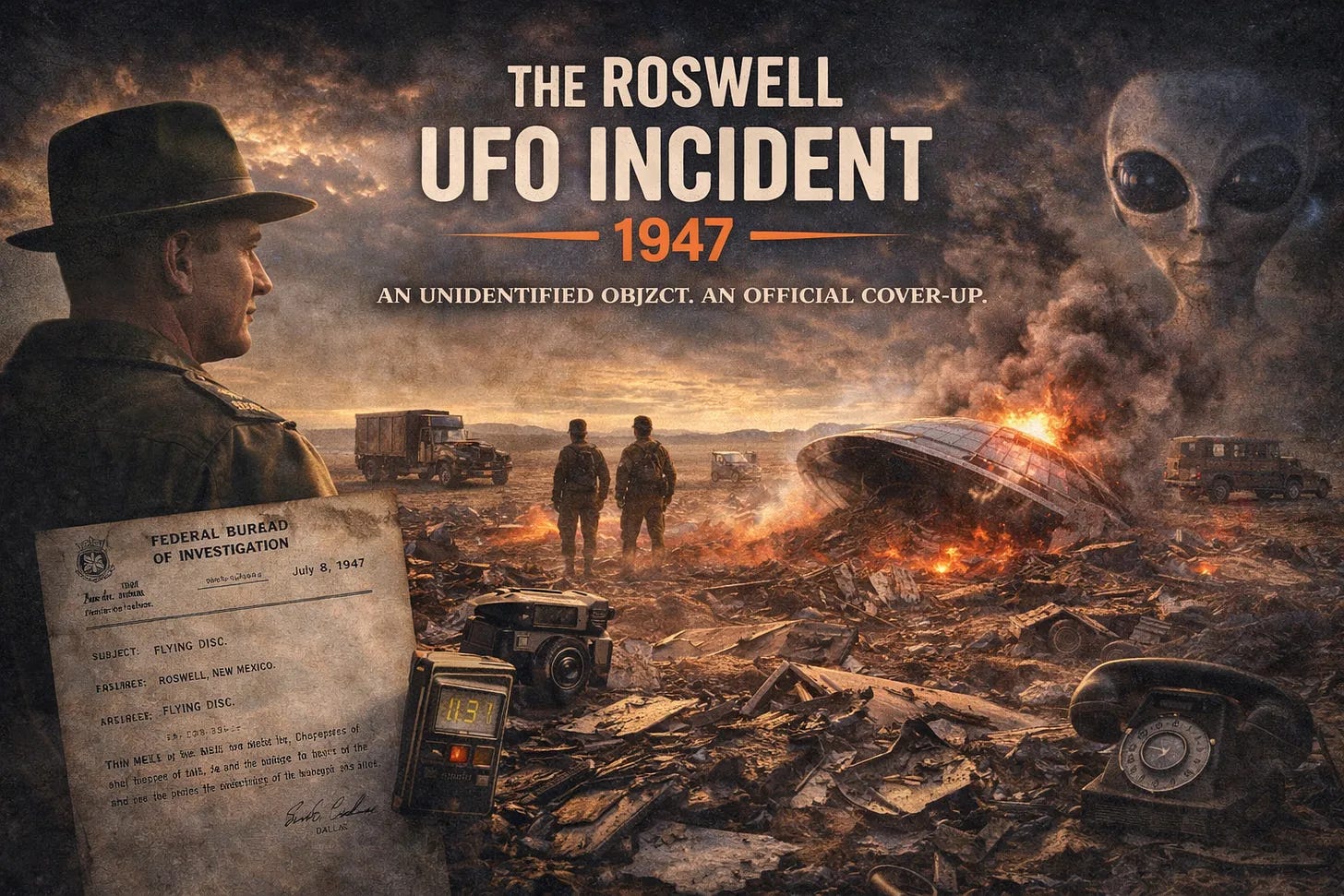
On the morning of July 8, 1947, a public information officer at Roswell Army Air Field sat down and typed a press release announcing that the United States Army Air Forces had recovered a flying disc from the New Mexico desert.
By the following afternoon, it was a weather balloon.
Someone told the truth for twenty-four hours. Someone else decided they should stop.
What happened in between, and what the record actually contains once you strip away seventy-eight years of mythology, hoax, and manufactured witnesses, is what this episode is about.
We cover the full case, including:
The setting: Roswell Army Air Field in the summer of 1947, home to the 509th Bomb Group, the only unit on earth cleared to deliver nuclear weapons, and why the caliber of the men stationed there matters to everything that follows
Rancher Mac Brazel, what he found on the Foster Ranch, why he told reporters directly that it was not a weather balloon, and what happened to him afterward
Major Jesse Marcel, the base intelligence officer who collected the debris, stopped at his home in the middle of the night to wake his eleven-year-old son and show him what he had found, and what he said thirty years later when he finally spoke
Jesse Marcel Jr., who spent 35 years repeating the same account until his own death: the I-beams, the geometric symbols he thought resembled hieroglyphics, the material unlike anything he had ever seen
Colonel William Blanchard, commanding officer of the most classified military unit in the United States, who examined the wreckage, ordered the site cordoned off, and told Haut to issue the flying disc press release, and why that decision is the hardest single fact in this case to explain away
The reversal: the debris flown to Fort Worth, General Ramey’s press conference identifying it as a weather balloon, and Marcel’s later statement that what was photographed was not what he recovered
Project Mogul as the official explanation: what it explains, what it does not explain, and why the article treats it seriously rather than dismissing it
The honest accounting of the body claims: why the late, inconsistent, and often second-hand nature of those reports means they do not constitute strong evidence on their own, and why they are still part of the record
Walter Haut’s sealed affidavit, prepared in 2002 and published after his death in 2005: the man who typed the press release, who spent sixty years saying almost nothing, who felt bound by an oath to his commanding officer, and what he described seeing in a hangar when Colonel Blanchard took him there personally
The missing records: the General Accounting Office finding that records concerning Roswell activities had been destroyed with no explanation of when or by whose authority, and the absence of any air accident report for the most significant military response in the history of the base
The contamination problem: why Roswell is the most mythologized UAP case in history, why that contamination matters, and how to separate the original 1947 signal from everything layered on top of it
What remains after you remove every hoax, every embellishment, and every fabricated document is not nothing.
It is a rancher who knew what weather balloons looked like. An intelligence officer who showed his son something in the middle of the night. A base commander who told the world the truth for twenty-four hours. A public information officer who sealed his account in a notarized document and waited until he was dead to release it. And records that should exist but do not, with no explanation of why.
The weather balloon explains the debris field.
It does not explain why Blanchard called it a flying disc.
📄 READ THE FULL CASE FILES

Case Study SQR-UFO-002: The Roswell UFO Incident, and the twenty-four hours that changed everything
Subscribe to Side Quests of Reality
The next case is already open. Because the cases are starting to talk to each other.


