
Why Paranormal Events Rarely Leave Evidence
On the central paradox of the strange, and what it might actually tell us
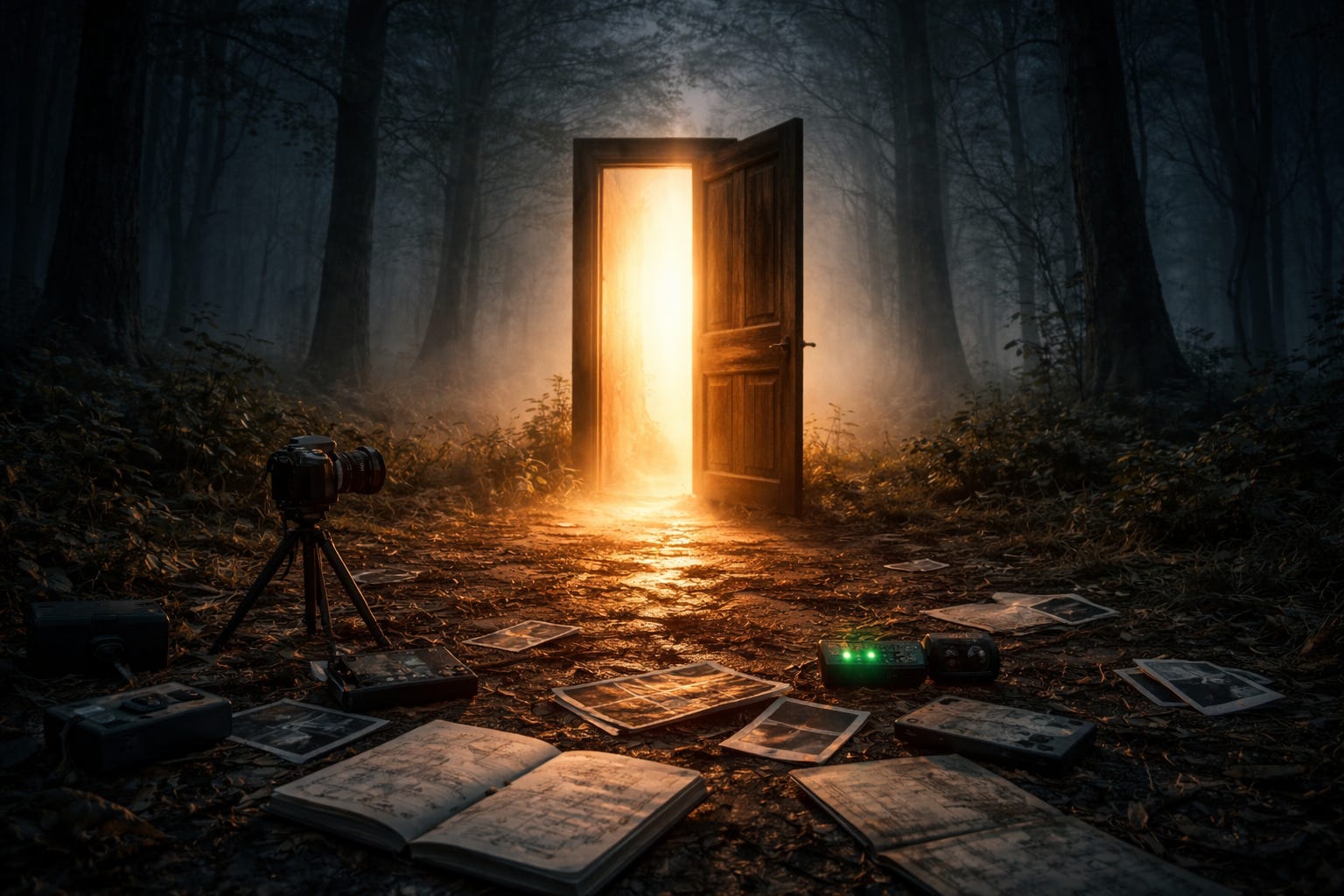
If any of this is real, why can’t we prove it?
This is the question that ends most conversations about the paranormal. It is asked as a closing argument, and it usually works. The absence of evidence becomes, by implication, evidence of absence. The phenomena retreat into the category of belief, of wish, of cognitive weakness, and the conversation moves on to more solid ground.
I want to stay with the question instead of retreating from it.
Because I think the question itself contains something worth examining. Not the answer most people expect, but a different one. One that doesn’t prove anything paranormal exists, but that changes the shape of what we’re actually asking when we demand evidence.
First, what kind of evidence are we asking for?
The implicit standard, when someone says why isn’t there proof, is physical. Measurable. Reproducible under controlled conditions. A photograph that can’t be explained. A reading on an instrument that shouldn’t be there. A result that holds up across independent trials in a laboratory setting.
This is the standard of experimental science. It is a good standard. It has produced an extraordinary map of reality.
But it was designed for phenomena that are stable, repeatable, and observer-independent. Phenomena that behave the same way whether or not anyone is paying attention. Phenomena that submit to the controlled conditions of the laboratory without changing their essential character.
The question worth asking is whether that standard is appropriate for what we’re trying to examine.
Consider what the experiential record actually shows.
Paranormal events, across cultures and centuries of accounts, share a set of structural characteristics that are so consistent they function almost as a signature.
They are brief. They occur at the boundary of expectation, at the moment between sleep and waking, between attention and distraction, between one state and another. They resist direct observation, appearing at the periphery and dissolving when looked at straight. They do not repeat on demand. They leave impressions in memory that are unusually vivid and unusually durable, but they leave almost nothing in the physical environment that wasn’t already there.
This pattern could mean the phenomena are not real. That they are generated entirely within the observer and have no external correlate at all.
But the pattern could also mean something else.
It could mean the phenomena are real and have a specific relationship to observation. Not that they hide. But that direct, structured, expectant attention is precisely the condition under which they do not occur.
There is a principle in quantum mechanics called the observer effect.
At the subatomic level, the act of measuring a system disturbs it. You cannot observe a particle’s position and momentum simultaneously with perfect precision, not because our instruments are too crude, but because the act of measurement is itself an interaction that changes what is being measured. The particle does not have a definite position independent of being measured. Measurement is part of what produces the definite state.
I am not claiming that paranormal phenomena are quantum mechanical. That argument is usually made sloppily, and I want to avoid it.
What I am pointing at is something more general. The assumption that observation is neutral, that looking at something leaves it unchanged, is not a law of nature. It is a reasonable approximation that works well at the scale of ordinary experience and breaks down at other scales.
Whether it breaks down at the scale of human consciousness and its relationship to certain kinds of phenomena is an open question.
But the assumption that it doesn’t break down there is just that.
An assumption.
There is a researcher named Dean Radin who has spent decades running laboratory experiments on phenomena that shouldn’t exist according to the standard model. Telepathy. Precognition. The effect of intention on physical systems. His methodology is rigorous. His results are persistently, modestly above chance. His work is largely ignored by mainstream science rather than seriously engaged with.
One of his more interesting findings involves the effect of observation on quantum systems.
In a series of experiments, he found that directed human attention appeared to affect the behavior of a double-slit interference pattern. The interference pattern, in standard quantum mechanics, results from a particle behaving as a wave and passing through both slits simultaneously. When you observe which slit the particle passes through, the interference pattern disappears. The act of observation collapses the wave into a particle.
Radin found that meditators, people trained in sustained directed attention, produced a measurably larger collapse of the interference pattern than non-meditators. That conscious attention, in other words, appeared to have a physical effect on a quantum system.
This result has not been widely replicated. It may not hold up.
But it points at something that the standard dismissal of paranormal evidence doesn’t account for. The possibility that consciousness is not a passive observer of physical reality but an active participant in it. And that designing experiments that treat it as passive may be precisely why the phenomena keep slipping through the methodological net.
There is another possibility that I find worth considering.
What if the phenomena are real, and are of a kind that is genuinely incompatible with the conditions required to produce evidence?
Not because they are hiding. Not because consciousness disturbs them. But because they belong to a category of event that is, by its nature, singular and non-reproducible.
Most of what matters in human experience is non-reproducible. A conversation that changes everything. A moment of grief. The particular quality of light on a specific afternoon that you will remember for the rest of your life.
These are real.
They have effects that are measurable in behavior, in memory, in the subsequent shape of a life.
But they cannot be reproduced in a laboratory. They cannot be summoned on demand.
We do not conclude from this that they didn’t happen.
We recognize that certain categories of experience are real and are not amenable to experimental verification, and we find other ways of taking them seriously.
Testimony. Pattern. The convergence of independent accounts. The consistency of effect across different people in different circumstances.
These are not the methods of physics.
They are the methods of history, of law, of medicine before the randomized controlled trial.
They are legitimate methods.
They have limits.
They also have genuine epistemic weight.
The paranormal evidence problem may not be that the phenomena leave no traces.
It may be that we have decided, in advance, which kinds of traces count.
Here is what the record actually contains, if you look at it without the prior commitment to dismissal.
Thousands of accounts, across centuries and cultures, describing experiences with consistent structural features. Independent witnesses reporting the same phenomena at the same locations without prior contact. Researchers with mainstream credentials who encountered the evidence in the course of other work and found they could not account for it through ordinary means. Physical effects, modest and inconsistent but recurring, that correlate with reported experiences in ways that are difficult to fully attribute to coincidence or fraud.
This is not proof.
It is not close to proof by experimental standards.
But it is not nothing.
And the habit of treating it as nothing, of moving directly from absence of experimental proof to absence of phenomenon, skips several steps that intellectual honesty requires.
The steps it skips are:
Is the experimental standard appropriate here?
Are there other forms of evidence that carry weight?
Have the alternative explanations been seriously tested rather than assumed?
Are there researchers doing careful work that the mainstream has decided not to engage with for reasons that are not purely methodological?
The answers to those questions are not obvious.
They require genuine inquiry rather than the comfortable closure that comes from demanding a standard of proof that the phenomena, if real, may be constitutionally unable to meet.
I want to end with the observation that started this piece, reframed.
If any of this is real, why can’t we prove it?
Maybe because proof requires repeatability, and these phenomena don’t repeat on demand.
Maybe because proof requires observer-independence, and these phenomena may be precisely observer-dependent.
Maybe because proof requires that the thing being studied remain unchanged by the act of studying it, and these phenomena may change when you look at them directly, the way certain things do.
Or maybe because the absence of proof is itself part of the pattern.
The phenomena exist at the boundary. They appear and withdraw. They leave impressions but not instruments. They repeat across people and cultures, but dissolve under controlled conditions.
If that is their nature, then demanding proof in the conventional sense is like demanding that the horizon hold still so you can touch it.
The horizon is real.
You can navigate by it.
You will never reach it.
Some things are like that.
The question is whether that makes them not worth looking at.
I think it makes them more worth looking at.
Because the things that resist capture are usually the things that are telling us something important about the limits of the net.