
The Missing Scientists: When Knowing Too Much Becomes Fatal
Side Quests of Reality | News Flash | 04/24/2026

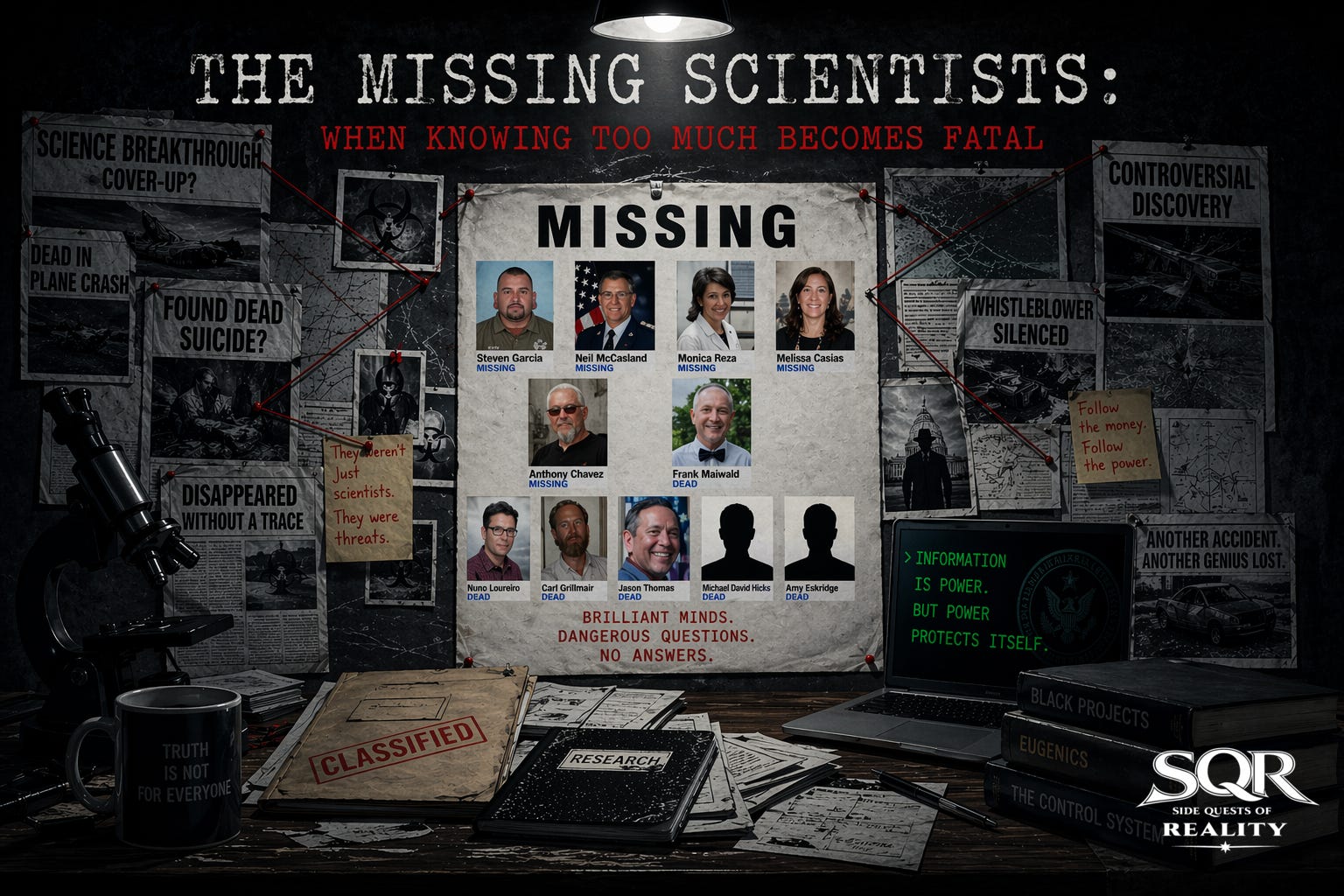
There are coincidences that unsettle you. And then there are patterns, sequences that repeat too often, too precisely, too consistently across too many unrelated lives, to keep dismissing with a wave of the hand.
In a window of less than twelve months, here is what happened:
A retired United States Air Force general, the one who ran the most classified research laboratory in modern military history, the one whose name appeared in WikiLeaks emails as a central figure in UFO disclosure, vanished from his Albuquerque home in broad daylight without triggering a single surveillance camera. Eight days earlier, Donald Trump had ordered the Pentagon to begin releasing UFO files.
In that same twelve-month window: a NASA scientist who co-invented a breakthrough strategic rocket engine superalloy disappeared on a hike, thirty feet behind her friends, on a clear day, on a trail she knew well. One of MIT’s top plasma physicists, among the most advanced minds working on fast magnetic reconnection, the fundamental bottleneck blocking large-scale nuclear fusion, was gunned down outside his front door in a residential neighborhood. A polymathic Caltech astronomer working on the Vera Rubin Observatory, one of the most sophisticated space surveillance instruments ever built, was shot dead on his porch.
Nuclear fusion. Exotic propulsion. Advanced metallurgy. Space surveillance. These are not random résumé items. They are not a cluster of bad luck striking unrelated people in unrelated fields. They are a list of disciplines. Specifically, the disciplines that sit closest to the technological thresholds that would most fundamentally alter the balance of power on this planet, and possibly beyond it.
Whether or not you believe these cases are connected, the pattern deserves to be named out loud.
The General Who No Longer Exists
On February 27, 2026, in the quiet neighborhood of Quail Run Court in Albuquerque, New Mexico, Neil McCasland, a 68-year-old retired Air Force general, was last seen at home around 10:00 a.m. by a repairman. His wife Susan left the house at 11:10 for a medical appointment. She was back by 12:04. He was gone.
What he left behind: his prescription glasses, his phone switched off, his smartwatch. Everything that would have made him trackable in the twenty-first century, abandoned in place. Not forgotten. Left. There is a difference.
What he took with him: a red backpack, his wallet, and a .38 caliber revolver with its holster. Not the most reassuring combination for a man his wife described as dealing with anxiety, sleep problems, and short-term memory issues. But also not the profile of a man who simply wandered into a canyon and got lost.
At 3:07 that afternoon, Susan reported him missing and the official police investigation began. In a newly released 911 call, she told the dispatcher he had been gone for about three hours, that he had changed his clothes, and that he appeared to have left on foot since none of their cars or bikes were missing. She mentioned the health issues, but framed them as ordinary aging. She never believed Neil would actually harm himself, even though he had apparently made comments to the effect that if his mind and body kept deteriorating, he did not want to live like that. Whether that was a genuine signal or a throwaway remark on a hard day, nobody can say with certainty.
The next morning, a Silver Alert went out across New Mexico, the kind of statewide notification issued when authorities believe a missing person may be disoriented or cognitively impaired. But McCasland’s own wife pushed back on that framing. He was not confused. He was not losing his bearings. He was, by all accounts, still sharp.
Sharp enough, in fact, that the week before he disappeared, he had cycled sixty miles. He had hiked those same foothills. He knew every trail in the area by name. He had once commanded the Phillips Research Site at Kirtland Air Force Base, a facility notorious for advanced weapons research, literally in his own backyard. Albuquerque was not unfamiliar territory to him. It was home.
Police accessed his electronic devices and searched his usual hiking areas, including the Elena Gallegos open space and Domingo Baca Canyon. The FBI’s Albuquerque field office joined the investigation. So did the Air Force Office of Special Investigations, New Mexico State Search and Rescue, Albuquerque Mountain Rescue, horseback teams, three types of search dogs, drones, helicopters, and systematic neighborhood canvassing. They put out public appeals for doorbell cameras, dashcams, GoPros, anything that might have captured a 68-year-old man walking away from his house on a Friday morning.
Nothing. Not one image. Not one digital trace. Not one physical footprint confirmed as his.
The only thing ever recovered: a gray Air Force sweatshirt found about a mile east of his house. DNA testing could not confirm it was his.
We are talking about a regimented, physically active, mentally intact military veteran who vanished from a modern American suburb without leaving a single verifiable trace, digital or physical, in a neighborhood dense enough with cameras to document virtually every package delivered to every door. That alone is strange. But it gets significantly stranger once you understand who McCasland actually was, and the world he came out of.
What McCasland Actually Knew
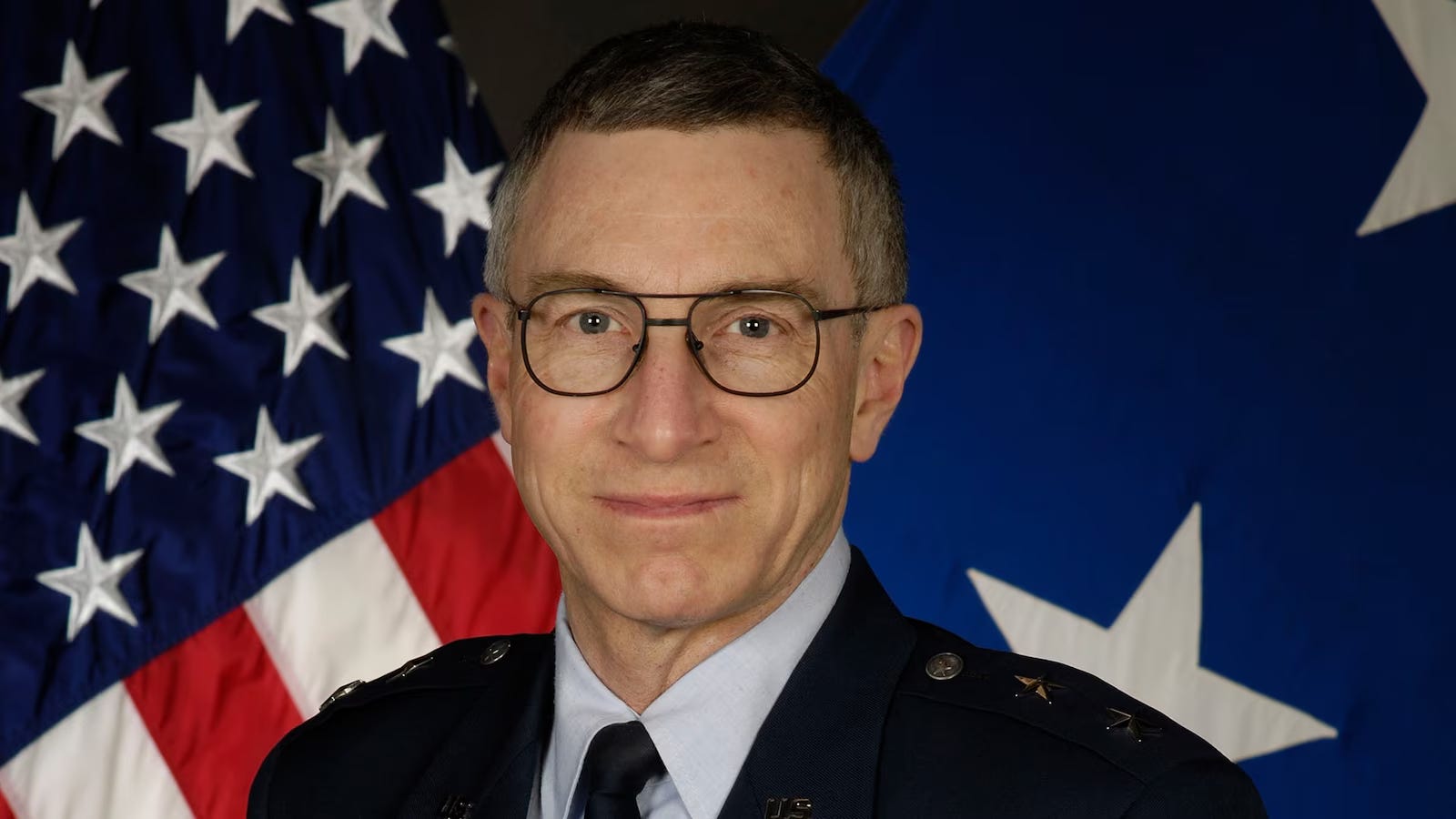
When you read McCasland’s official Air Force biography, you quickly realize you are looking at someone who had access to programs the rest of us are not even supposed to know exist.
He ran the research laboratory at Wright-Patterson Air Force Base. For anyone who has spent time in the UFO research space, that name carries enormous weight. Wright-Patterson is the most mythologized facility in American UFO history, the place that decades of testimony, from military personnel, from intelligence insiders, from researchers with serious credentials, has connected to the recovery and analysis of non-human technology and materials. Whether those claims are true is a separate question. What is not in dispute is that Wright-Patterson housed some of the most sensitive and advanced aerospace research programs in American history, and McCasland ran the laboratory at its center.
He also oversaw some of the Pentagon’s most classified aerospace and defense programs during his active career, programs that operated well outside public visibility and congressional oversight in any meaningful sense.
And then there are the WikiLeaks emails. His name appears in correspondence connected to discussions about UFO disclosure, identified as a central figure in the gatekeeping and potential release of information about non-human phenomena. He is not a peripheral name in those emails. He is someone people were paying attention to.
Eight days after Trump signed the executive order directing the Pentagon to begin declassifying and releasing UFO-related files, this man disappeared without a trace.
The timing is either one of the more remarkable coincidences in recent American history, or it is not a coincidence at all.
Monica Reza and the Rocket Metal Lineage
Monica Reza was a materials scientist at NASA. Her work was not theoretical. She had co-invented a superalloy, a high-performance metal composite engineered for use in advanced rocket engines, exactly the kind of exotic propulsion material research that connects directly to the programs McCasland was overseeing at Wright-Patterson.
The lineage here matters. Wright-Patterson has long been associated not just with UFO sightings and recovered craft, but specifically with materials analysis. The standing claim among serious researchers is that whatever was recovered at Roswell and other sites ended up at Wright-Patterson for metallurgical study, and that the exotic properties of those materials, their unusual strength-to-weight ratios, their heat resistance, their structural behavior under extreme conditions, informed American advanced materials research for decades afterward. Monica Reza was working in exactly that lineage, whether she knew it or not.
She disappeared on a hike. She was thirty feet behind her companions on a trail. Thirty feet. That is not a distance at which someone falls into a ravine unnoticed, or wanders off a path without anyone seeing it happen. Her friends turned around and she was simply not there. No sound. No sign. No trace of what happened in the space between one moment and the next.
Melissa Casias
Melissa Casias was a scientist working in advanced aerospace materials, with a professional background that placed her squarely in the same technical neighborhood as Monica Reza and the programs McCasland oversaw. The specifics of her most sensitive work are not fully public, which is itself worth noting. In a world where most scientists publish prolifically and maintain visible academic footprints, gaps in the record tend to mean one of two things: the work was proprietary, or it was classified.
She disappeared after bringing lunch to her teenage daughter at a café in Towels Plaza. This was not a wilderness hike or an isolated location. This was a public commercial space in the middle of an ordinary day, in a busy area, surrounded by people going about their lives. She delivered the food and vanished.
What makes her case particularly unsettling within this cluster is not just who she was, but where and how she disappeared. The other cases, a general vanishing from a residential street, a scientist disappearing on a hiking trail, physicists shot at their front doors, already span a wide range of circumstances.
Casias adds something else to that range: the complete absence of any condition that would conventionally explain a disappearance. No remote terrain. No isolated setting. No moment of vulnerability that an outside observer could point to. Just a woman walking through a commercial plaza in daylight, and then nothing.
If these cases are connected by something beyond coincidence, whatever that mechanism is, it does not require remoteness or opportunity in any traditional sense. It operates in plain sight, in the middle of the day, in front of witnesses who saw nothing.
Carl Grillmair and the Eye in the Sky
Carl Grillmair was not a narrow specialist. He was the kind of scientist who thought across fields, a Caltech astronomer with a broad enough command of astrophysics to contribute meaningfully to multiple areas of research simultaneously. He was working on the Vera Rubin Observatory, the most ambitious wide-field survey telescope ever constructed, a facility capable of imaging the entire visible sky every few nights with unprecedented depth and resolution.
The Vera Rubin Observatory is not just an astronomical instrument. It is a surveillance system for the solar system and beyond. It is specifically designed to detect faint, fast-moving, or previously invisible objects. The kinds of objects that interstellar visitor designations like Oumuamua and Borisov represent. The kinds of objects that, if they turned out to be artificial rather than natural, would represent the most significant discovery in human history.
Grillmair was shot dead on his porch. A scientist working on the instrument most likely to detect something humanity is not supposed to be looking for, killed at home, in the quiet of his own neighborhood.
Nuno Loureiro and the Fusion Lock
Nuno Loureiro was a plasma physicist at MIT, and his specialization was not general. He worked specifically on fast magnetic reconnection, a phenomenon that occurs when opposing magnetic field lines break and rapidly reconnect, releasing enormous amounts of energy in the process. Fast magnetic reconnection is one of the core unsolved problems in plasma physics, and solving it is considered the key to making controlled nuclear fusion viable at industrial scale.
Nuclear fusion, clean, essentially limitless energy derived from hydrogen isotopes, has been the promise of energy physics for seventy years. The reason it remains a promise rather than a reality is largely because of problems like fast magnetic reconnection. Loureiro was one of the people closest to cracking it.
He was assassinated on his doorstep in Brookline, Massachusetts. Shot outside his own home. A man at the precise frontier of the technology that would, if it worked, eliminate humanity’s dependence on fossil fuels, destabilize the economic and geopolitical foundations of every petro-state on Earth, and render much of the current global power structure obsolete overnight.
The people who benefit most from fusion remaining theoretical are not difficult to identify.
This Is Not New
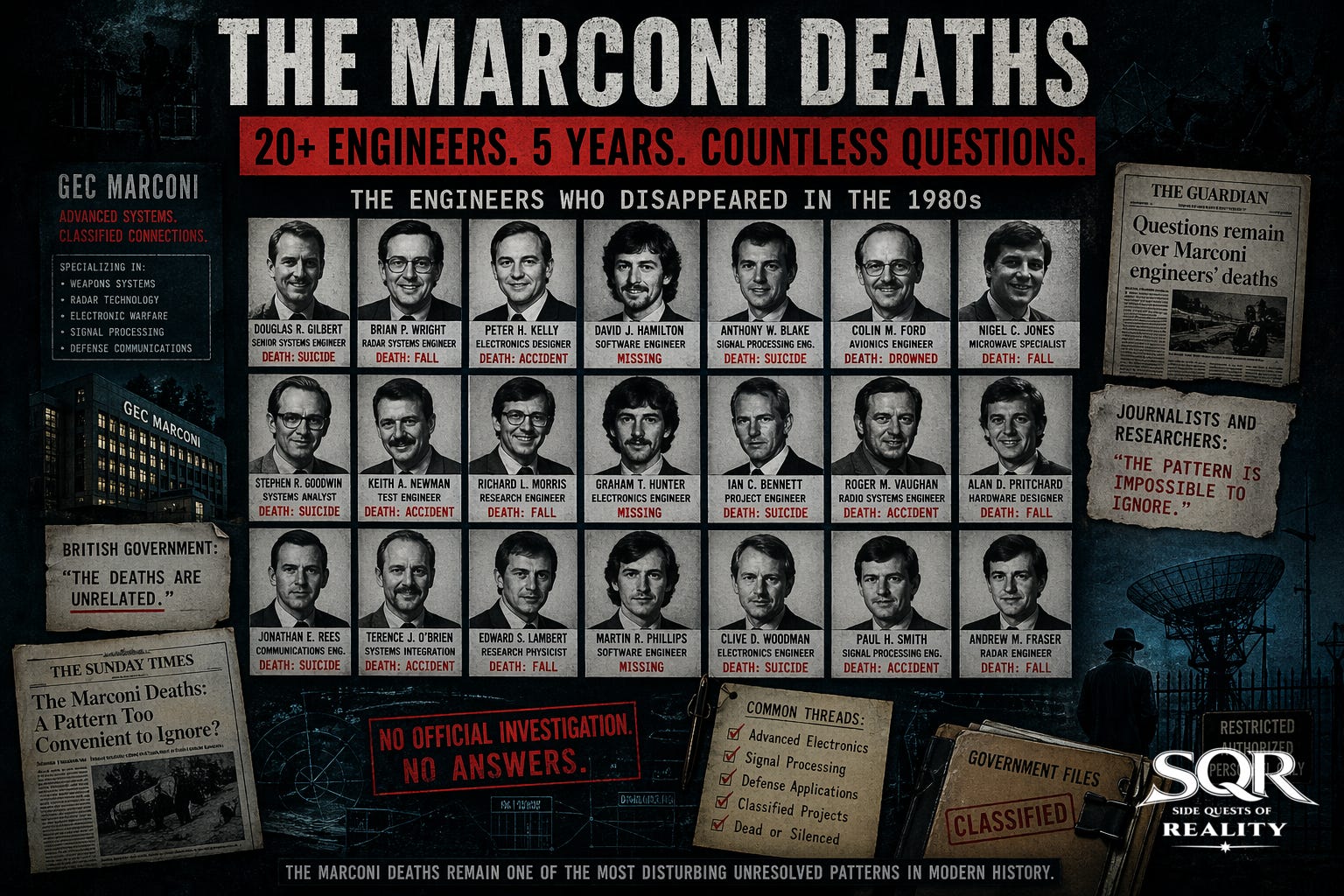
If any of this feels familiar, it should.
In the 1980s, more than twenty engineers and scientists working for GEC Marconi, a British defense contractor specializing in weapons systems, radar, and advanced electronic technologies with deep connections to classified military programs, died under unexplained circumstances over a span of a few years. The deaths were varied enough to resist easy categorization. Suicides that did not fit the profile of the individuals involved. Accidents in improbable configurations. Falls from places that did not make sense to fall from.
The British government maintained that the deaths were unrelated. Journalists and researchers who examined the case in detail found that implausible. The affected individuals were clustered in specific technical areas, specifically the kinds of advanced electronics and signal processing work that borders on classified defense applications. The case became known as the Marconi Deaths and was never officially resolved. It remains one of the better-documented historical precedents for the pattern we are now looking at.
Jacobo Grinberg and the Energy Matrix
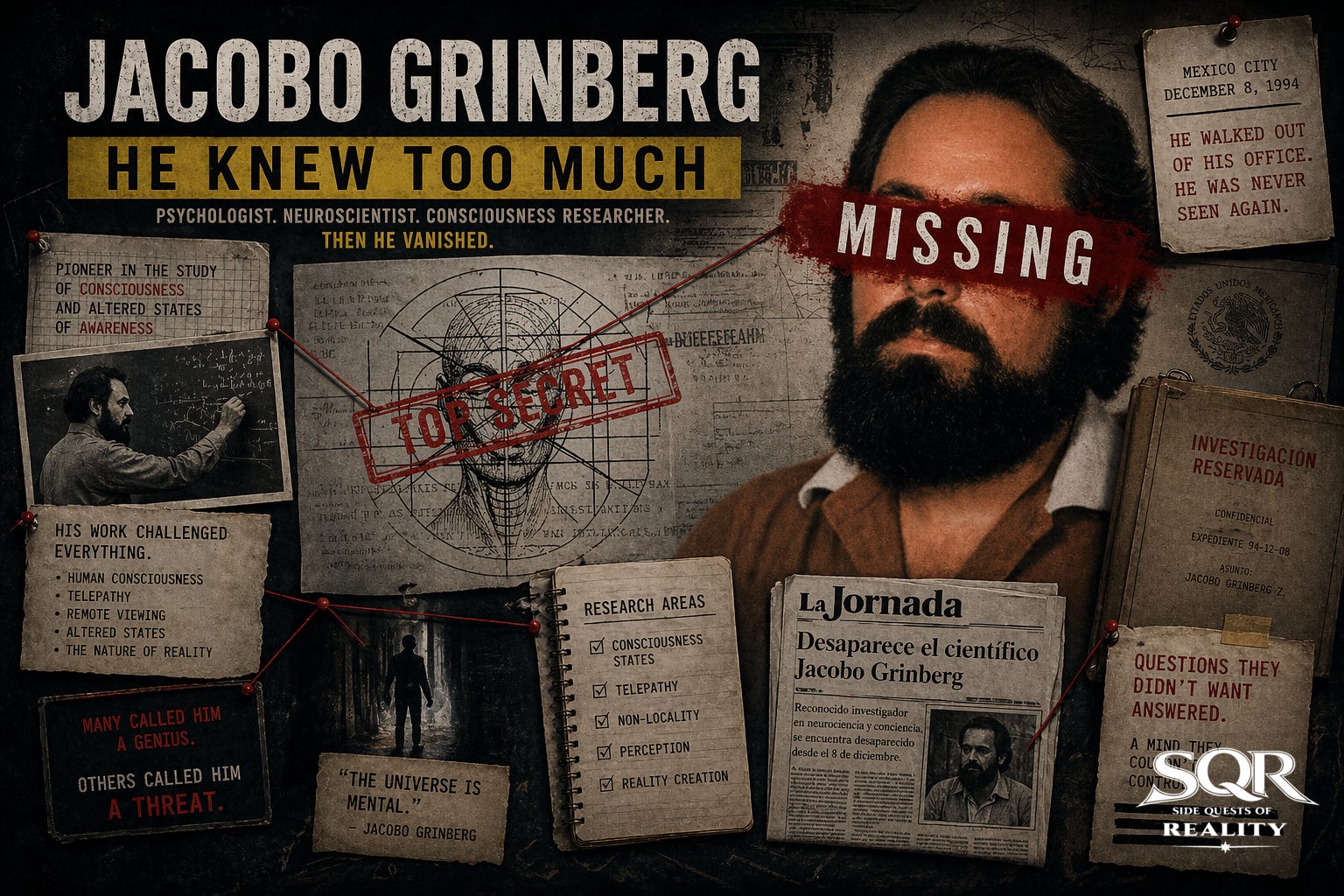
Jacobo Grinberg was a Mexican neuroscientist whose research took him into territory that mainstream science preferred to leave unmarked. He developed what he called the syntergic theory, a framework describing an energy matrix underlying physical reality that could account for phenomena like consciousness, telepathy, and direct mind-to-matter interaction. His experimental results, whatever one makes of the theoretical framework, were documented and reproducible in his laboratory conditions.
He disappeared in 1994 after returning to Mexico from a research trip. He was never found. His files, his data, and his ongoing research projects effectively ceased to exist along with him. He was 43 years old.
Ning Li, John Norseen, and the Technology Frontier
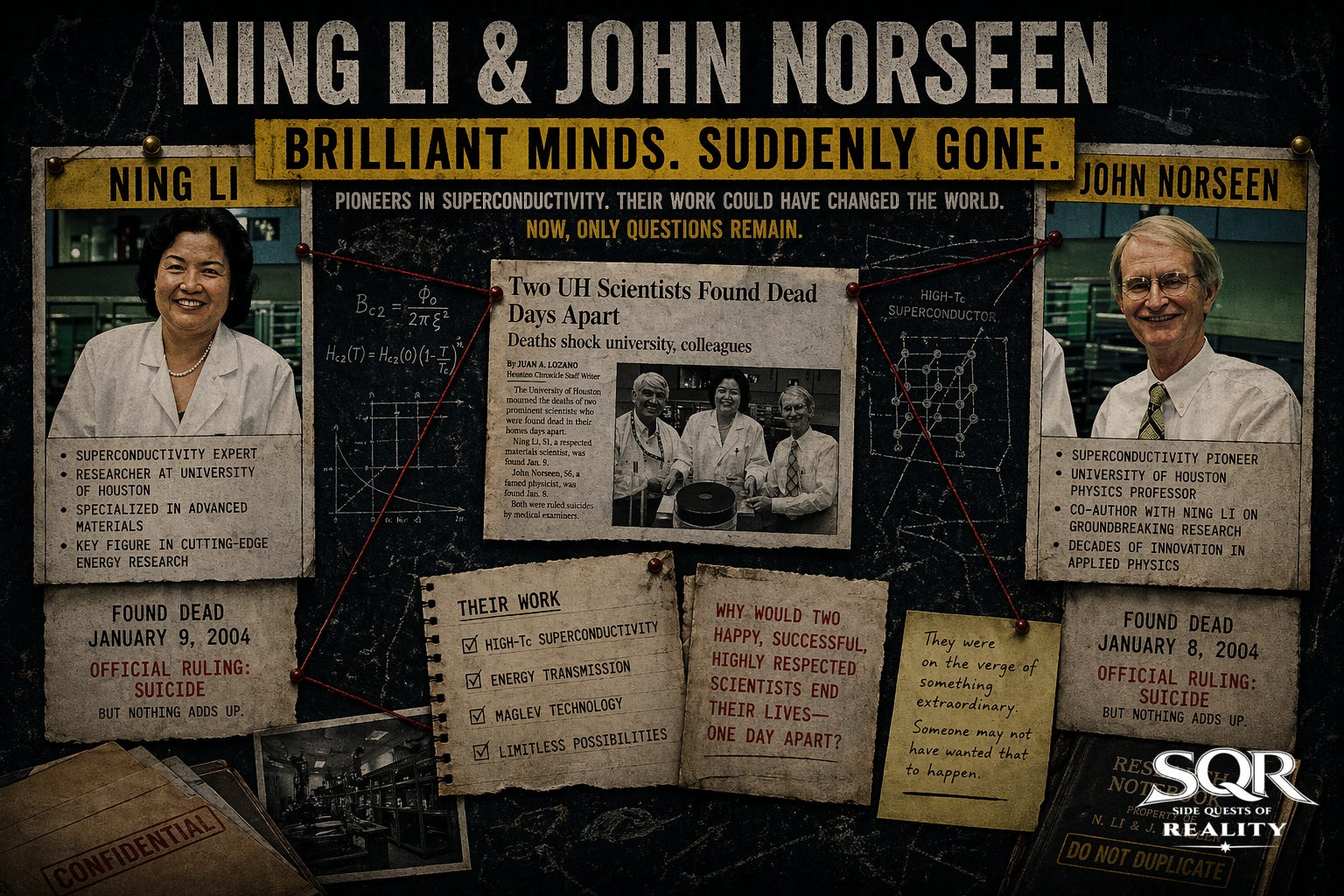
Ning Li was a Chinese-American physicist at the University of Alabama who received NASA funding for research into gravitational field manipulation, specifically into whether superconducting materials rotating at high speeds could generate measurable antigravitational effects. Her results, by her own account, were significant. Her funding was terminated. She disappeared from public scientific life. Nobody in the research community has a clear account of what happened to her or where she went.
John Norseen was a specialist in brain-machine interfaces at Lockheed Martin, working on technologies for reading human intent remotely through the brain’s electromagnetic output. His research had obvious defense applications and equally obvious implications for civil liberties and cognitive sovereignty. He died of kidney failure in 2009 at the age of 54. His colleagues described him as having been in good health. The rapidity and the circumstances of his decline were noted at the time and not satisfactorily explained.
The thread running through all of these cases is not a single government, a single agency, or even a single era. It is a category of knowledge: the precise frontier between what mainstream physics accepts and what it still formally refuses to integrate. Fusion. Antigravitation. Exotic propulsion. Deep space surveillance. Anomalous materials. Brain-to-field interaction.
Every time a researcher gets close enough to that frontier to threaten the status quo, something tends to happen.
TAE Technologies, Trump Media, and the Fusion Money Trail
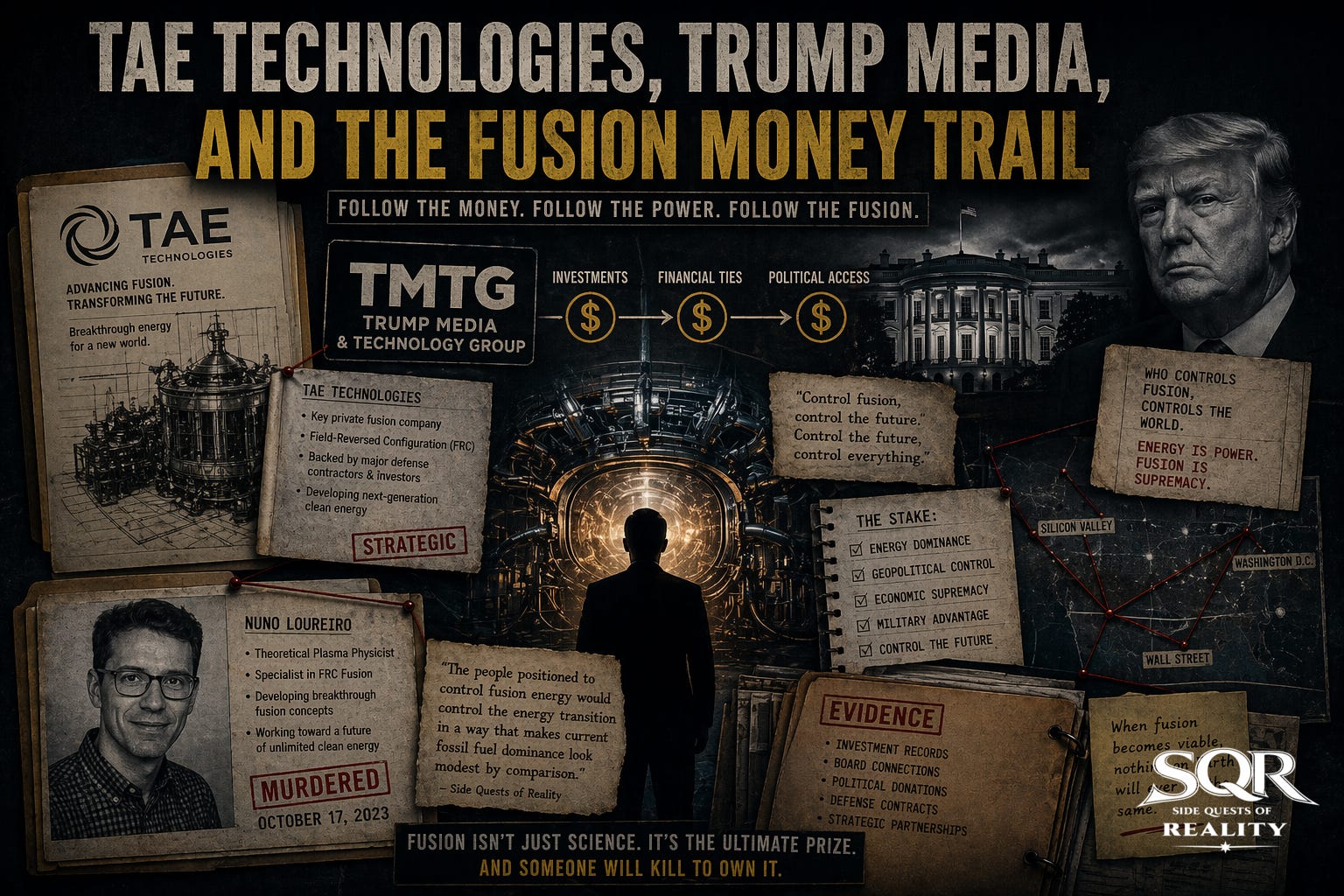
It is worth noting that the political and financial dimensions of fusion research are not abstract. TAE Technologies, one of the leading private fusion companies, has connections to Trump Media that have attracted attention from researchers tracking the intersection of advanced energy technology and political power. The question of who controls fusion, if and when it becomes viable, is not a scientific question. It is a question of geopolitical dominance on a generational scale.
The people positioned to control fusion energy would control the energy transition in a way that makes current fossil fuel dominance look modest by comparison. That is the stake. That is what Loureiro was working toward. That is the context in which his assassination has to be understood, whatever its ultimate explanation.
The Three-Body Problem
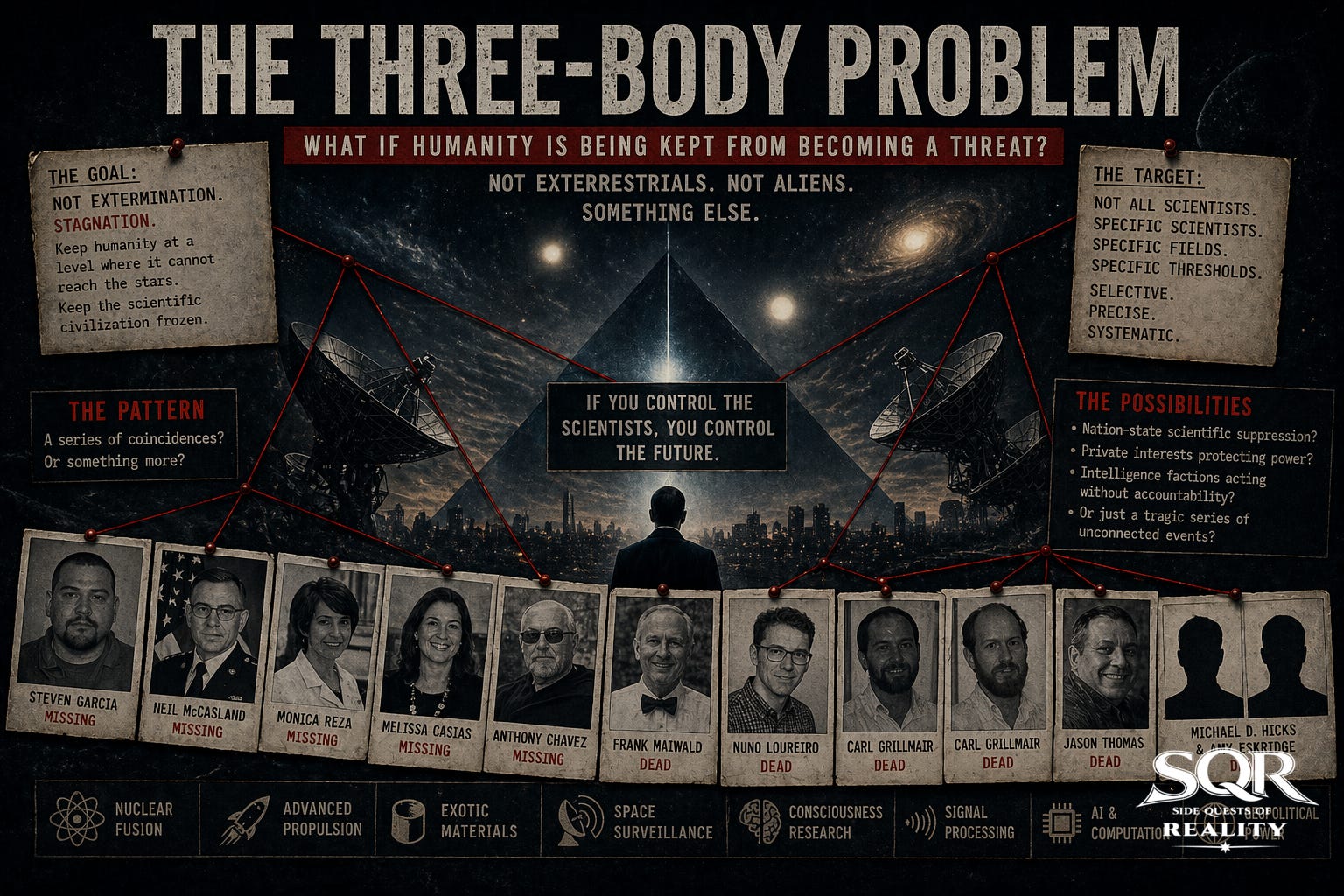
In Liu Cixin’s science fiction novel The Three-Body Problem, an extraterrestrial civilization begins systematically targeting Earth’s scientists. Not all scientists. Specific scientists, working in specific areas, approaching specific thresholds. The goal is not extermination. It is stagnation. Keep humanity scientifically frozen at a level where it cannot pose a threat, cannot develop the technologies that would make it a peer, cannot reach the stars.
The question gets raised slowly, deliberately, in examining these real cases: what if something analogous is happening?
Not necessarily extraterrestrials. The more grounded version of the hypothesis involves nation-states conducting systematic scientific suppression against competitors. It involves private interests whose economic foundations depend on certain technologies remaining theoretical. It involves factions within intelligence and defense establishments that have decided, without public accountability or democratic input, that some knowledge is too dangerous to allow to spread.
Or maybe this is just a series of unconnected tragedies, each with its own mundane explanation, assembled into a pattern by minds that are very good at finding patterns.
Both possibilities deserve serious consideration. The evidence does not yet compel a conclusion. But the pattern is real, the timing is striking, and the fields involved are not random. These are the exact areas where a breakthrough would most fundamentally reshape civilization.
What We Know, What We Don’t
Here is what is established: multiple scientists and military figures working at the frontier of advanced physics, exotic propulsion, space surveillance, and anomalous materials research have died or disappeared within an unusually compressed timeframe. Several under circumstances that do not yield to simple or obvious explanation. The cases span multiple countries, multiple decades, and multiple institutional contexts, which makes coincidence increasingly difficult to sustain as the sole explanatory framework.
Here is what we do not know: why. By whom. To what end. Whether the cases are connected by a coordinating intelligence or merely by the dangerous nature of the knowledge involved. Whether the pattern will continue or has already peaked.
What can be said with confidence is that scientific suppression in frontier domains is not a new phenomenon. It is not a conspiracy theory. It is almost a universal historical artifact. Every time human knowledge has approached a threshold capable of radically redistributing power, whether free energy, fusion, propulsion without conventional fuel, or the understanding of interstellar objects, forces have worked to slow, redirect, or eliminate that progress. Sometimes through institutional pressure. Sometimes through funding cuts. Sometimes through the elimination of the individuals carrying the knowledge in their heads.
The question is not whether this happens. History is clear on that point. The question is who decides where the line is drawn, by what authority, accountable to whom.
And who pays the price for crossing it.