
Case Study : The Feeling of Being Watched
SIDE QUESTS OF REALITY | SQR-MTA-001 | BFEELING BEING WATCHED

You have felt it.
Not the dramatic version. Not the horror movie certainty that something is behind you. The quiet version. The ordinary version. You are alone in a room, or walking down a street, or sitting in a public space with your eyes on something else, and something shifts.
Not in the environment.
In you.
A subtle, involuntary change in the quality of your attention that turns your head before your conscious mind has processed a reason to turn it.
And someone is looking at you.
Not always. But often enough that you have stopped being surprised by it.
This experience is so common it barely registers as strange. We have normalized it completely. And in normalizing it, we have stopped asking what it actually is.
The standard explanation is peripheral vision.
You detected the person at the edge of your visual field without consciously registering the input. The brain processed the information below the threshold of awareness and surfaced it as a feeling. There was no mystery. Just unconscious perception operating faster than conscious attention.
This is almost certainly true. The brain is extraordinarily good at processing information it doesn’t bother to report to consciousness. The peripheral visual system is sensitive to movement and to the particular configuration of a human face oriented in your direction. It is entirely plausible that what feels like a sixth sense is simply the fifth sense operating below the level you are aware of.
The problem is the cases it doesn’t cover.
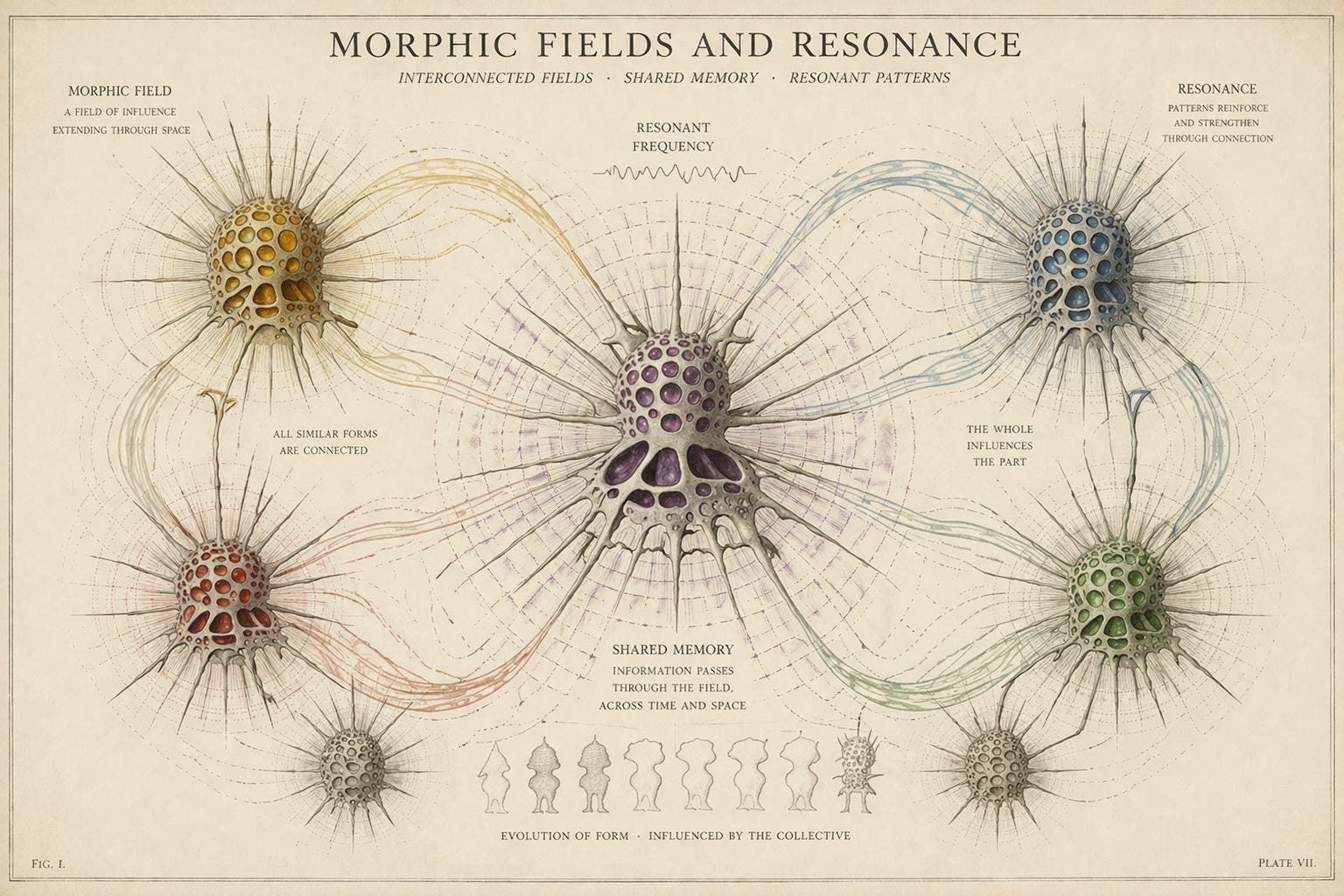
Rupert Sheldrake, whose morphic field work appeared in the previous piece, spent years running controlled experiments on the feeling of being watched. Thousands of trials. Subjects seated with their backs to observers, no reflective surfaces, no sound cues, no possible sensory channel between observer and observed. The task was simple. Is someone looking at you right now, or not?
The results were consistently above chance. Not dramatically. Not overwhelmingly. But persistently, across trials and across populations, people performed better than random at detecting observation they had no sensory access to.
The scientific establishment’s response was largely to question the methodology and decline to replicate. Which tells you something, though reasonable people disagree about what.
Sheldrake has made his data available. He has invited replication. He has revised his methods in response to criticism. The replications that have been conducted have produced mixed results. Some confirm the effect. Some don’t.
This is where the phenomenon sits. Not proven. Not disproven. Occupying the uncomfortable middle ground that serious anomalies tend to occupy before the field either integrates them or decides, for reasons that are not always purely scientific, to stop looking.
There is an older framework for this that predates the experiments by millennia.
Every traditional culture in the world has a concept of the evil eye. The belief that directed attention, particularly malevolent attention, has effects on its object. That being watched, specifically being watched with intent, does something to the person being watched.
The universality of this belief is itself a data point.
When something appears in every human culture independently, the instinct to dismiss it as superstition should be accompanied by a question. What observation gave rise to this belief, across populations that had no contact with each other, with such consistency that they all arrived at the same conclusion?
The conclusion may be wrong. The observation underneath it may still be real.
I want to separate two things that often get conflated in discussions of this phenomenon.
The first is the detection question. Can humans sense when they are being observed through a channel we haven’t identified yet? This is an empirical question. It has a true answer. We don’t know what it is.
The second is the mechanism question. If the detection is real, what produces it? This is where the speculation begins and where intellectual honesty requires acknowledging that we are guessing.
The guesses range from the mundane to the radical.
On the mundane end: we are detecting micro-signals we haven’t consciously catalogued. Changes in the environment so subtle that only the unconscious registers them. The way a room sounds different when someone enters it. The way air moves differently when directed attention is accompanied by physical orientation. These are real effects that could, in principle, be detected by a sufficiently sensitive nervous system.
On the radical end: attention itself has physical properties. Consciousness is not simply a passive observer of reality but an active participant in it. The act of looking does something to the thing being looked at, and that something is, under certain conditions, detectable by the object of the looking.
Quantum mechanics has accustomed physicists to the idea that observation is not neutral. That the act of measurement affects the measured. Whether this scales from the subatomic to the human is genuinely unknown. Most physicists say no. Some find the question more open than the consensus suggests.
What I notice in my own experience is this.
The feeling doesn’t discriminate well between sources.
When I turn and find someone looking at me, that someone is usually a person.
But not always.
There are moments, in particular locations, when the turning finds nothing. No person. No obvious source.
And yet the feeling that prompted the turn was identical in character to the feeling that precedes finding someone there.
This is either the system misfiring.
A false positive from a detection mechanism calibrated for a world with more predators in it.
Or it is detecting something other than human attention.
I don’t know which.
I keep the record.
There is a quality to being watched that is distinct from other sensory experiences and difficult to articulate precisely.
It isn’t a sound or a sight or a physical sensation on the skin, though people sometimes describe it as the latter. It is closer to a change in the felt relationship between self and environment. A sudden awareness of being located. Of having a position in space that something else has registered.
Philosophers call this intersubjectivity. The experience of being an object in someone else’s subjectivity. Of existing not just as a subject experiencing the world, but as an object within another subject’s experience.
Normally this awareness is constructed through eye contact, through social cues, through the ordinary mechanisms of mutual recognition.
But sometimes it arrives before any of that. Before you turn. Before there is any confirmed other subject present.
Something registers your position before you confirm it is there.
That sequence, that priority of the feeling over its apparent cause, is what I find worth sitting with.
The oldest human instinct, the one evolution spent the most time refining, is the one that keeps you from being eaten.
Predator detection. The sensitivity to being targeted. The alarm system that fires before the conscious mind has assembled the evidence.
We carry that system still. It was not designed for the world we currently inhabit, but it runs continuously, scanning, evaluating, surfacing its conclusions as feelings rather than thoughts.
What we may be doing, when we feel watched and turn and find someone looking, is using an ancient instrument for its original purpose.
What we may be doing, when we feel watched and turn and find nothing, is using the same instrument and receiving a signal from a source the instrument was not designed to name.
Both possibilities deserve to be taken seriously.
The instrument is real. The signal is real.
What is transmitting it, in the cases that don’t resolve cleanly, remains the question.
This case is filed as SQR-MTA-001.
If you want to be notified when SQR-CRP-002 drops, and when the cases start talking to each other in ways that are difficult to explain, subscribe below.
That’s all this is. Careful attention. Sustained over time.
Welcome to Side Quests of Reality.