
Sleep Paralysis and the Consistency of the Visitor
On the oldest terror, and why it always wears the same face
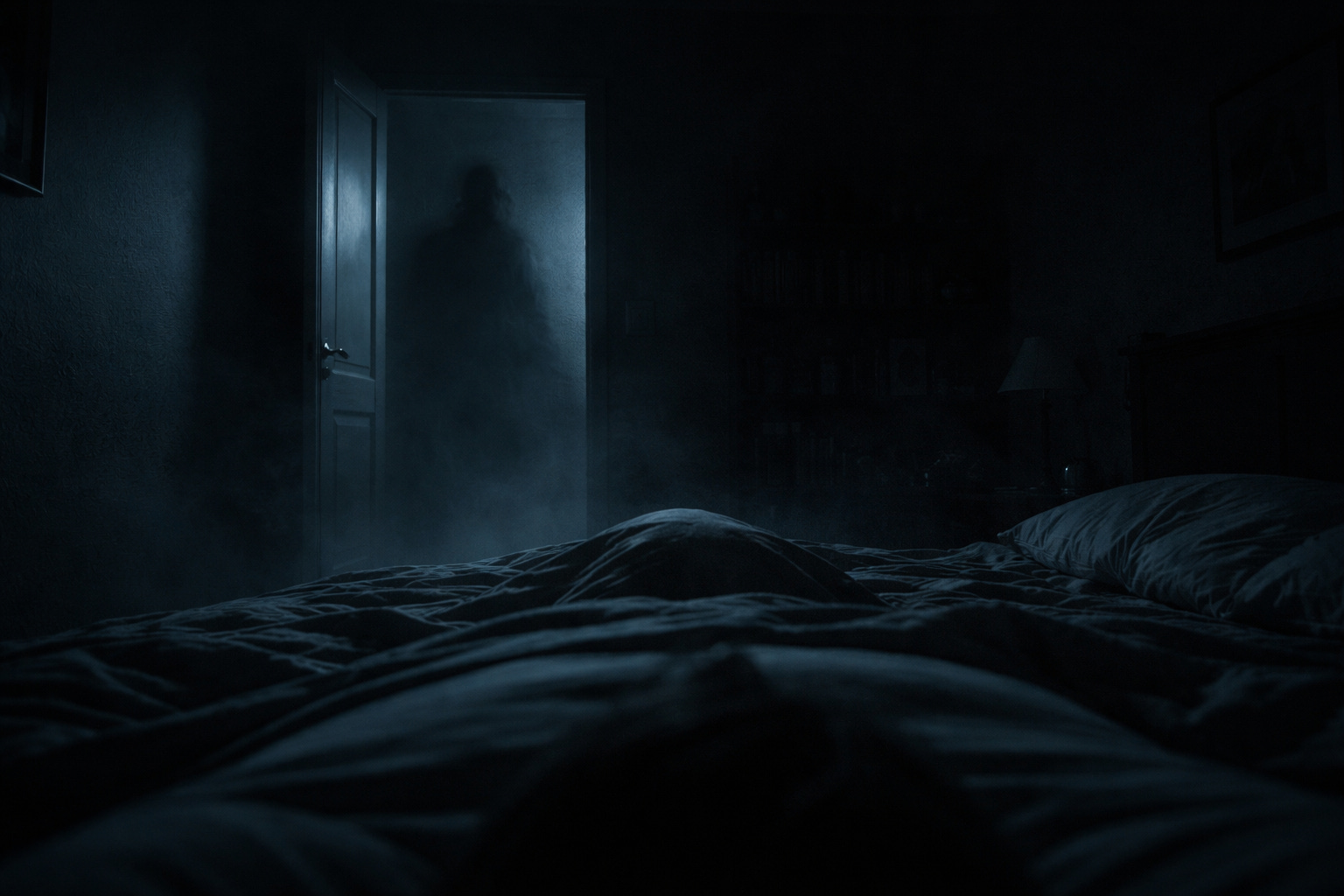
I have had it twice.
The waking is sudden and complete. You are conscious before you understand that something is wrong. Then you try to move, and the attempt goes nowhere. Not heaviness. Not numbness. Something more deliberate than that. Like the instruction leaves you and is intercepted before it arrives. The body is fine. The will is fine. The space between them has been closed.
And there is something in the room.
Not in a corner. Not at the door. Nowhere specific and everywhere at once. A presence that fills the space without occupying a location, which is precisely what makes it impossible to manage. You cannot turn toward it. You cannot measure it. You can only lie there, unable to move, while it attends to you from everywhere and nowhere simultaneously.
That is the experience. Twice. Both times identical in structure.
I am telling you this before the research because the research should follow the experience, not replace it.
Sleep paralysis is a documented neurological phenomenon.
During REM sleep, the brain suppresses voluntary muscle movement. This is protective. It prevents you from acting out your dreams. Under normal circumstances, the suppression lifts as you transition to waking. Occasionally the transition misfires. Consciousness returns before the motor suppression releases. The result is a period of complete paralysis, usually lasting seconds to a few minutes, during which the brain is still generating the perceptual intensity of the dream state while the body is awake and unmoving.
The neuroscience is solid. The mechanism is well understood.
What it does not fully account for is the content.
If sleep paralysis were simply a neurological misfire, a glitch in the transition between states, you would expect the experiences it generates to be as varied as dreams themselves. Sometimes frightening, sometimes mundane, sometimes absurd. The full range of what the dreaming mind produces.
But that is not what the record shows.
The record shows something far more specific. Across cultures, across centuries, across populations with no contact with each other and no shared narrative framework, the sleep paralysis experience converges on a remarkably consistent set of elements.
The presence. Almost always there is a presence. Not just the feeling of not being alone, but something perceived as an entity, as having location, intention, and a quality of attention directed at the person who cannot move.
The interference. Not paralysis in the way a limb falls asleep. Something more deliberate. The sense that the signal is being intercepted. That the connection between will and body has been closed by something outside both.
The terror. Not the ordinary fear of a bad dream. Something reported consistently as categorically different. A quality of dread that experiencers describe as the most intense fear they have ever felt, disproportionate to anything in their ordinary emotional range.
And the presence without location. Everywhere and nowhere. Impossible to orient toward, impossible to assess, impossible to manage.
That last detail appears across accounts with a consistency that is difficult to attribute to coincidence. It is also the detail that makes the experience most unbearable. Location is how we manage threat. Remove location and you remove every tool the mind reaches for.
Whatever produces this experience knows, or behaves as if it knows, exactly what it is doing.
The names change. The entity does not.
In medieval Europe it was the night hag. An old woman, malevolent, who sat on sleepers and pressed the breath from them. The word nightmare comes from this tradition. Mare was the Anglo-Saxon term for the creature. It rode you in the night.
In Newfoundland it is the Old Hag. The accounts are consistent across generations of isolated fishing communities with limited contact with the broader European tradition.
In West Africa it is the devil that sits. In China it is gui ya, ghost pressure. In Japan, kanashibari, bound in metal. In Turkey, the dark presser. In Mexico, the dead climbing on you.
Different words. Different cultural frameworks. Different centuries.
The same interference. The same presence without location. The same quality of attention from something that cannot be faced because it has no face to face.
The neurological explanation accounts for the paralysis. It accounts for the hallucinations.
It does not account for why the hallucinations are the same hallucination.
There are two ways to approach this consistency.
The first is psychological and evolutionary. The human brain, under the specific conditions of sleep paralysis, generates threat perception. The body is immobile and vulnerable. The alarm system fires. And when the alarm system fires in the absence of a visible threat, the brain constructs one from available materials. The construction draws on deep evolutionary templates. The predator above you. The thing that pins you. The presence that has no location because, in the dark, before fire and walls, the threat could come from anywhere.
The consistency across cultures reflects not a shared external entity, but a shared internal architecture. We all have the same brain. Under the same conditions, it produces the same outputs.
This is a compelling account. It may be the correct one.
The second approach asks a question the first doesn’t fully address.
Why this specific template?
The brain has an enormous range of threat responses available. Why does sleep paralysis so consistently produce not just generalized threat, but a specific interference, a specific presence, a specific quality of attention? Why the sensation of interception rather than simple heaviness? Why the presence without location rather than the presence with one?
The evolutionary account is plausible.
It is also built to fit the data after the fact.
The question is whether it fully accounts for the specificity, or whether it smooths over details that resist the explanation.
There is a third possibility I want to name without endorsing.
What if the condition of sleep paralysis, the specific neurological state it produces, creates a perceptual opening? A brief window in which something that is ordinarily below the threshold of ordinary perception becomes, under these specific conditions, accessible?
The entity would then be real in a sense that is genuinely difficult to define. Not a construction of the frightened brain. Not a demon in the medieval sense. Something that exists at the boundary of the state the paralyzed sleeper occupies. Something that the state makes briefly accessible.
This is the oldest interpretation. It is not falsifiable. It may be wrong.
But it sits more comfortably with certain features of the experience that the neurological account struggles with. The felt reality of the presence, which experiencers consistently describe as categorically different from any dream. The specific quality of the interference, which does not feel like a body failing, but like a signal being blocked. The terror, which experiencers describe not as the fear of something imagined, but as the fear of something encountered.
The difference between those two fears is difficult to articulate.
For anyone who has felt both, it is unmistakable.
There is a detail in the accounts that I return to often.
In many reports, the experiencer describes a moment when the entity becomes aware that it is being observed in return. That the person who cannot move is nevertheless present, attending, watching back.
And something changes.
Not always. Not dramatically. A shift in the quality of the encounter. The presence adjusts. In some accounts it withdraws. In others it comes closer. In others it simply holds, as if reassessing.
This detail appears across accounts with no obvious common source. The moment of mutual attention. The awareness running in both directions.
It is either the most frightening thing about the experience.
Or the most interesting.
Because it suggests that whatever is encountered in those moments is not a passive phenomenon being perceived.
It perceives in return.
Both times I lay there unable to move, I did not see anything.
I felt something attend to me from everywhere in the room at once. And I felt, with a certainty that had nothing to do with reasoning, that it was aware of me in return. That my waking, my presence, my attention in that specific moment was not incidental to it.
That it had noticed.
I don’t know what noticed me. I don’t know if noticed is even the right word for what something like that does.
What I know is that the experience left a residue that ordinary bad dreams don’t leave. Not trauma. Something more neutral than that. A persistent background awareness, for days afterward, that the room at night is not simply the room.
That whatever I usually assume is not in it may, under conditions I don’t control and cannot predict, be there.
Attending.