
Places That Remember
On locations where the strange repeats, and what that might suggest about the relationship between space and event
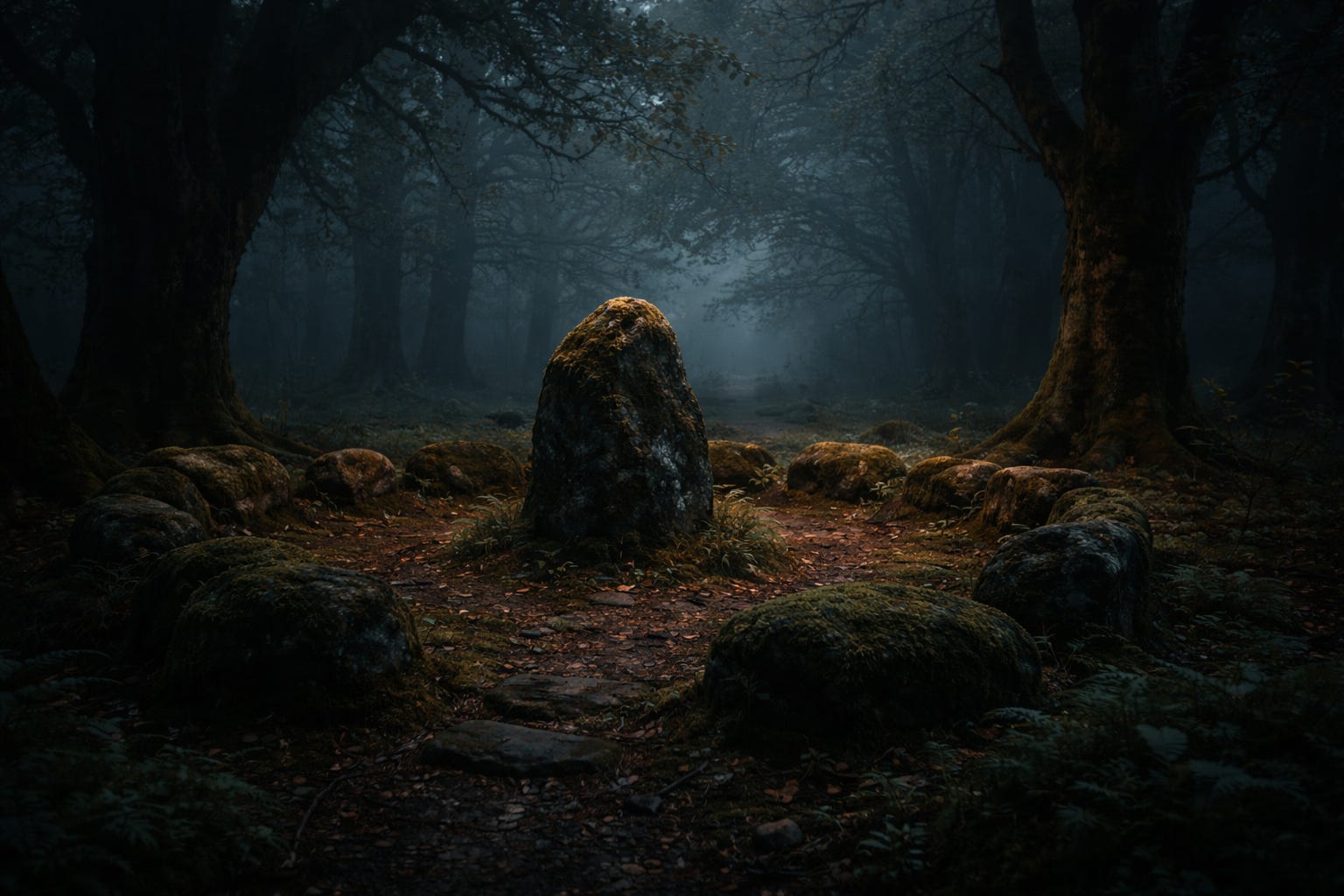
There are places where things happen once.
And there are places where things keep happening.
This is the distinction that interests me. Not the isolated event. The one-time occurrence that can be filed under coincidence and moved past. But the location that generates the same category of experience, again and again, across different people, different eras, sometimes different centuries.
It’s the repetition that changes the question.
Every culture has them. The hill where people lose time. The crossroads where figures appear and disappear. The house where successive occupants report the same sensation in the same room, describe the same quality of presence, without having spoken to each other or read each other’s accounts.
The easy explanation is contamination. People hear stories about a place and then experience what they were primed to experience. The mind is obliging. It delivers what the narrative prepared it for.
This explains some cases. Probably many.
But it doesn’t explain the cases that predate the stories. The first report, before there was a reputation to fulfill. The accounts from people who arrived without context and left with experiences that matched, precisely, what others had reported before them.
Contamination requires a vector. Sometimes there isn’t one.
There is a concept in archaeology and folklore studies called a thin place. The term comes from Celtic tradition. It describes locations where the boundary between what is ordinarily visible and what lies beyond it feels reduced. Where whatever usually separates layers of reality seems, in that specific geography, to be worn down.
The tradition doesn’t explain the mechanism. It just names the observation.
Researchers working at the edge of mainstream science have tried to find physical correlates. Unusual electromagnetic fields. Fault lines and piezoelectric effects in quartz-bearing rock, which generate electrical charges under pressure. Infrasound, sound below the threshold of hearing, which produces in humans a range of effects including unease, the sense of a presence, and in some cases visual disturbance.
These explanations account for some of the reported effects at some locations. They are worth taking seriously.
But they don’t account for the specificity.
Infrasound produces unease. It does not produce the same apparition, described in matching detail, by witnesses separated by decades. Electromagnetic fields create disorientation. They don’t explain why the disorientation takes the same narrative shape in the same corner of the same building, across people who have never compared notes.
The physical explanations are partial. They open the door slightly and then stop.
I want to propose something that I hold carefully, without insisting on it.
What if certain locations are better described as recording devices rather than generators?
Not that they produce phenomena. But that they retain them.
The physicist David Bohm spent much of his later career developing what he called the implicate order. The idea, enormously simplified, is that what we experience as the explicit surface of reality is a kind of unfolding from a deeper, enfolded structure. That beneath the apparent separateness of events, there is a layer where everything that has occurred remains present, in a different form.
Bohm was not talking about hauntings. He was doing physics.
But the implication, taken seriously, is that the past does not simply cease. It enfolds. It becomes part of the structure of what is. And if that is true, then the question of whether places can retain the imprint of what happened in them becomes less mystical and more physical.
Stone, particularly certain kinds of stone, has properties we don’t fully understand. Water has properties we don’t fully understand. The relationship between electromagnetic fields and human neurological experience has properties we don’t fully understand.
We are working with incomplete instruments on an incompletely mapped territory.
The honest position is not certainty in either direction, but attention.
I have been to one such place.
I won’t name it yet, because naming it would shift the attention in a direction I’m not ready to go. What I will say is this.
It was a location with a documented history of reports. I arrived knowing the history, which means I arrived compromised, at least by the contamination standard.
What I experienced was not dramatic. There was no figure, no sound, no event.
What there was, was a quality of attention the place seemed to require. As if something in the environment was drawing perception in a specific direction, the way a subtle change in air pressure draws your breath before you consciously notice it. The sensation was involuntary, and it was consistent across the time I spent there.
I left without a conclusion.
I went back twice. The sensation was the same. Localized to the same area. Consistent in character.
I don’t know what to make of that. I include it not as evidence, but as data. The kind of data that sits in a record and waits for context to arrive.
There is a researcher named Rupert Sheldrake whose work is largely rejected by mainstream science and largely ignored rather than seriously refuted. He proposes what he calls morphic fields, regions of influence that carry the patterns of what has occurred before, shaping what occurs next.
The idea has been used to explain everything from why rats learn mazes faster after other rats have learned them to why certain behaviors seem to emerge spontaneously across unconnected populations.
It is speculative. The evidence is contested.
But the core intuition, that place and pattern are not independent, that location carries something forward from its history, that events leave a residue that subsequent events can, under certain conditions, contact, is not obviously absurd.
It is, in fact, what most human traditions have believed for most of human history.
The question is not whether the ancients were being superstitious. The question is whether they were observing something real that we have, in our particular historical moment, decided not to look at.
What I notice about these locations, the ones with documented repeating histories, is that they tend to share certain characteristics.
They are old. Not always, but often.
They are geologically unusual in some way. Fault lines, water sources, particular rock formations.
They are places where human activity has concentrated over long periods. Sites of repeated gathering, repeated ritual, repeated significance.
And they are places where the accounts, across time, describe not random phenomena but patterned ones. The same type of experience, returning. As if the location has a repertoire.
A repertoire implies something that selects. Something that organizes. Not randomly generating strangeness, but returning, again and again, to a particular register.
That consistency is what I find most difficult to dismiss. Not any single account. The shape of the whole record.
I don’t think places are conscious. I don’t think they intend.
But I think they may retain. And I think the relationship between human attention and retained pattern may be more active than our current models allow for.
When you walk into a room where something terrible happened, and you feel it before you are told, something is occurring.
Whether that something is your unconscious reading micro-signals in the environment, or a genuine contact with retained information in the space itself, the effect is real.
The effect is real.
That is where I start. Not with theory. With the effect, repeating, across people and time, in specific locations that seem to hold something the surrounding landscape does not.
What they are holding, and how, and why only there, are the questions.
They are good questions.
They deserve better than dismissal and better than credulity.
They deserve the same thing all good questions deserve.
Careful, sustained attention.