
Case Study SQR-UFO-003: The Shag Harbour incident, and the only UFO case where a government never changed its mind
SIDE QUESTS OF REALITY | SQR-UFO-003 | SHAG HARBOR INCIDENT
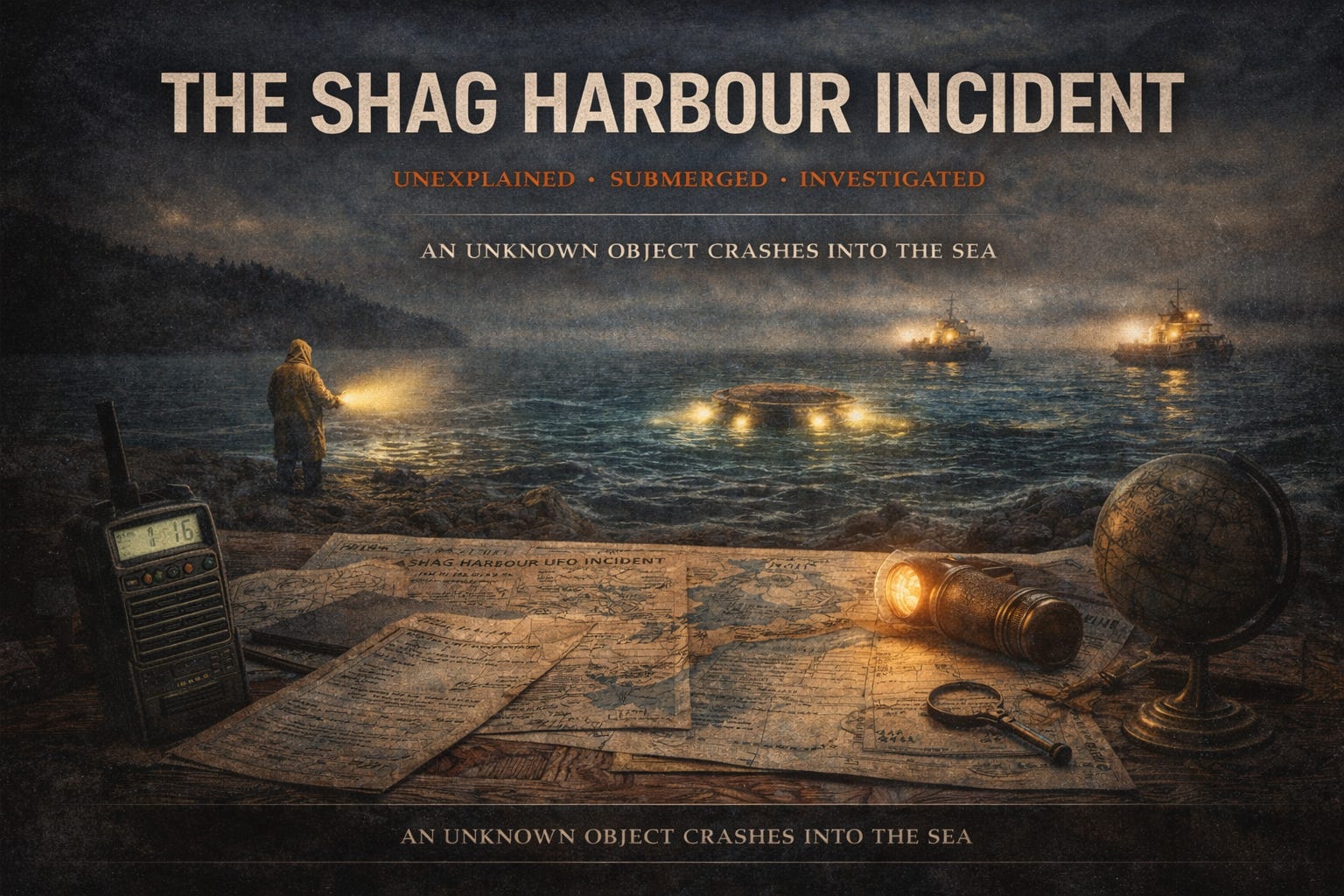
On the night of October 4, 1967, at approximately 11:20 PM, something crashed into the waters of Shag Harbour, Nova Scotia.
No debris. No survivors. No missing aircraft. No conventional explanation that holds.
Just a thick yellow foam floating on the cold surface of the Atlantic, and eleven witnesses watching from the shore.
What sets Shag Harbour apart from almost every other case in this series is not the spectacle of the event. It is what the Canadian government did afterward. It investigated seriously, found no conventional explanation, officially classified the object as being of unknown origin, and never changed that position.
Fifty-eight years later, the classification still stands.
🎙️LISTEN TO THE SIDE QUESTS OF REALITY PODCAST

The Setting
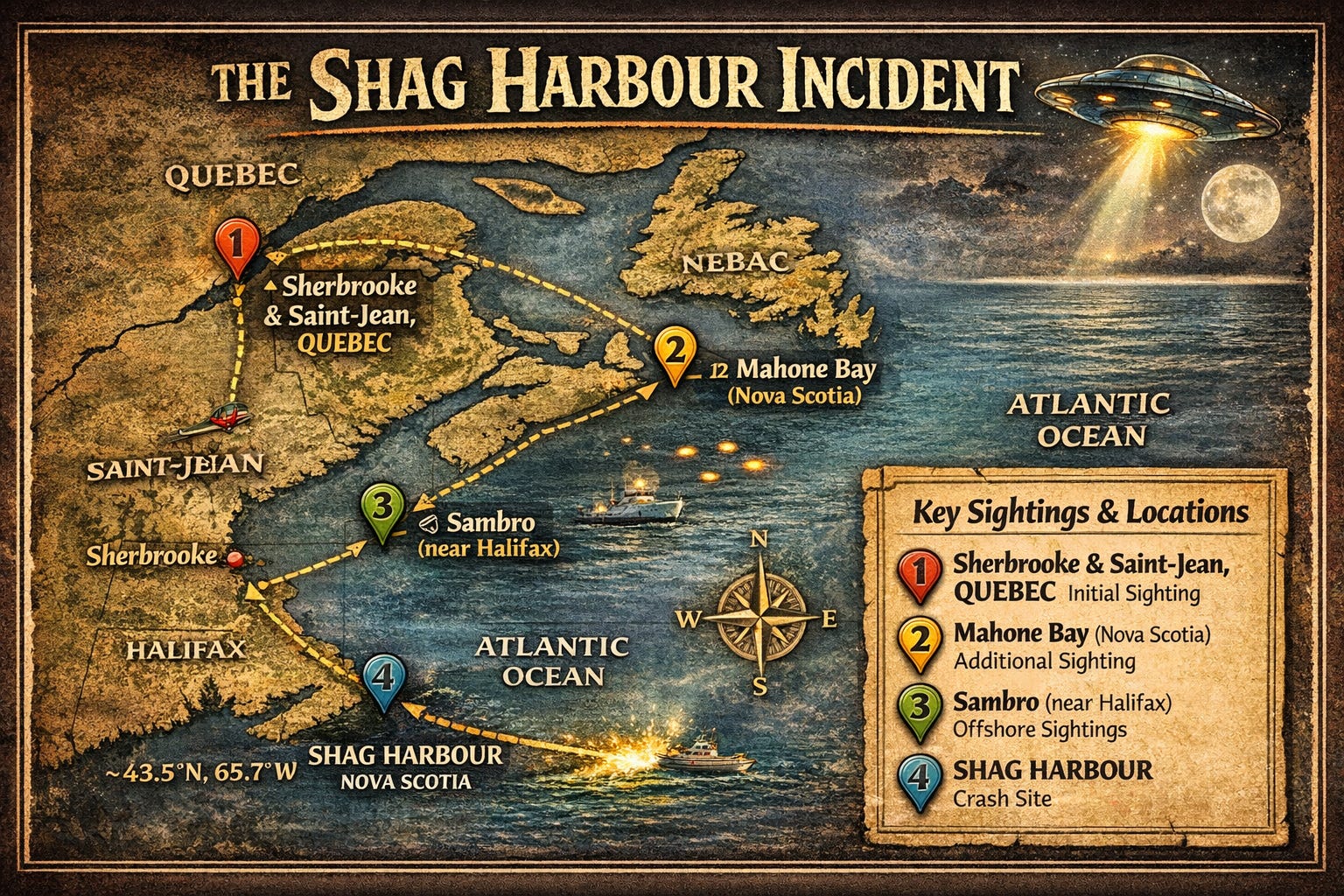
Shag Harbour is a tiny fishing village at the southern tip of Nova Scotia. In 1967 it was so small it appeared on almost no maps. The people there lived off lobster fishing. The local stories involved sea serpents, ghost ships, and giant squid.
That night they would add another one to the list.
What is less commonly known, and what becomes crucial later in this story, is the military geography of the region. A few dozen kilometers to the northeast sat HMCS Shelburne, an American naval installation operating under the cover of an oceanographic research base. It was part of the SOSUS network, the Sound Surveillance System, a top-secret array of underwater microphones deployed throughout the North Atlantic to track Soviet submarines during the Cold War. A MAD grid, Magnetic Anomaly Detection system, was also laid beneath the waters to register the metal signatures of any submerged object.
This was not an ordinary stretch of sea.
The Hours Before
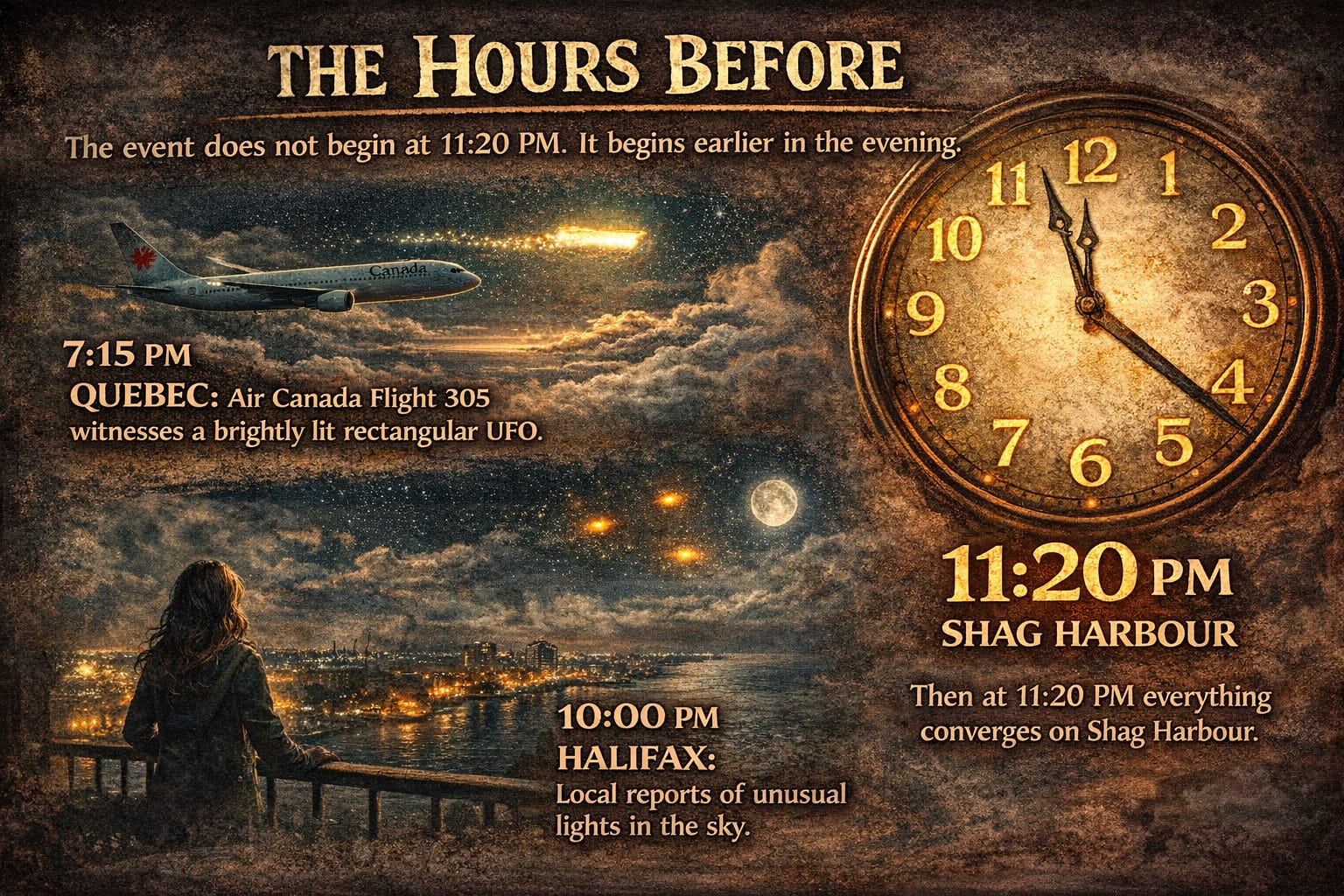
The event does not begin at 11:20 PM. It begins earlier in the evening.
At 7:15 PM, Air Canada Flight 305 Captain Pierre Charbonneau and First Officer Robert Ralph are cruising at 12,000 feet over Quebec when they notice something off the left side of the aircraft. They describe a brilliantly lit rectangular object with a string of smaller lights trailing behind it, traveling on a parallel course. They watch it for several minutes before it disappears.
Later in the evening a woman in Halifax reports unusual lights in the sky around 10 PM.
Then at 11:20 PM everything converges on Shag Harbour.
The Witnesses
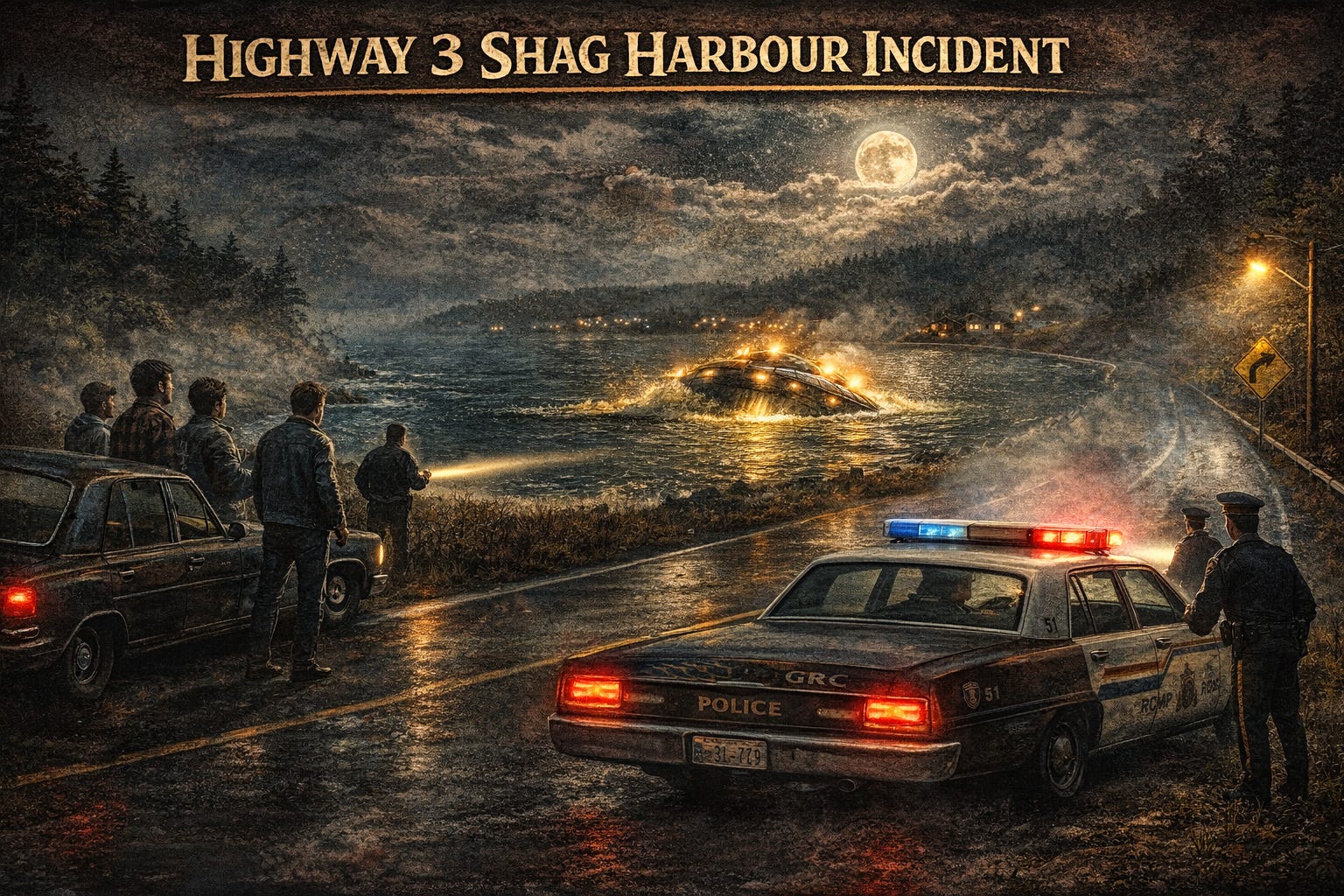
Laurie Wickens was driving Highway 3 with four friends when they saw the object descending toward the harbour waters. His first thought was not space. It was a plane crash. He pulled over, found a better vantage point, and watched an object floating 250 to 300 meters offshore, its lights still visible on the surface of the water.
Wickens called the RCMP detachment in Barrington Passage and reported that a large aircraft had crashed into the waters off Shag Harbour.
Meanwhile, RCMP Constable Ron Pound was already driving Highway 3 toward the harbour when he saw the lights himself. He estimated the object at roughly 60 feet in length. Four orange lights, all attached to a single structure, flashing in sequence before tilting at a 45-degree angle and diving toward the water’s surface.
In total, eleven witnesses saw a low-flying lit object head toward the harbour. Several of them reported hearing a sequence of sounds: a whistling noise like a falling bomb, then a whoosh, then a loud bang on impact. The object did not immediately vanish beneath the waves. It floated, lights still showing, for several minutes, before beginning to sink and disappearing below the surface.
Among the eleven witnesses: local residents, fishermen, and three RCMP officers.
Every one of them thought they were watching an aircraft accident. They were looking for survivors.
The Response
What follows is what makes Shag Harbour exceptional in the record of UAP cases.
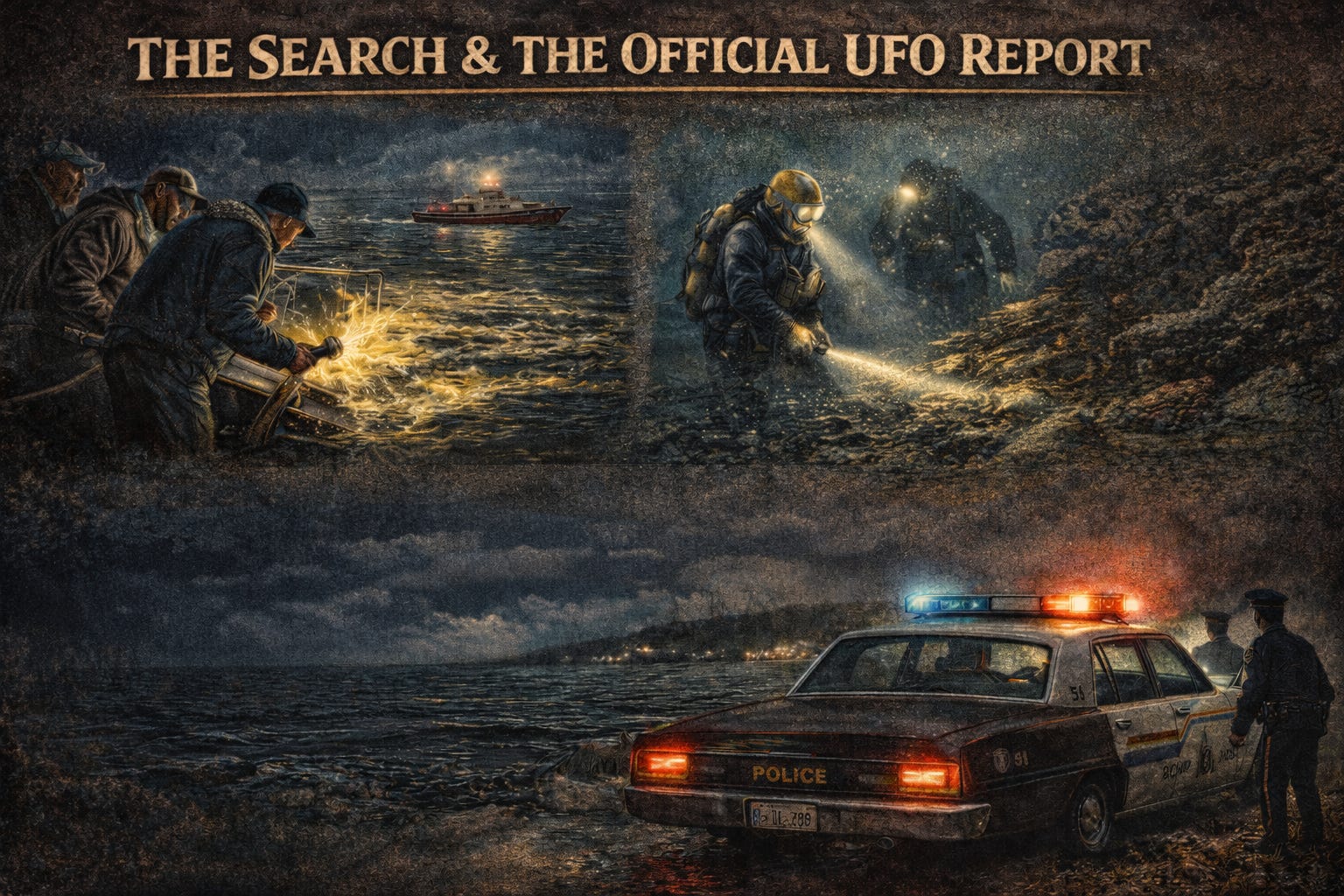
Within thirty minutes of the crash, local fishing boats were already at the site searching for survivors. A Canadian Coast Guard vessel arrived from Clark’s Harbour about an hour later.
They found nothing. No aircraft wreckage. No bodies. No survivors. Just a thick yellow foam covering the surface of the water, which persisted for hours.
The next morning, the Rescue Coordination Centre in Halifax confirmed that no aircraft, commercial, private, or military, was missing anywhere along the eastern seaboard of both the Atlantic provinces and New England.
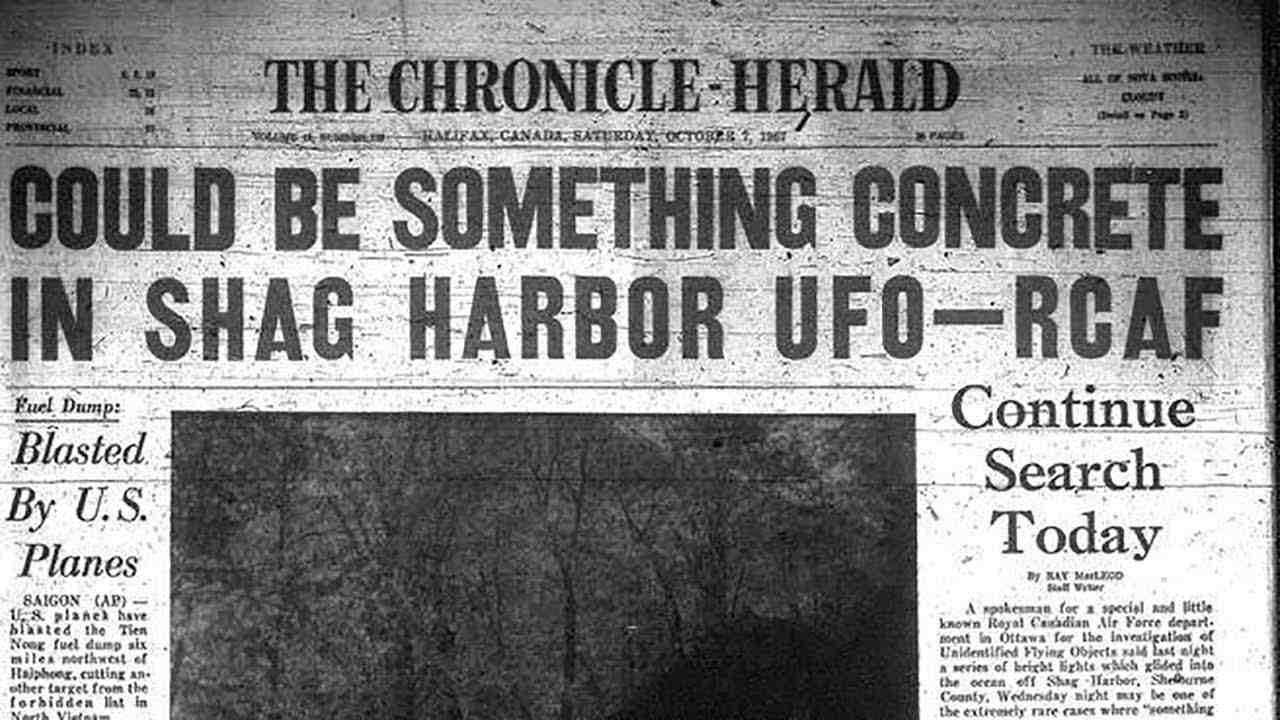
That same morning, RCC Halifax sent a priority telex to the Air Desk at Royal Canadian Air Force headquarters in Ottawa, the department responsible for all civilian and military UFO reports. The message informed them that an object of unknown origin had crashed into the waters of Shag Harbour, and that all conventional explanations including aircraft, flares, and atmospheric phenomena had been ruled out.
The official classification: UFO Report.
This was not a journalist using that term. Not a UFO enthusiast. This was the Canadian government, in a priority telex between military agencies, stating that it could not explain what eleven witnesses had watched crash into the sea.
The head of the Air Desk in Ottawa, Squadron Leader Bain, then sent another priority telex to Royal Canadian Navy headquarters recommending an underwater search be mounted. The Navy in turn tasked Fleet Diving Unit Atlantic with carrying out the operation.
Bain told the press: We get hundreds of reports every week, but the Shag Harbour incident is one of the few where we may get something concrete.
Two days after the crash, professional Navy divers were combing the seafloor off Shag Harbour. They spent three consecutive days searching.
Their final report: no trace of any object found.
What the Divers Did Not Say Officially
This is where the official story and the fuller story begin to diverge.
In the 1990s, a MUFON researcher named Chris Styles, who had himself been twelve years old in 1967 and had watched the lights in the sky that night from his home in Nova Scotia, began interviewing original witnesses and pulling military documents through freedom of information requests. He was joined by researcher Doug Ledger. Together they reconstructed a picture of the event considerably more complex than what the official files described.
What they found: the object that had sunk into the waters off Shag Harbour had not stayed there.
According to civilian and military witnesses who agreed to speak only anonymously, fearing the loss of their pensions or public ridicule, the object had traveled underwater approximately 70 kilometers to the northeast, toward Government Point, in the vicinity of HMCS Shelburne and its surrounding detection network.
The US had maintained a sensitive military installation at Government Point, managing a Magnetic Anomaly Detection grid for tracking submarines in the North Atlantic. If something unknown had crashed in Canadian waters and then traveled underwater to one of the most sensitive surveillance installations on the continent, the detection systems there would almost certainly have registered it.
According to Styles and Ledger’s sources, they did.
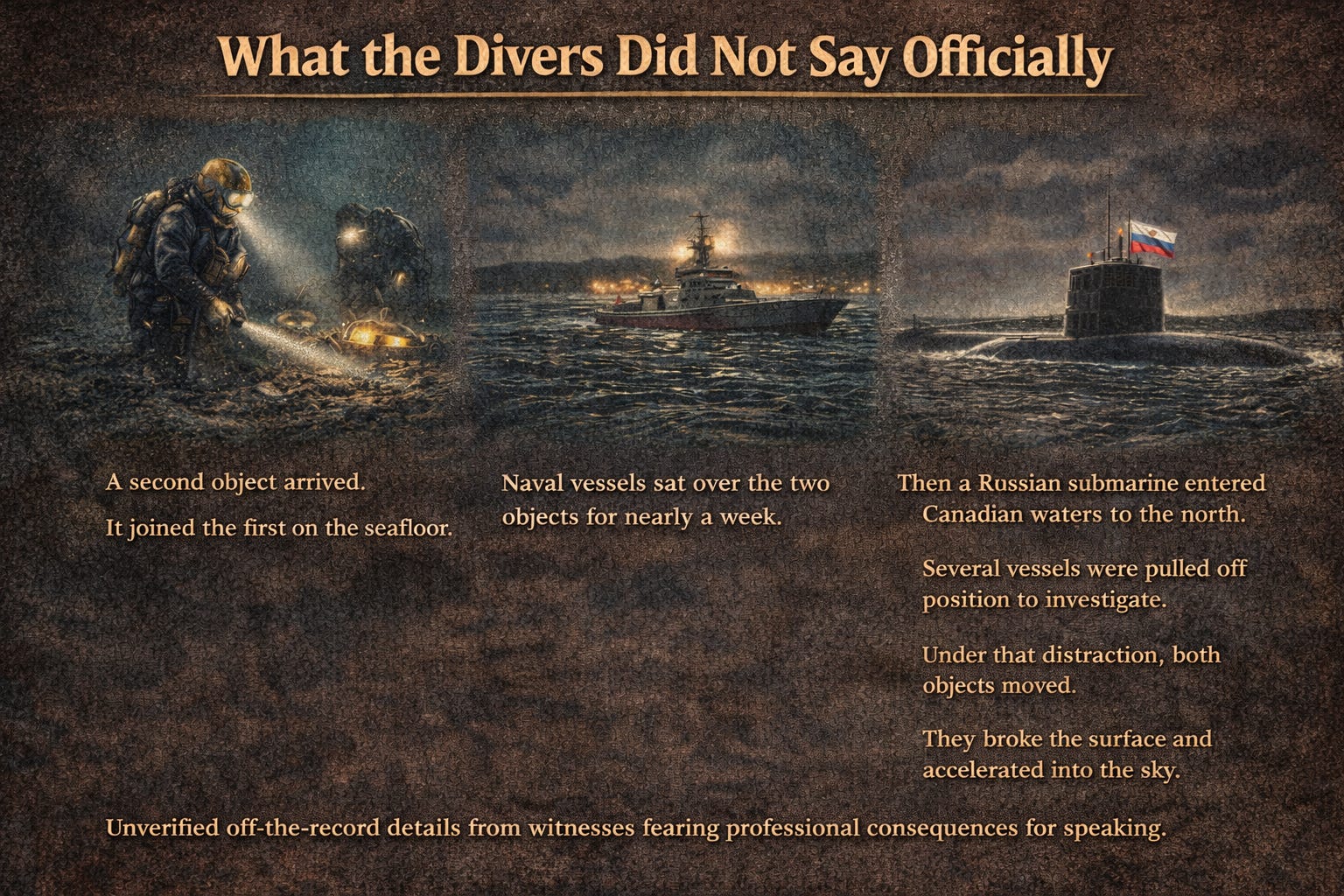
Naval vessels were positioned over the object after it stopped moving near Government Point. Sonar contacts were made. The military planned a salvage operation. Then, after approximately three days of no movement, something unexpected happened.
A second object arrived.
It joined the first on the seafloor.
The prevailing interpretation among the military personnel involved, speaking off the record decades later, was that the second craft had come to assist the first. The Navy held its position and observed.
For nearly a week, naval vessels sat over the two objects.
Then a Russian submarine entered Canadian waters to the north, and several vessels were pulled off position to investigate. Under cover of that distraction, both objects moved. They traveled underwater toward the Gulf of Maine, outdistancing the remaining vessels pursuing them, broke the surface, and accelerated into the sky.
They were gone within seconds.
These accounts come from off-the-record witnesses who feared professional consequences for speaking. They are not in the official files. They represent the contested and unverified layer of this case, sitting above the solid documented core in the same way that the body reports sit above the verified debris field at Roswell.
The documented core alone is extraordinary enough.
What the Record Actually Contains
It is worth being precise about what is established and what is not.
What is established: eleven witnesses including three RCMP officers saw a lit object descend into Shag Harbour. No aircraft was missing. No conventional explanation was found. The Canadian government officially classified the object as of unknown origin and recommended a military underwater search. Navy divers searched for three days and found nothing. A thick yellow foam of unknown composition covered the crash site for hours. The official classification was never changed.
What is unverified: the object’s alleged underwater travel to Government Point, the second object, the week of naval observation, the departure into the sky. These elements come from anonymous sources interviewed decades later by civilian researchers. They are corroborated by multiple independent witnesses telling consistent stories, but they cannot be confirmed through documents.
The distinction matters. It is the difference between what we know and what we suspect.
What we know is already enough to make Shag Harbour remarkable.
Most governments confronted with an inexplicable event follow a predictable sequence: investigate, find a plausible conventional explanation, apply it publicly, move on. When no conventional explanation exists, they either classify everything and say nothing, or they manufacture an explanation and say that.
Canada did neither.
Canada investigated thoroughly, found no conventional explanation, said so in official government documents, and then left the classification standing for nearly six decades without revision.
That combination is essentially unique in the history of documented UAP cases.
The Foam
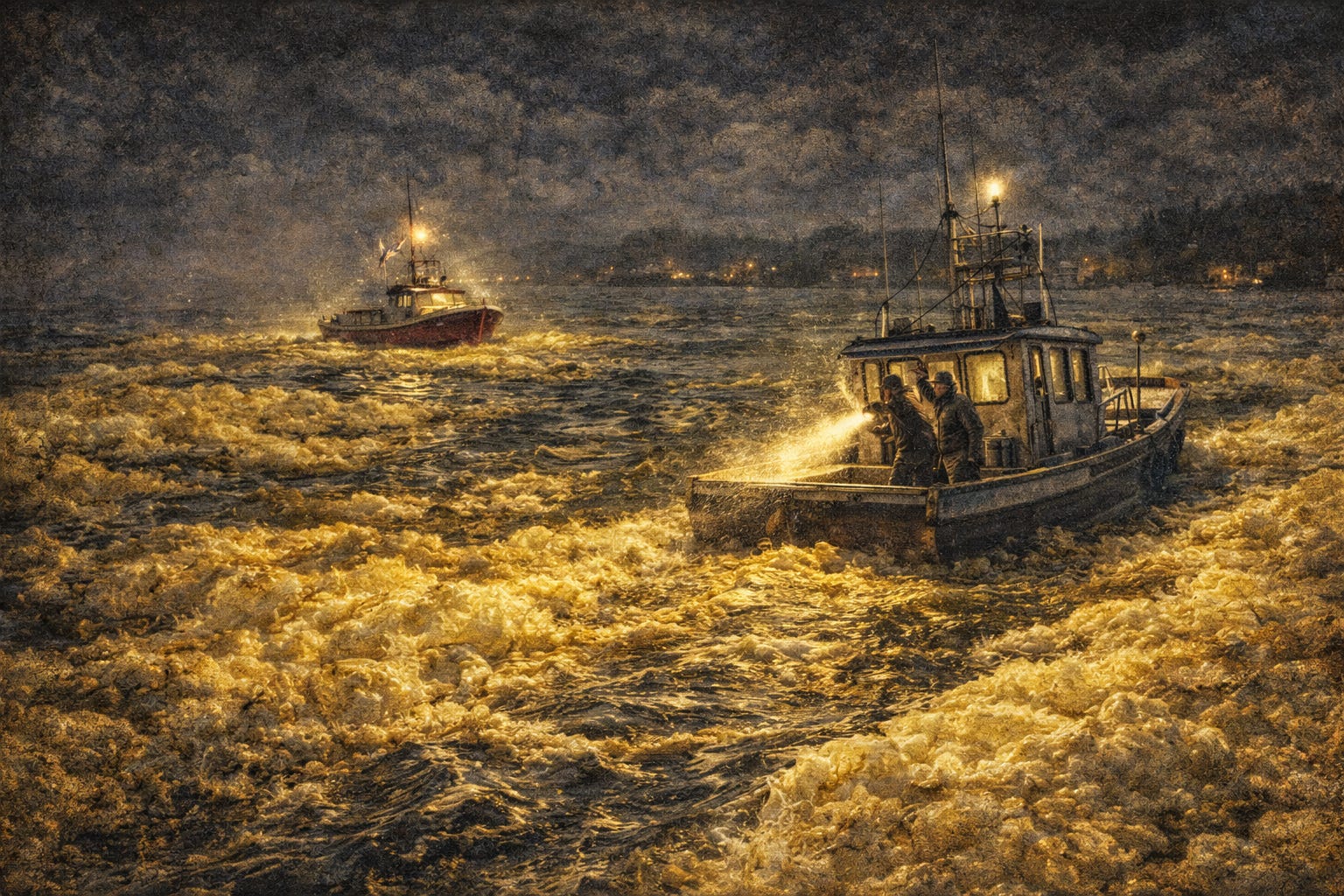
The yellow foam deserves more attention than it usually receives.
Witnesses described it as thick, sulfurous, and covering a large area of the surface. It was visible for hours after the object sank. Local fishermen who went out to the site described it as unlike anything they had encountered on those waters before.
The Canadian Coast Guard collected samples. What analysis was done on those samples, and what results if any were obtained, has never been publicly disclosed.
Something produced that foam. Whatever hit the water at 11:20 PM on October 4, 1967 interacted with it in a way that left a persistent and unusual residue on the surface. Not oil. Not aircraft fuel. Not debris.
Yellow foam.
It is the physical trace that Shag Harbour left behind. Like the depressions in the forest floor at Rendlesham, like the radiation readings at the Roswell debris field, it is the mark that something real left on the material world before the official record closed.
What Shag Harbour Is
Shag Harbour is the cleanest case in this series so far.
It is clean because the contamination that plagues Roswell, the decades of mythology, the hoaxes, the embellishments, the celebrity witnesses with no credible connection to the events, has never attached itself to Shag Harbour in the same way. The village is too small, too remote, and too genuinely strange for that kind of cultural machinery to gain purchase.
What it has instead is a short, verifiable chain of documented events. Something was seen by eleven credible witnesses. It crashed into the water. No conventional explanation was found. The government said so. Divers searched and found nothing. The foam was there.
And then nothing.
No recovery. No announcement. No leaked memo thirty years later. No deathbed confession from the base commander. The case simply sits in the Canadian government’s files, officially unresolved, quietly waiting.
The head of the Air Force’s Air Desk in Ottawa said in 1967 that this was one of the few cases where they might get something concrete.
They never did.
Or if they did, they have kept it longer and more completely than almost any other secret in the history of documented UAP investigation.
Something entered the waters of Shag Harbour on a clear October night in 1967.
The fishermen went out looking for survivors and found yellow foam.
The Navy divers went down looking for wreckage and found nothing.
The government looked at all of it, put its name to a document calling it unknown, and has never had anything else to add.
That is the record.
It is short. It is clean. It is unresolved.
And it is, by the standards this series has established for what makes a case worth examining carefully, one of the most credible in the file.
This case is filed as SQR-UFO-003.
If you want to be notified when SQR-UFO-004 drops, and when the cases start talking to each other in ways that are difficult to explain, subscribe below.
That’s all this is. Careful attention. Sustained over time. Welcome to Side Quests of Reality.