
Case Study SQR-CRP-004: The Mothman of Point Pleasant, and what it means that the sightings stopped
SIDE QUESTS OF REALITY | SQR-CRP-004 | MOTHMAN
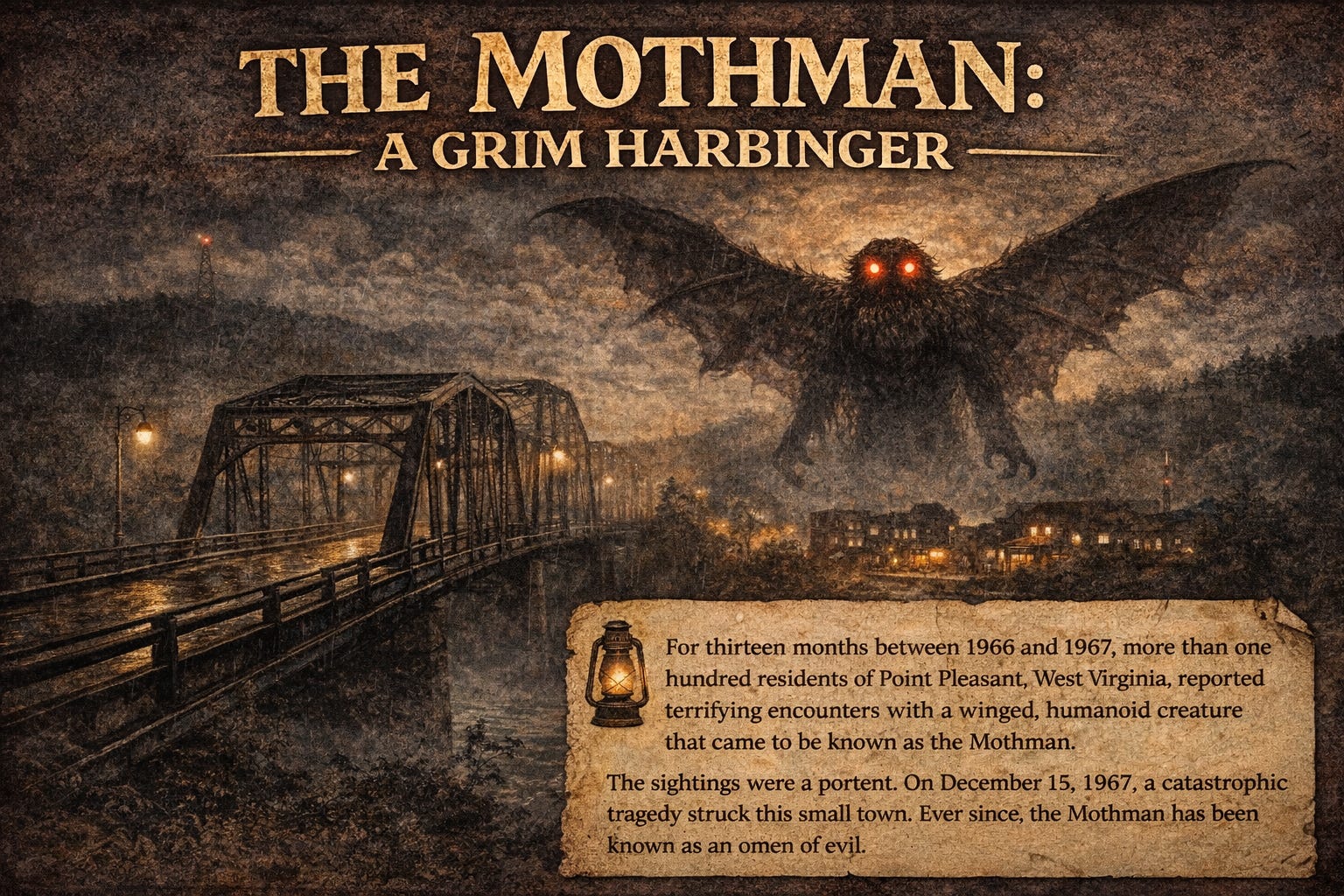
The sightings lasted exactly thirteen months.
They began on November 12, 1966, when gravediggers working in a cemetery above the Elk River near Clendenin, West Virginia, looked up and saw something enormous moving through the trees. They described it as a brown human being, soaring from branch to branch with speed that no bird they knew could match.
Three days later, two young couples driving near an abandoned World War Two munitions facility outside Point Pleasant saw something standing near the road. They described it as a large flying man, six to seven feet tall, with massive wings folded against its back and eyes that glowed red when their headlights caught them. When they drove away, it followed. They pushed their car to speeds approaching a hundred miles per hour on the road back toward town. The thing kept pace with them in the air before breaking off at the city limits.
The sightings multiplied across that winter and through 1967. More than a hundred people in Mason County and the surrounding area reported encounters. Two volunteer firefighters saw it. Local law enforcement took reports. A wildlife biologist from West Virginia University said publicly that witnesses were probably seeing a misidentified sandhill crane. The Mason County Sheriff thought it was an unusually large heron.
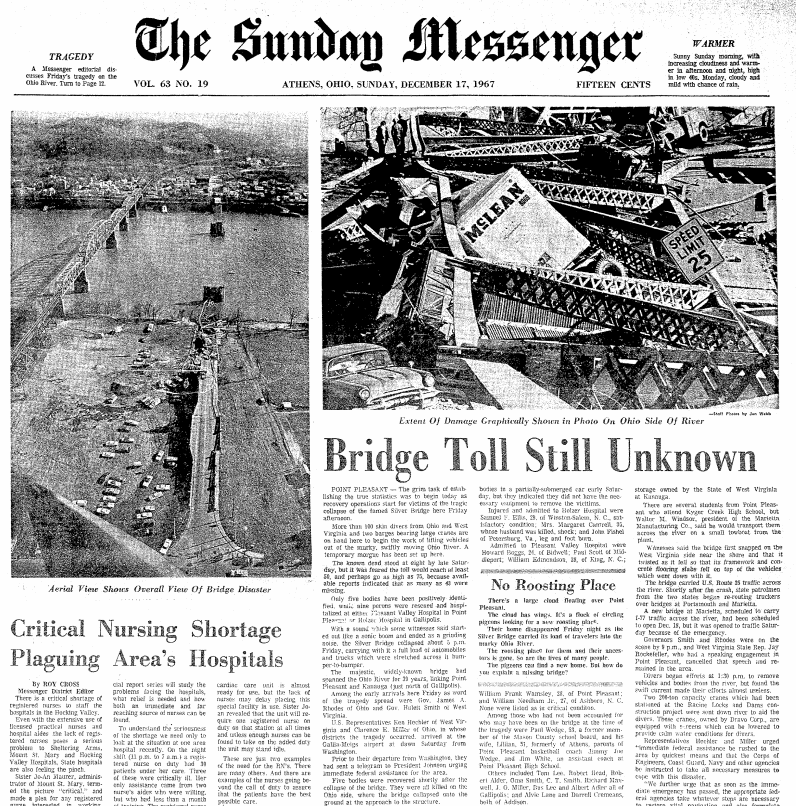
The sightings stopped on December 15, 1967, the day the Silver Bridge collapsed into the Ohio River and forty-six people died in the water below.
That is the structure of the Mothman case. Thirteen months of concentrated encounters around a specific location, bookended by nothing before and nothing after, ending on the day of a specific catastrophe.
Whatever else is or is not true about the Mothman, that structure is real. It is in the newspaper record. It is in the police reports. The Mothman Museum in Point Pleasant holds the original handwritten witness statements.
The question is what to make of it.
The TNT Area
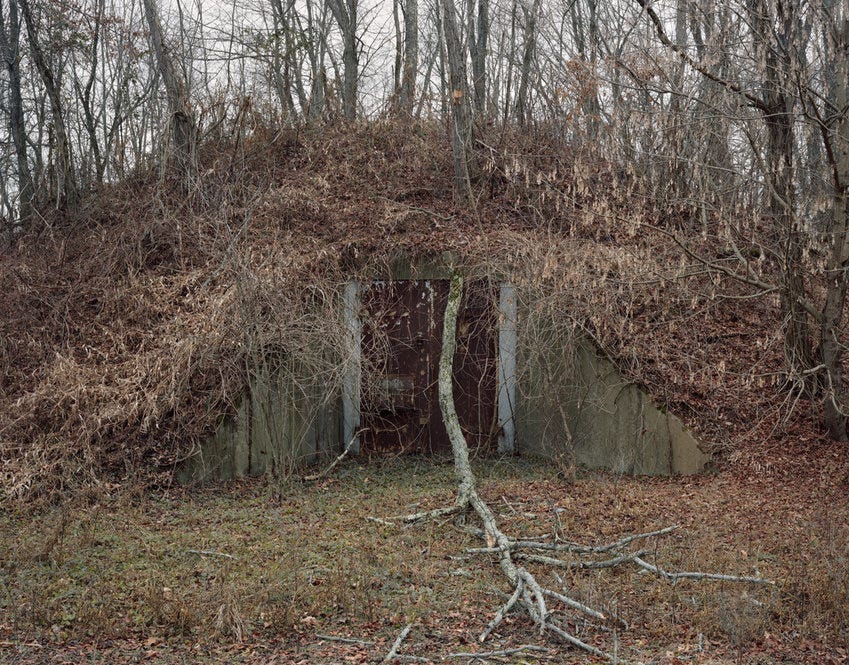
Almost every significant Mothman sighting occurred in or near a place locals called the TNT area.
Its official name was the West Virginia Ordnance Works, a former World War Two munitions manufacturing facility covering several thousand acres north of Point Pleasant along the Ohio River. During the war it had produced TNT and other explosive materials in a network of low concrete bunkers scattered across the landscape. After the war it was decommissioned, the bunkers left standing, the land converted to a wildlife management area but never fully remediated.
The area had an atmosphere that witnesses consistently described as unsettling even before the Mothman encounters. Dense woods, abandoned concrete structures half-swallowed by vegetation, rumored chemical contamination, and a remoteness that made it a gathering place for teenagers and a subject of local speculation about what might still be stored in the sealed bunkers.
It was also legitimately wild habitat. The McClintic Wildlife Management Area, as the TNT area was formally designated, bordered the Ohio River floodplain and contained wetlands, woodland, and open areas that supported large bird populations. Herons nested there. Great horned owls hunted there at night.
This is where the sandhill crane explanation draws its strength. Sandhill cranes are large birds, standing up to four feet tall with wingspans approaching seven feet. They have distinctive red skin patches around their eyes that can appear to glow under certain lighting conditions. They are not typical West Virginia residents, which would make an out-of-range sandhill crane startling to anyone who encountered it unexpectedly in poor light. Wildlife biologist Dr. Robert L. Smith made this argument publicly in November 1966, and it remains the most scientifically grounded conventional explanation for the sightings.
The crane explanation accounts for some of what was reported. It does not account for all of it.
A sandhill crane cannot chase a car at a hundred miles per hour. It cannot follow vehicles from the TNT area to the city limits of Point Pleasant while remaining airborne. Its wingspan, impressive as it is, falls substantially short of the ten-foot spread that multiple witnesses described. And a sandhill crane, however startling when encountered unexpectedly, is a bird with a bird’s behavior. It does not stand bipedally at the side of a road regarding a car with apparent interest.
Something in the TNT area was being seen repeatedly by people who were not all credulous, not all strangers to local wildlife, and not all looking for an encounter with something unusual.
What it was is the first question this case raises.
The Witnesses
The Scarberry and Mallette couples, whose November 15 sighting became the defining account, were not looking for a monster. Roger Scarberry, one of the four, said afterward that if he had seen it alone he would not have reported it. Four people saw it together. They went directly to the Mason County Sheriff’s office. Their account was taken seriously enough to be filed.
Linda Scarberry’s description has been consistent across every interview she has given in the decades since. She described a slender, muscular figure shaped like a man but considerably larger, with white wings folded against its back. She said she was unable to discern its face because the eyes held her attention. She said the eyes did not glow from behind, like an animal’s eyeshine, but were lit from within, like two circles of red light.
The structural detail she returned to repeatedly was the eyes. Not the wings or the size or the speed, but the quality of those two red points of light in the dark.
Over the following weeks, this detail appeared in account after account from independent witnesses who had not read the Scarberry-Mallette report before their own encounters. A farmer saw something in his field. It had red eyes. A woman driving alone at night was paced by something flying outside her window. It had red eyes. A retired naval officer watching the sky from his back yard saw something moving. It had red eyes.
Red eyes appearing across independent accounts from witnesses who had varying levels of familiarity with the developing legend is the detail in the Mothman record that the sandhill crane explanation handles least well. Sandhill crane eye patches are red by day. At night, the crane’s eyes produce a normal amber eyeshine when caught by a light source. They do not produce the internally-lit red-glow quality that witnesses consistently described.
Whatever was being seen, the eyes were real to the people who saw them.
The Bridge
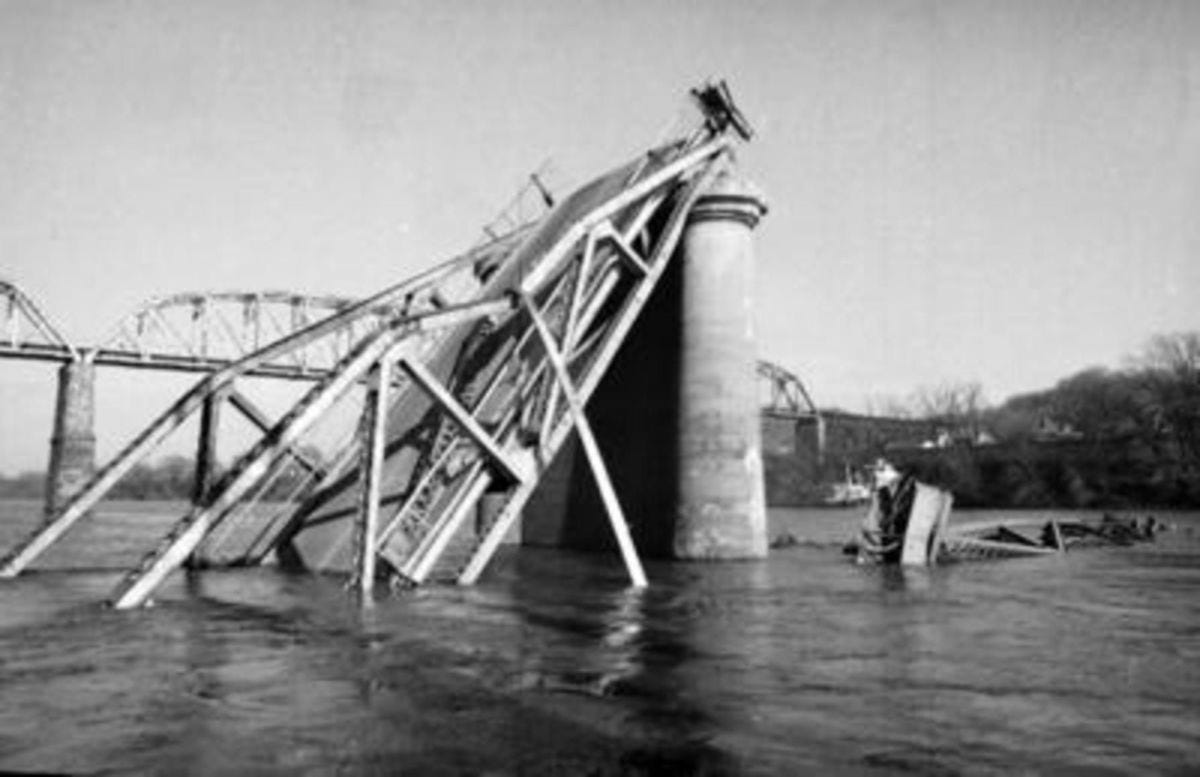
The Silver Bridge was built in 1928 to connect Point Pleasant, West Virginia, with Gallipolis, Ohio, across the Ohio River. It was an eyebar-chain suspension bridge, a design that used linked steel bars rather than traditional wire cables to carry the load. It opened as an engineering landmark, one of the first bridges in America to use a new high-strength steel for its eyebars.
What the designers did not anticipate was that the new steel, stronger than conventional material, was also more brittle. And the design carried an inherent vulnerability: unlike bridges with multiple redundant load-bearing elements, the Silver Bridge’s suspension system depended on every component in each chain. If a single eyebar failed, the chain failed. If the chain failed, the bridge fell.
For forty years the bridge carried increasingly heavy traffic. Cars in 1928 weighed around 1,500 pounds. Cars in 1967 weighed closer to 4,000. The cumulative stress on the eyebars accumulated invisibly, a flaw developing within the steel in a location that could only have been detected by disassembling the bridge itself. No inspection protocol of the era could have found it.
On December 15, 1967, at approximately 5 PM during rush hour, eyebar 330 on the north Ohio-side suspension chain fractured. The fracture was 0.1 inches deep, a stress corrosion crack that had grown across four decades to the point of critical failure. When the eyebar broke, the chain broke. When the chain broke, the entire bridge fell within seconds. Thirty-one vehicles went into the icy water. Forty-six people died.
The National Transportation Safety Board’s investigation, completed after three and a half years of analysis, concluded unambiguously: the cause was a cleavage fracture caused by stress corrosion and corrosion fatigue, developing over the forty-year life of the bridge to a critical size, in a location impossible to inspect without dismantling the structure.
The bridge failed because of its design, its materials, its age, and the increasing weight of twentieth-century traffic. Not because of anything supernatural.
The Mothman did not collapse the Silver Bridge.
The Connection That Wasn’t, and the One That Might Be

John Keel’s 1975 book The Mothman Prophecies established the narrative connection between the sightings and the bridge collapse that has persisted ever since. Keel argued that the Mothman was a harbinger, that the sightings were warnings, that something was trying to communicate an impending catastrophe to the people of Point Pleasant.
This is not a claim that evidence supports. The bridge fell because of metallurgical failure. The sightings and the collapse occupy the same geography and the same period, but proximity in time and space is not causation.
And yet.
The structure of the Mothman phenomenon is itself a data point that the sandhill crane explanation does not address. Sandhill cranes do not appear repeatedly in one area for exactly thirteen months and then vanish. They do not concentrate their presence around a specific abandoned industrial site for a year and then disappear on the day a specific catastrophe occurs twelve miles away.
Whatever was being seen in Mason County from November 1966 to December 1967 was concentrated, geographically specific, and temporally bounded in a way that a misidentified bird population is not.
Two things are true simultaneously. The Silver Bridge collapse has a complete engineering explanation that requires nothing paranormal. And the thirteen-month concentration of unusual sightings that ended the day of the collapse is a structural feature of the record that no conventional explanation fully accounts for.
Whether these two facts are connected, and if so how, is not answerable from the available evidence.
The honest position is: the sightings were real to the people who had them. The bridge fell for engineering reasons. The timing is strange. The strangeness does not resolve into anything that can be stated confidently.
What Stopped
The most peculiar feature of the Mothman case is not what happened during those thirteen months. It is what happened at the end.
The sightings stopped. Completely. On December 15, 1967, the day of the bridge collapse, and then nothing. No credible cluster of Mothman encounters in Point Pleasant has been documented in the decades since. The occasional isolated report surfaces, as it always will, but the sustained concentrated phenomenon of 1966 and 1967 did not resume.
This is unusual for a cryptid case. Bigfoot sightings are continuous. Nessie contacts recur across decades. Cases that involve genuine misidentification of a persistent animal population produce persistent sightings because the animal is still there.
Whatever generated the concentrated Mothman encounters of 1966 and 1967 was no longer generating them after December 15.
Something stopped. Or something left. Or something was completed.
What that means is not established. It is only observed. And it is the detail that, once noted, does not resolve into any of the available explanations.
A sandhill crane does not understand that a bridge has collapsed. A hoax does not end itself on a specific date without agreement among all participants. Mass hysteria, if that is what it was, does not extinguish itself overnight.
Whatever the Mothman was, the day it stopped is the day that Point Pleasant buried its dead.
This case is filed as SQR-CRP-004.
If you want to be notified when SQR-CRP-005 drops, and when the cases start talking to each other in ways that are difficult to explain, subscribe below.
That’s all this is. Careful attention. Sustained over time. Welcome to Side Quests of Reality.