
Case Study SQR-CRP-002: The Loch Ness Monster, and what sonar keeps finding at the bottom of a Scottish loch
SIDE QUESTS OF REALITY | SQR-CRP-002 | LOCH NESS MONSTER
Loch Ness is not a mysterious place in the way that forests are mysterious.
A forest has depth and concealment and edges that recede indefinitely. Something can live in a forest for decades without being found because the forest offers an almost infinite number of places to be.
Loch Ness is a lake. It has fixed dimensions. It is 37 kilometers long, roughly 2.7 kilometers wide at its widest point, and 230 meters deep at its deepest. Its volume is known. Its bottom has been mapped. Its temperature is consistent, around 5.5 degrees Celsius below the surface layer. The water is dark with peat, which limits visibility to a few meters, but it is still water. A contained, finite, exhaustively studied body of cold Scottish water.
If something large lives in it, it should have been found by now.
It has not been found.
What has been found instead is a record of unexplained sonar contacts that has persisted across sixty years of serious investigation, with readings consistent enough in their characteristics that the people who have spent their professional lives on this loch have stopped dismissing them and started wondering what they represent.
That is where this case begins. Not with the photographs, most of which are either hoaxes or ambiguous. Not with the legend, which is older than the modern media and carries the weight of Scottish folklore rather than empirical observation. With the sonar.
The Loch
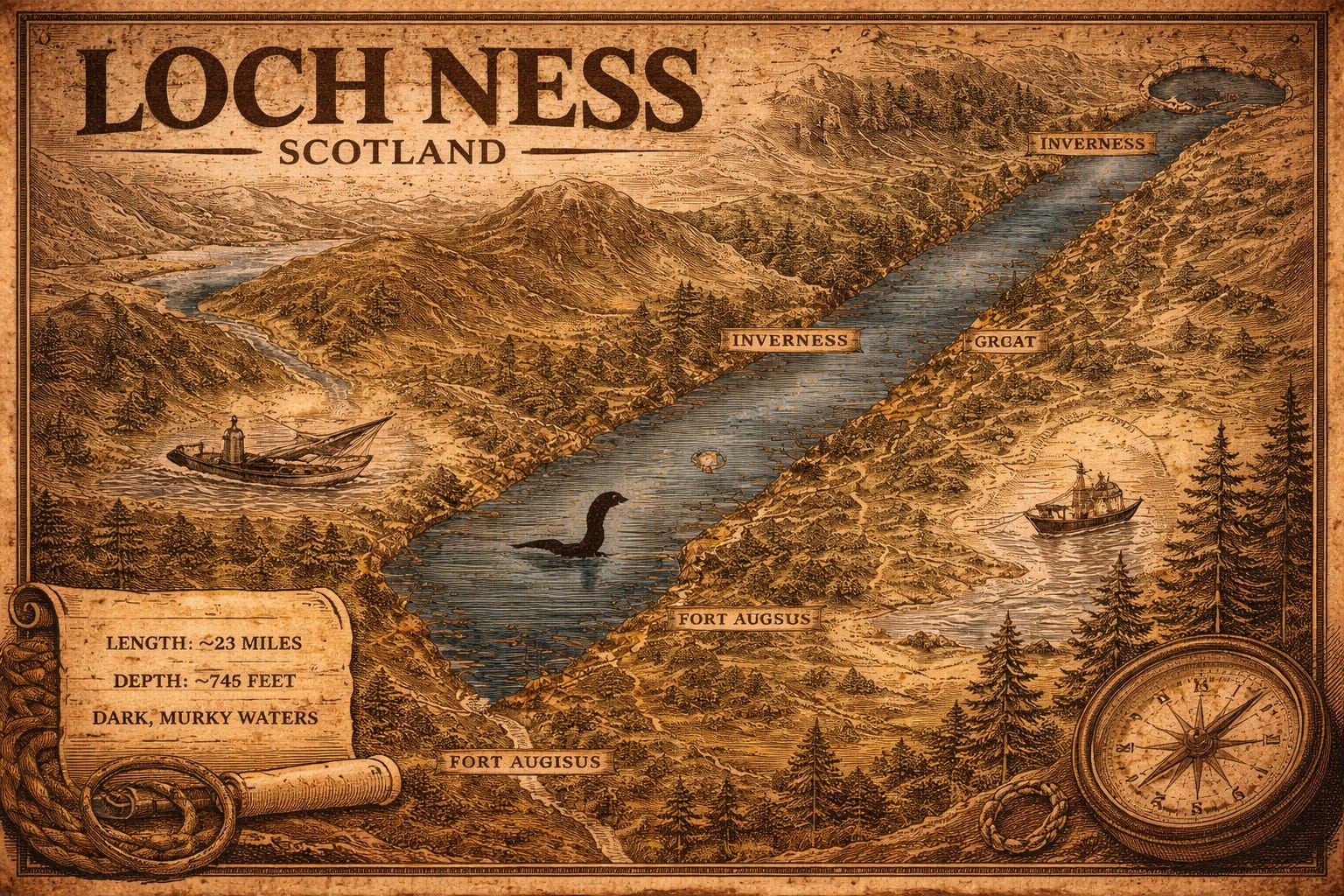
Loch Ness sits in the Scottish Highlands, running southwest to northeast along the Great Glen fault. It was carved by glaciers and is connected to the sea via the River Ness and the Caledonian Canal. Its depth is remarkable for a freshwater body in Scotland, reaching 230 meters in places, with an average depth of around 132 meters.
The water is cold and peaty dark. Visibility underwater is measured in feet rather than meters. Any systematic search of the loch faces a fundamental practical challenge: the combination of depth, peat turbidity, and sheer volume makes comprehensive underwater observation effectively impossible with any technology currently available for sustained deployment.
This is important to hold in mind. The absence of a confirmed specimen from Loch Ness does not mean the loch has been searched. It means the loch has been sampled. Extensively, creatively, with increasingly sophisticated technology, but sampled. The difference matters.
The Modern Sightings Begin
The modern legend begins on April 15, 1933, when Aldie Mackay and her husband were driving along the newly completed A82 road that for the first time provided an unobstructed view of much of the loch’s northern shore. Mackay looked out at the water and saw something.
She described it years later to marine biologist Adrian Shine, founder of the Loch Ness Project, as black, wet, with water rolling off it. It went in a circle, round and down. She yelled at her husband who was driving: Stop. The beast.
The Inverness Courier published the account on May 2, 1933. The editor chose the word monster. London newspapers sent correspondents north. The international media arrived. The tourism industry followed.
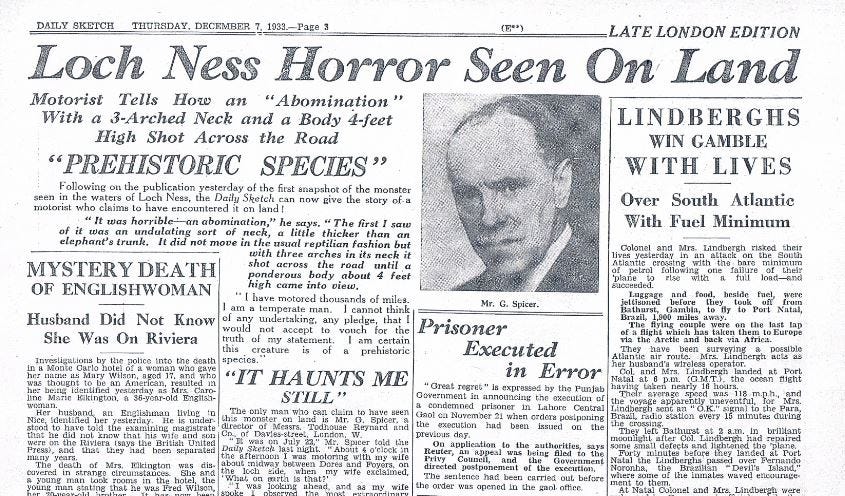
Within months, sightings were multiplying. In August 1933, George Spicer and his wife described a large creature with a long wavy narrow neck crossing the road in front of their car and disappearing into the loch. A motorcyclist in early 1934 described a prehistoric marine creature with four large fins and a long neck.
The pattern that would define the next ninety years of Nessie observation was established almost immediately: the road giving people unobstructed views of the water, the description centering on a large dark body and a long neck, the official response of skepticism, and the continuing flow of accounts that skepticism did not stop.
The Photographs and Their Fates
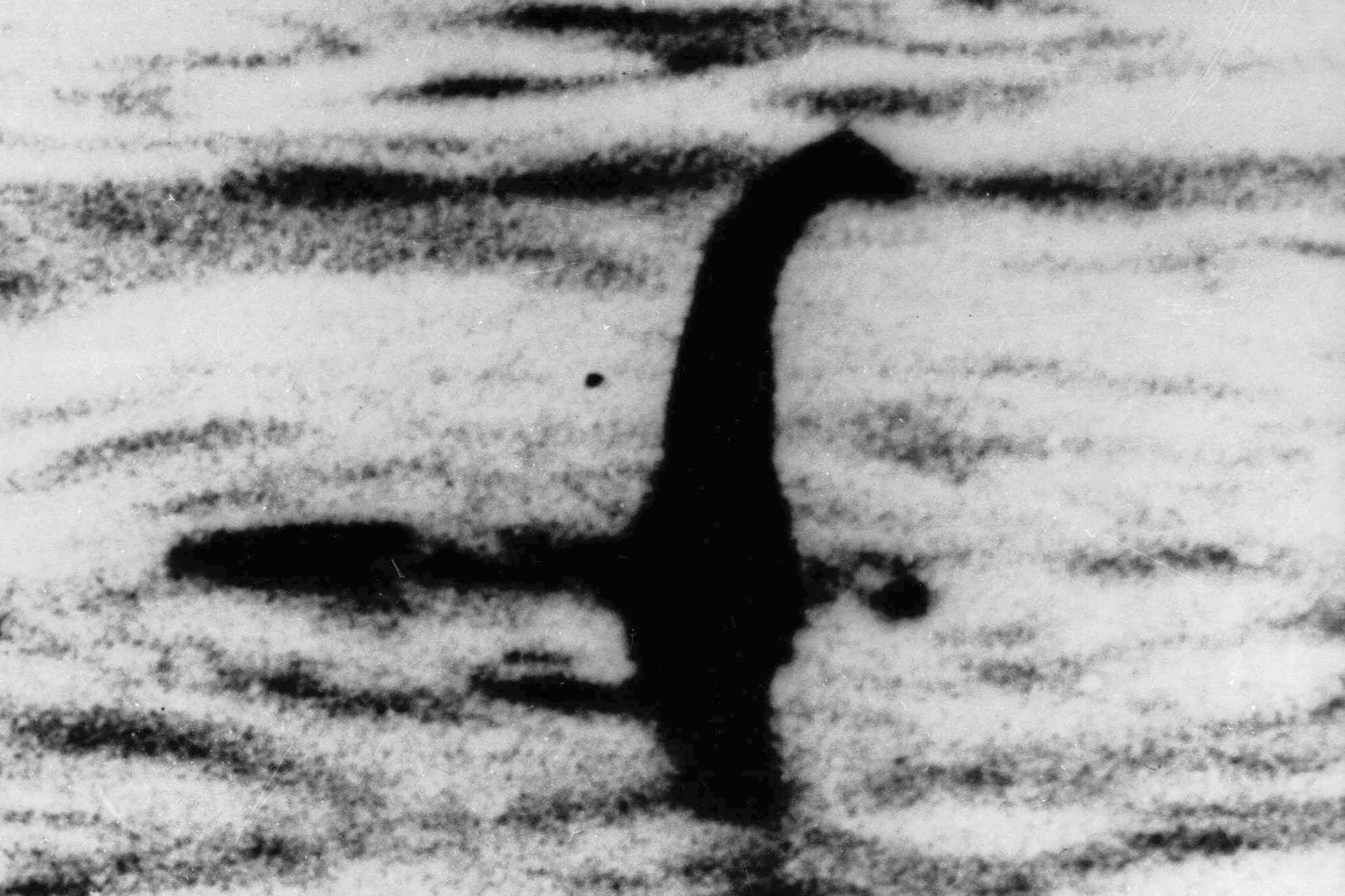
The photographic record of the Loch Ness Monster is, when examined honestly, a record of disasters.
The first photograph, taken by Hugh Gray in November 1933, shows an indistinct shape in the water that has been variously interpreted as a large animal, a dog carrying a stick, an otter, and a swan. It has never been definitively identified and has never been definitively debunked. It sits in the record as unresolved.
The most famous photograph is the one known as the Surgeon’s Photograph. Published in the Daily Mail in April 1934, it showed a long dark neck rising from the surface of the loch with a small head at its tip. It was attributed to a London gynecologist named Robert Kenneth Wilson, whose professional respectability lent the image enormous credibility. For sixty years it was the central image of the Loch Ness Monster in the public imagination.
In 1994, Christian Spurling, a sculptor and the stepson of the big-game hunter Marmaduke Wetherell, confessed before his death to having created the fake. Wetherell had been hired by the Daily Mail in 1933 to find evidence of the monster. He had claimed to discover enormous footprints near the loch’s shore, which were then exposed by Natural History Museum researchers as having been made with a dried hippopotamus foot of the kind commonly used as umbrella stands. Humiliated, Wetherell had hatched a plan of revenge. With Spurling’s help he constructed a small model head and neck from plastic wood, attached it to a toy submarine purchased at Woolworths, photographed it in the loch, and then arranged for the image to be attributed to Wilson, whose credibility would make the photograph convincing.
The hoax worked for sixty years. The best-known image of the Loch Ness Monster was a fourteen-inch toy submarine with a sculpted head glued to it.
This revelation is damaging in the obvious way. The image that defined the creature in the public imagination for six decades was fabricated. Every person who believed in Nessie because of that photograph was believing in a toy.
But the revelation is also clarifying in a way that is easy to miss. The Surgeon’s Photograph was a hoax motivated by revenge against the Daily Mail, not by a desire to manufacture evidence of a monster. Wetherell’s fabrication did not create the legend. It amplified one that already existed. And when the photograph was exposed, the sightings continued. The underlying phenomenon, whatever it was or was not, did not depend on Wilson’s photograph.
The film record is somewhat more resilient. Tim Dinsdale, a British aeronautical engineer, filmed what he believed to be a large animate object moving across the loch on April 23, 1960. The film, analyzed by the Joint Air Reconnaissance Intelligence Centre in 1966, was assessed as probably animate. Digital enhancement in 1993 revealed a shadow in the negative suggesting a submerged body beneath the visible surface object. Skeptics have argued the film shows a boat. Supporters point to the wake pattern and movement characteristics as inconsistent with a conventional vessel.
The Dinsdale film has not been definitively resolved. Unlike the Surgeon’s Photograph, it has no known confession attached to it.
The Sonar
The sonar record is where the case for something in Loch Ness becomes genuinely difficult to dismiss.
It begins in December 1954, when the fishing vessel Rival III tracked a large object 146 meters down for approximately 800 meters. The contact followed the vessel. Whatever it was, it moved with the boat.
In 1972, a research expedition led by Robert Rines of the Academy of Applied Science combined side-scan sonar with underwater photography. The system produced a simultaneous sonar contact and photograph of what appeared to be a large flipper-like structure. The photograph, taken by strobe light in the dark peaty water, was analyzed by scientists at the Jet Propulsion Laboratory at the California Institute of Technology, who found no evidence of fraud. Harold Edgerton, the MIT scientist who invented strobe photography and side-scan sonar, examined the results and found them significant. Sir Peter Scott, one of Britain’s most respected naturalists, examined them and concluded they showed evidence of a large unknown animal.
Operation Deepscan in 1987 was the most ambitious systematic search of the loch. Twenty-four boats equipped with Laurence X-16 sonar units swept the length of the loch in a coordinated line, capable of detecting objects as small as 30 centimeters. The operation registered three unexplained underwater targets at depths between 78 and 180 meters. The strongest contact lasted 140 seconds. The sonar expert leading the operation, Darrell Laurence, described the signals as coming from something larger than a shark but smaller than a whale.
Three unexplained contacts in a comprehensive sonar sweep of a known lake, from something whose biological characteristics were consistent with a large organism.
More recently, the tour vessel Spirit of Loch Ness, equipped with state-of-the-art sonar, has made several large contacts near the bottom of the loch in the vicinity of Invermoriston, where the water reaches approximately 189 meters. One contact registered at approximately ten meters in length, 500 feet below the surface. The skipper, Ronald Mackenzie, a man with thirty years of experience on the loch who by all accounts does not seek publicity, described the contact as unlike anything he had seen in his professional career.
The sonar record is not conclusive. Sonar can produce false readings from thermoclines, schools of fish, underwater debris, and gas from decomposing organic matter on the loch bed. Each individual contact can be attributed to mundane causes.
What is harder to attribute to mundane causes is the consistency of the contacts across sixty years of sonar monitoring, their recurring characteristics in terms of depth and apparent size, and the fact that they continue to occur under conditions where the equipment is sophisticated enough that mundane objects should produce identifiable returns.
The official Loch Ness Monster Sightings Register records 1,162 sightings as of May 2025. The sonar contacts are a small subset of this record. They are its most technically grounded component.
The DNA and What It Found
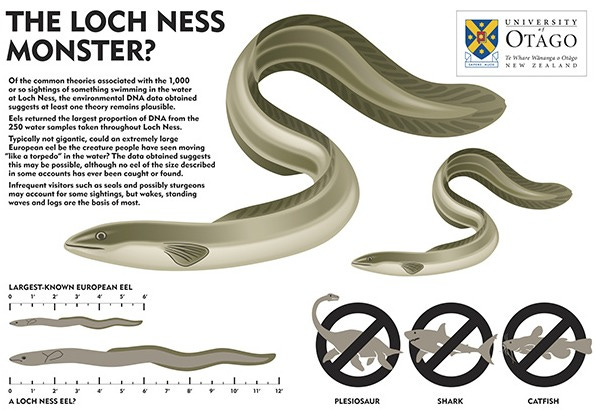
In 2018, a research team led by Professor Neil Gemmell of the University of Otago conducted an environmental DNA survey of Loch Ness. Environmental DNA analysis works by sampling water and identifying the genetic material shed by organisms living in it. Every living thing in the loch leaves traces of its DNA in the water. The technique can in principle detect any species present.
The results found no evidence of large reptiles, no plesiosaur sequences, no unknown large vertebrate of any kind. The scientific consensus from this study was that a large prehistoric reptile is not living in Loch Ness.
What the survey found in unexpectedly large quantities was eel DNA.
Professor Gemmell noted that he could not rule out the possibility of eels of extreme size, though none had been found or caught. He acknowledged that the large amount of eel DNA might simply reflect a very large population of ordinary-sized eels. He added, carefully: a lack of evidence is not necessarily evidence of absence.
The eel hypothesis is worth taking seriously. European eels are known to inhabit Loch Ness. They are long, dark, and can reach considerable size. A very large European eel, or an unknown species of large eel, could potentially account for some of the sightings of dark humped shapes moving through the water. It would not account for sightings of a long-necked creature, but it might account for a portion of the overall record.
It does not account for the sonar contacts showing objects ten meters in length at 170 meters depth.
The Lake’s Geometry and the Absence Problem
Loch Ness presents a version of the absence problem that is different from the one posed by Bigfoot.
With Bigfoot, the absence is of biological remains across a continent. With Loch Ness, the absence is of any organism of significant size in a contained and increasingly well-characterized water body.
Loch Ness has a functioning ecosystem. Arctic char have been found living at 220 meters depth. The food supply, while not abundant, is real. A very large predator would put stress on the ecosystem in ways that might be detectable, though ecological modeling of an unknown apex predator in a poorly understood system is speculative territory.
More importantly: large aquatic animals surface. They breathe, if they are air-breathing, or they appear at the surface for other behavioral reasons. Ninety years of cameras pointed at Loch Ness have not produced a clear photograph of a large unambiguous animal. Every image is indistinct, ambiguous, disputed.
The options here are: the animal, if it exists, is extraordinarily rare and elusive; the animal is primarily deep and rarely surfaces; the animal is something the existing biological categories do not quite accommodate; or there is no animal and the sonar contacts are all mundane.
None of these options is obviously correct.
What the Picts Saw
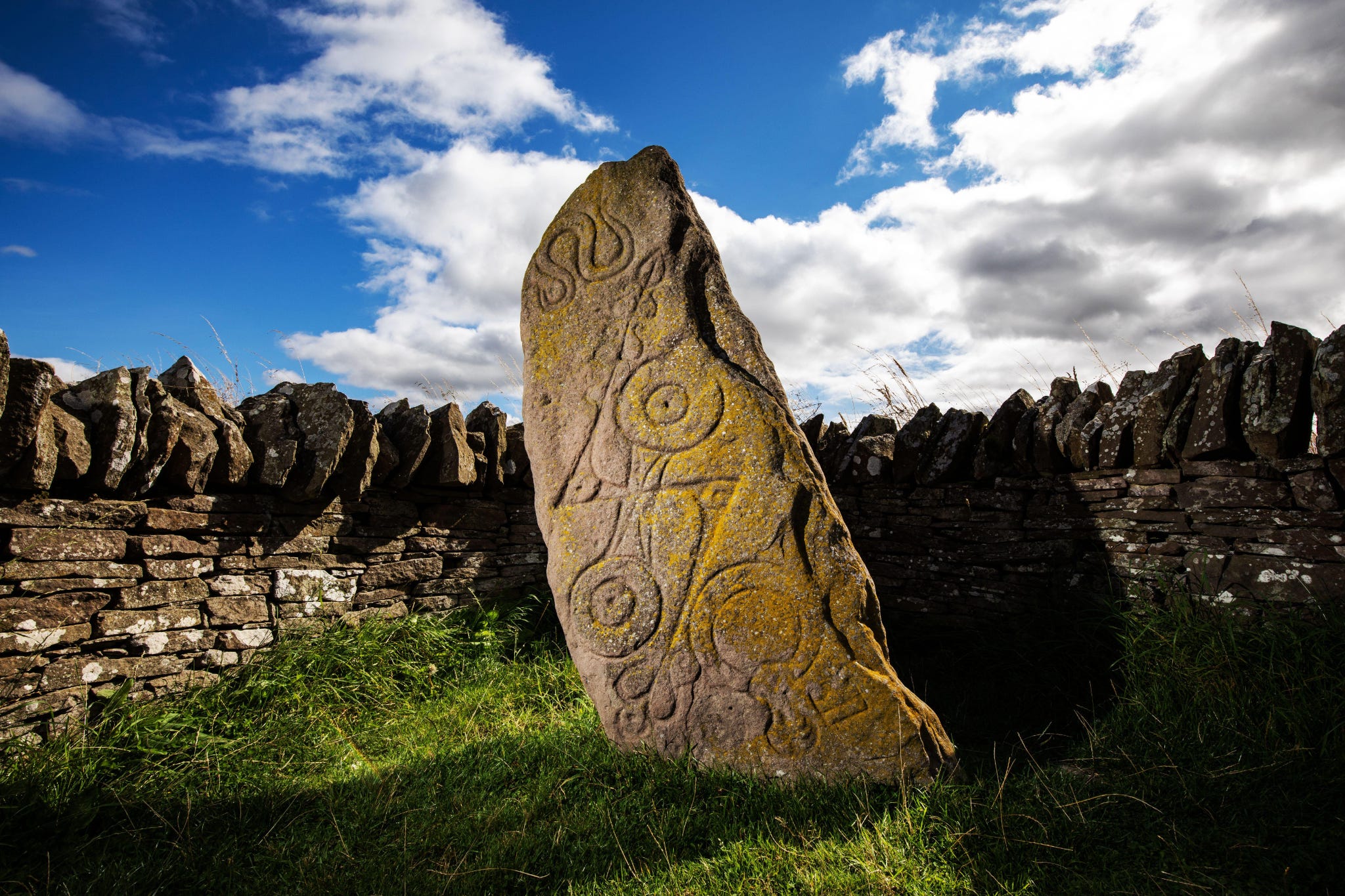
The modern legend begins in 1933. The observations do not.
The Picts, the indigenous people of northern Scotland in the early medieval period, carved stone monuments throughout the Highlands depicting the animals of their world with a naturalistic accuracy that archaeologists find impressive. Among these carvings is a mysterious creature, depicted consistently, that does not match any known Scottish animal. It has a long neck, a large body, and what appear to be flippers.
The earliest written account is from the seventh century biography of Saint Columba, which describes an encounter between the saint and a creature in the River Ness in 565 AD. Columba reportedly commanded the beast to withdraw, and it obeyed. Skeptics note that water-beast stories were common in medieval hagiographies and that the account may reflect a literary convention rather than a genuine sighting.
But the Pictish carvings predate the hagiographic tradition. And the Gaelic term for the creature, uilebheist, existed in the local oral tradition long before the 1933 newspaper articles that launched the modern legend.
Something was described in these waters before the cameras and the sonar. Whatever the Picts carved on their standing stones was consistent enough in its features to be depicted repeatedly with the same basic form.
Whether what they depicted and what the sonar has been tracking for sixty years are the same thing is not known.
What Remains
Strip away the Surgeon’s Photograph, which was a toy submarine. Strip away the ambiguous images that might be logs, otters, boat wakes, or birds. Strip away the sightings that cluster around tourist season and the economic incentives that create them.
What remains is this.
A loch that has been more thoroughly investigated than almost any other body of fresh water on earth, in which repeated sonar surveys across six decades have produced contacts consistent with large biological organisms at depth, which have not been explained by subsequent investigation, and which continue to occur.
A tradition of local observation going back before the Norman Conquest, documented in stone carvings and oral tradition, describing a large creature with a long neck in these waters before any modern media existed to shape what people expected to see.
A 2018 environmental DNA survey that found no large reptile but found extraordinary quantities of eel DNA, leaving open the possibility of something in the eel family at sizes unknown to science.
And an honest assessment by the people who have spent the most time on this loch, not the tourists, not the media, but the researchers with decades of professional engagement, that they cannot explain what the sonar has been registering.
Professor Gemmell’s phrase deserves to close this section and stay in the record: a lack of evidence is not necessarily evidence of absence.
Loch Ness is a lake. It has known dimensions. It has been mapped and sampled and searched.
And something keeps registering on the sonar at 170 meters depth.
What it is has not been established.
The loch is not saying.
This case is filed as SQR-CRP-002.
If you want to be notified when SQR-CRP-003 drops, and when the cases start talking to each other in ways that are difficult to explain, subscribe below.
That’s all this is. Careful attention. Sustained over time. Welcome to Side Quests of Reality.