
Case Study SQR-CRP-003: The Chupacabra, and what it was blamed for
SIDE QUESTS OF REALITY | SQR-CRP-003 | CHUPACABRA
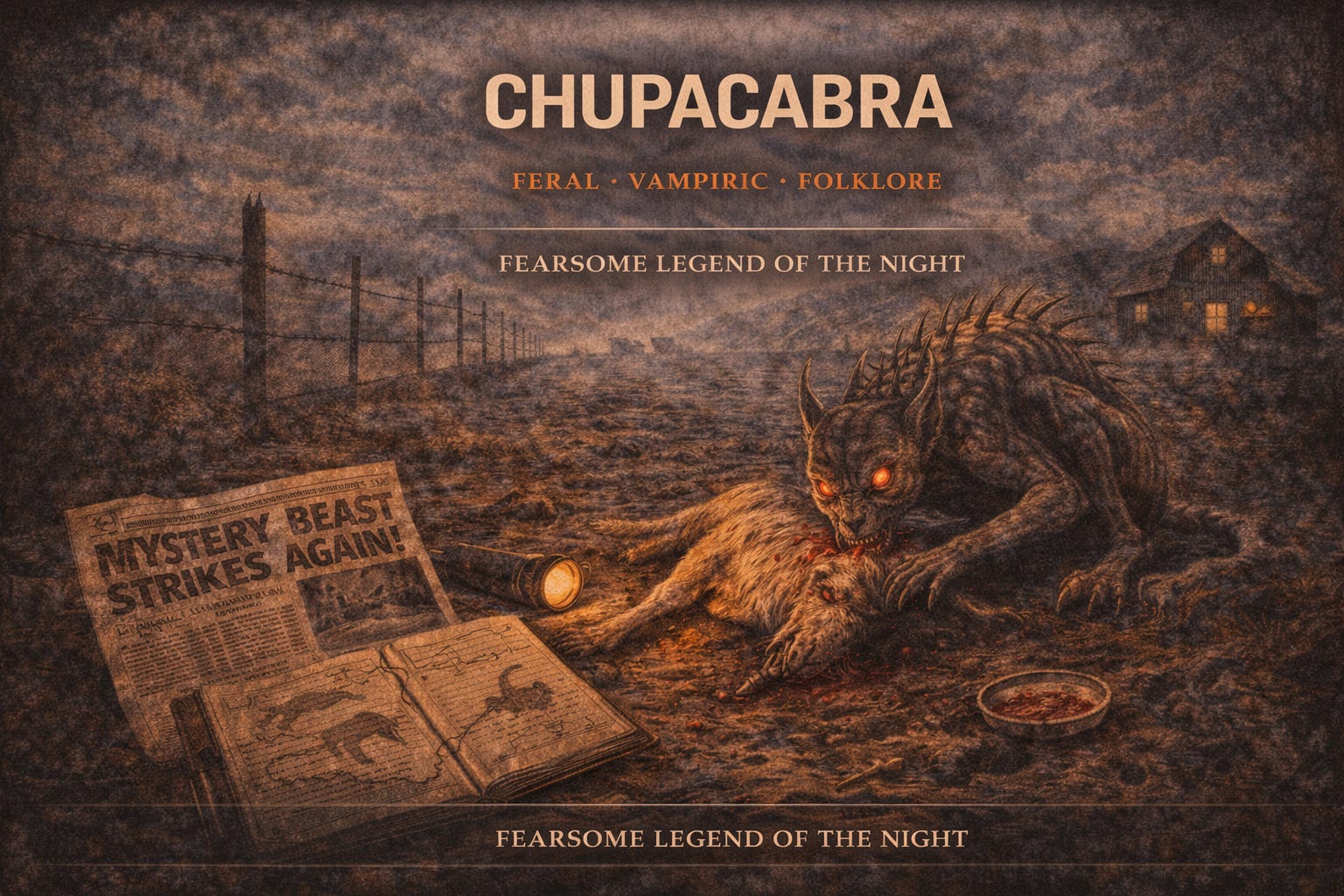
Most cryptids have no known birthday.
Bigfoot has been described for centuries. The Loch Ness Monster traces its modern form to 1933 but its local traditions to medieval Scotland and Pictish stone carvings. Whatever is being seen in those cases has been seen for long enough that no one can identify the moment the observation began.
The Chupacabra is different. It has a birthday, a birthplace, a name with a known author, and a primary eyewitness whose account has been traced to a specific film she watched one month before her sighting.
This makes it the most documented origin story in the cryptid record. It also makes it the most explained.
And yet.
The livestock deaths that preceded the creature’s description, and that gave the name its meaning, have not been cleanly explained.
These are two separate things. The creature and the deaths. This article will treat them separately, because conflating them is where most analysis of the Chupacabra goes wrong.
The Deaths
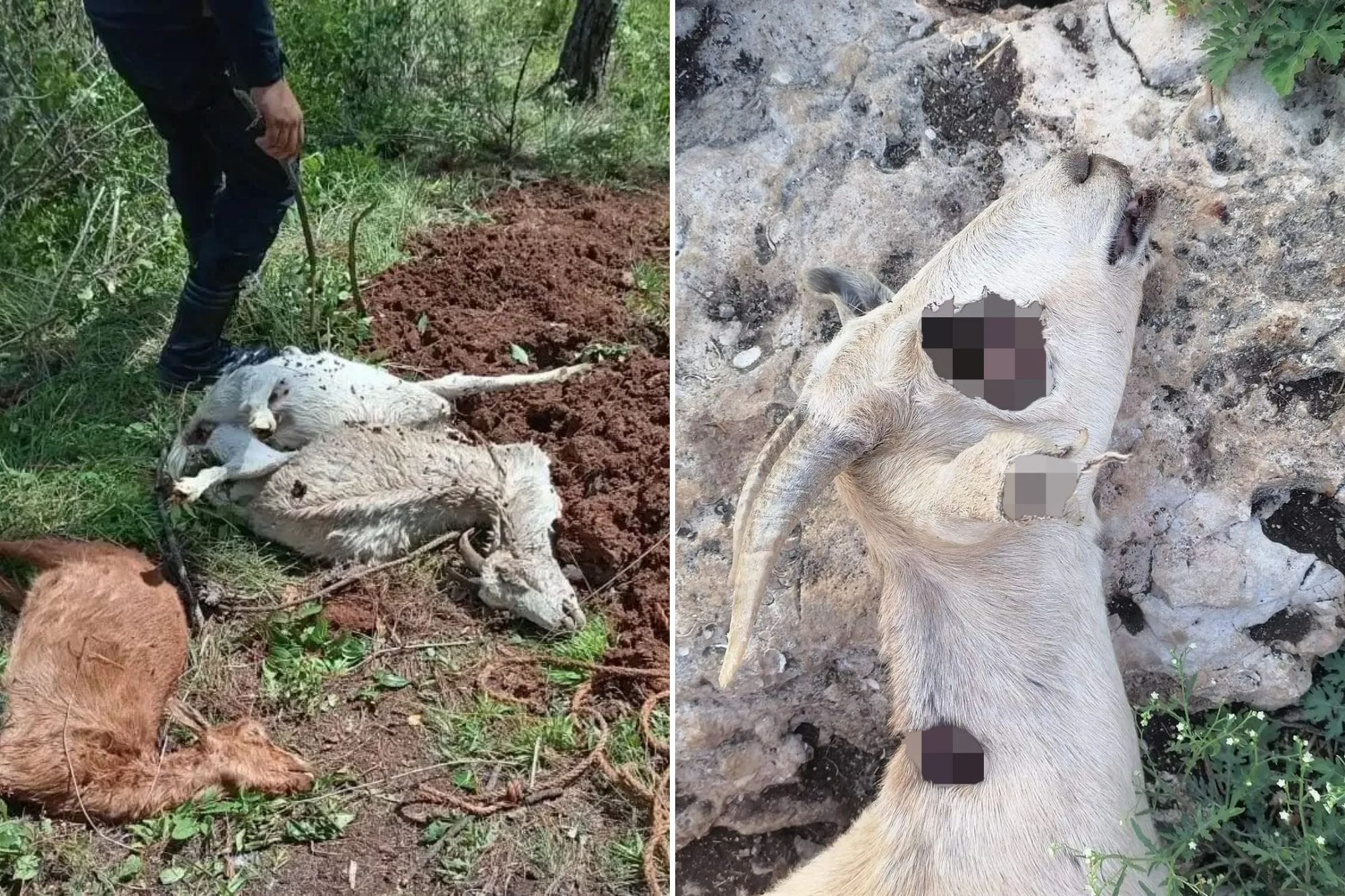
In March 1995, eight sheep were found dead in Puerto Rico. The animals had three puncture wounds in the chest. They appeared to have been drained of blood. No blood was found at the scene. The wounds were examined and could not be attributed with certainty to any known predator on the island.
Over the following months, similar deaths were reported across Puerto Rico. Goats, chickens, rabbits, and other livestock were found with identical or similar wounds. The pattern was consistent enough to generate serious alarm among farming communities. By the end of 1995, the killings had been attributed to over 150 animals in the Canóvanas area alone.
These deaths were real. Farmers lost real animals. The wounds were documented. The absence of blood at the scene was noted repeatedly.
The question of what caused them has not been definitively answered.
The leading veterinary explanation is that the deaths were caused by known predators, primarily stray dogs, mongooses, and other native animals, operating under conditions of environmental stress. Puerto Rico had experienced severe drought conditions in 1995, which can drive predators closer to human settlements and toward easier prey. University of Michigan biologist Barry O’Connor, among others, noted that weakened predators under nutritional stress sometimes kill without eating, producing carcasses with puncture wounds and minimal visible trauma that can be misread as bloodless.
The apparent blood drainage is also explained. When an animal dies and the carcass sits, blood pools in the lowest portions of the body through gravity and post-mortem processes. A carcass examined hours after death can appear bloodless in the chest and neck area even when blood is present in the body. This is standard forensic pathology, not a mystery.
Veterinary necropsies conducted in Puerto Rico in 1995 found no anomalies inconsistent with known predator attacks. The wounds, when examined, were consistent with canine bites. No evidence of surgical precision or unusual methodology was found.
This explanation is plausible. It may be correct. But it has a gap.
The accounts from farmers who found these animals describe wounds that struck trained agricultural workers as unlike what they had seen from dog attacks. Puerto Rican farmers who had lived with stray dogs and mongooses their entire lives were reporting something that did not match their experience of what those predators left behind. This is not proof of anything supernatural. But experienced agricultural observers describing wounds as unlike known predator attacks is a data point that the explanation from drought-stressed dogs does not entirely absorb.
The honest position on the deaths is: most likely known predators under unusual environmental stress, producing wounds that were misread through the lens of subsequent panic, but not fully accounted for to the satisfaction of everyone who observed them directly.
The Name

The creature got its name from a comedian.
In 1995, Puerto Rican comedian and radio personality was commenting on the livestock killings during a broadcast. He coined the term chupacabra, from chupar meaning to suck and cabra meaning goat. Goat-sucker.
The name was catchy. It spread. It appeared on the popular Spanish-language television program El Show de Cristina, which functioned as the Spanish-speaking world’s equivalent of a major daytime talk show. Within weeks the name had moved from a radio joke to an international headline.
The name preceded the creature description. There was no visual account of a bipedal alien-like entity when Pérez coined the term. There were livestock deaths. The name described what the unknown killer was doing, not what it looked like. The creature that would come to be associated with the name emerged afterward.
This sequence matters. The name created an expectation, and the expectation shaped what came next.
The Creature
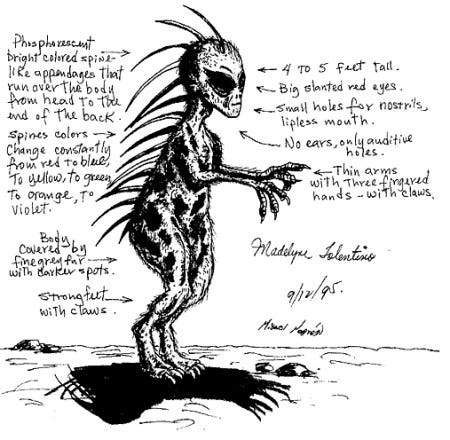
In August 1995, approximately one month after the livestock deaths began generating headlines, a woman named Madelyne Tolentino reported seeing a creature outside her mother’s house in Canóvanas.
She described it in detail. Bipedal, roughly four feet tall. Dark elongated eyes running up toward its temples, damp and protruding. Arms drawn back in what she described as an attack position. Three long skinny fingers on each hand. Three toes. A slash of a mouth. Two small holes for a nose. Short hair close to its body. And along its lower back, flat protrusions she initially described as feathers but later said moved like spines.
A local UFO enthusiast drew the creature based on her description. The drawing circulated. It became the defining image of the Chupacabra. Every subsequent sighting, every piece of media coverage, every artist’s rendering derived from what Tolentino described and what the drawing rendered.
Benjamin Radford, a scientific paranormal investigator and research fellow at the Committee for Skeptical Inquiry, spent five years investigating the Chupacabra’s origins. He tracked down Tolentino, who had almost never been interviewed since her 1995 account, and spoke with her directly.
What Radford found is the central fact of the Chupacabra case.
The film Species was released in Puerto Rican theaters on July 7, 1995. One month before Tolentino’s sighting. The film’s creature, designed by Swiss artist H.R. Giger, who had also designed the xenomorph in Alien, was named Sil. Sil was bipedal, alien-featured, with large dark eyes, a reptilian body, and spines along its back.
The resemblance between Tolentino’s description and Sil is not approximate. It is, as Radford documented point by point, nearly exact. The eye shape, the bipedal stance with arms drawn back, the spines, the proportions, the number of fingers and toes. Detail for detail, the creature Tolentino described matches the H.R. Giger design for a 1995 science fiction horror film.
Tolentino had seen the film. She confirmed this. She also confirmed something more revealing: she told Radford that she believed the creatures and events she saw in Species were happening in reality in Puerto Rico at the time.
Radford’s conclusion was direct. The most important Chupacabra description cannot be trusted.
Tolentino was not lying. She was not attempting to deceive anyone. She appears to have genuinely seen or believed she saw something, and when she described it, the most available template for a frightening bipedal alien-like creature was the one she had seen on screen a month earlier. Her description, produced in good faith, was shaped by a film in a way she herself may not have fully recognized.
This is not a minor problem for the Chupacabra as a cryptid. It is the foundational problem. Every subsequent sighting, every artist’s rendering, every description that followed Tolentino’s account derived from a description that Radford’s investigation showed was contaminated at the source by a specific film.
The creature as described does not have a credible independent eyewitness account. It has Tolentino’s account, which traces to Species, and everything built on top of it.
The Two Chupacabras
Something important happened to the Chupacabra between 1995 and the mid-2000s.
It changed shape entirely.
The original Puerto Rican creature was bipedal, reptilian, alien-like, with spines and large dark eyes. No physical specimen of this creature has ever been recovered, examined, or confirmed.
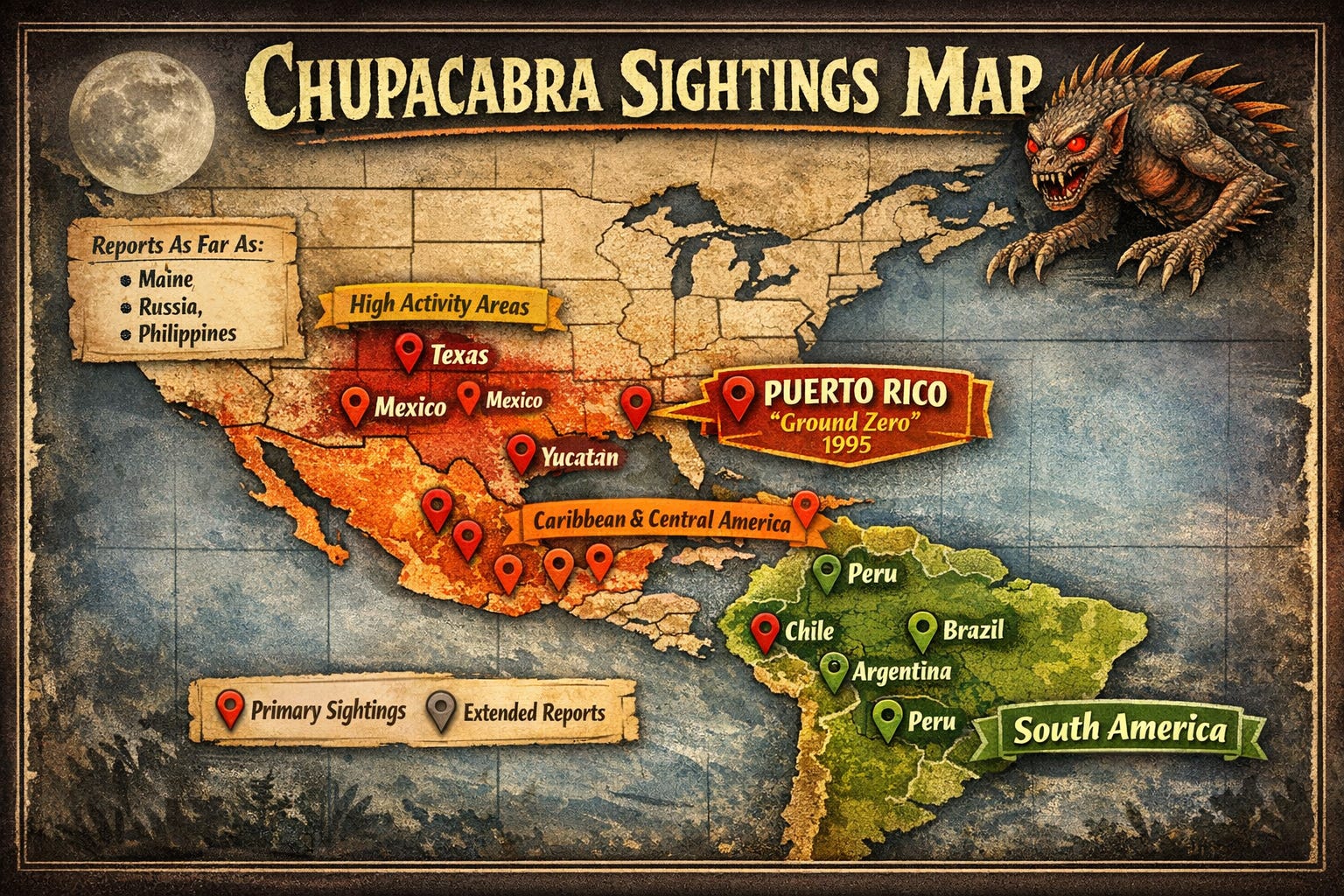
By the early 2000s, as reports moved north through Mexico and into Texas and the American Southwest, the description shifted. The Chupacabra became quadrupedal, hairless, dog-like, with a pronounced spinal ridge and an emaciated appearance. This version was very different from the Puerto Rican original, but it shared the name and the blood-drinking mythology.
The quadrupedal version has been caught. Repeatedly. In Texas, in Mexico, in multiple states across the American Southwest. Photographs were taken. Carcasses were recovered. DNA was extracted.
Every single one tested positive for coyote, domestic dog, or raccoon with severe sarcoptic mange.
Sarcoptic mange, caused by the mite Sarcoptes scabiei, produces dramatic physical changes in affected animals. It causes complete hair loss, skin thickening and darkening, a skeletal emaciated appearance, and behavior changes including increased aggression and desperation that can drive animals to attack livestock. A mangy coyote in daylight looks disturbing. A mangy coyote at dusk looks like something that has no name in any normal taxonomy.
This is not speculation. Texas A&M AgriLife researchers collected and analyzed tissue samples from multiple alleged Chupacabra specimens. The results were consistent across all samples: known canids with mange. The 2007 Cuero, Texas specimen, which generated enormous media attention when rancher Phyllis Canion found it and preserved the carcass, was tested at the University of California Davis Veterinary Genetics Laboratory. It was a coyote, possibly with some domestic dog ancestry. The hairlessness was mange.
The North American Chupacabra is a mangy coyote. This is not contested by anyone who has examined the physical evidence.
What This Leaves

Strip away Tolentino’s description, which traces to Species. Strip away the North American carcasses, which are mangy coyotes and dogs. Strip away the secondary sightings, which derived from Tolentino’s contaminated template and cannot stand independently.
What remains is the livestock deaths.
The animals found dead in Puerto Rico in 1995, with puncture wounds and apparent blood drainage, before anyone had described a creature, before Silverio Pérez had coined the name, before Tolentino had seen anything through her window.
Those deaths have a probable explanation. Drought-stressed predators, post-mortem blood pooling creating the appearance of drainage, wounds consistent on examination with known animals. The explanation is plausible and may be entirely correct.
But the farmers who found those animals were not credulous people new to livestock death. They were agricultural workers who had spent their lives around animals and predators and knew what dog attacks looked like. Their insistence that what they were finding was different is a data point the probable explanation does not fully account for.
It is a thin residue. Thinner than what remains in the Bigfoot or Nessie cases. The livestock deaths of 1995 Puerto Rico, examined carefully, are probably explicable by known predators under unusual environmental conditions. Probably.
The Chupacabra as a creature, the bipedal spined alien thing that walked out of Madelyne Tolentino’s description and into global mythology, is almost certainly a film character. Radford’s five-year investigation is the most thorough examination this case has received, and his conclusion stands up to scrutiny. The description that launched a thousand sightings was shaped by H.R. Giger’s design for a 1995 science fiction film.
The name came from a comedian. The creature came from a movie. The carcasses are coyotes.
But something was killing the animals.
And what that was, examined without the mythology attached to it, is a smaller and more boring question than the Chupacabra became. Drought. Predators. Post-mortem decomposition. These are not the stuff of legend.
The legend filled the space that the boring explanation left. As it does. As it always does.
This case is the clearest example in this series of how a real phenomenon, unexplained livestock deaths, can acquire a fictional creature to explain it, and how that fictional creature, once named and drawn and broadcast on television, becomes more real in the cultural record than anything that actually happened in the fields of Puerto Rico in the spring of 1995.
The animal deaths were real.
The goat-sucker was a movie.
This case is filed as SQR-CRP-003.
If you want to be notified when SQR-CRP-004 drops, and when the cases start talking to each other in ways that are difficult to explain, subscribe below.
That’s all this is. Careful attention. Sustained over time. Welcome to Side Quests of Reality.