
Case Study SQR-UFO-009: The Varginha Incident
SIDE QUESTS OF REALITY | SQR-UFO-009 | THE VARGINHA INCIDENT
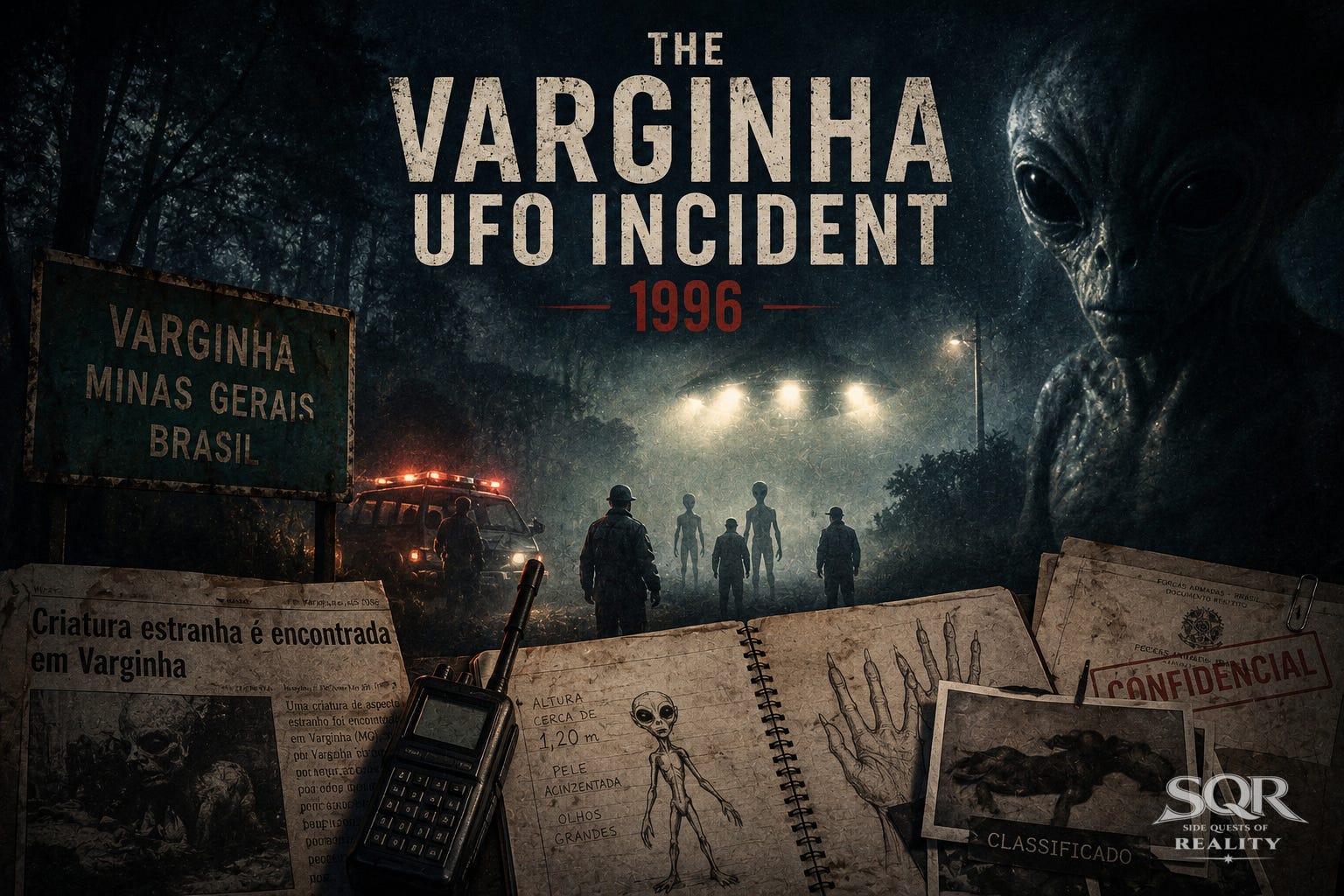
At approximately 3:30 in the afternoon on January 20, 1996, three young women cutting through a vacant lot in the Brazilian city of Varginha came face to face with something crouching against a wall that none of them had a category for.
They ran. They told their mother it was o diabo. The devil.
It was not the devil. What it was has not been officially established in the thirty years since. What happened next involves military trucks flooding the streets of a small Brazilian city, the capture and hospitalization of at least one nonhuman being, the death of a young soldier under circumstances that remain unexplained, classified medical records, a neurosurgeon who spent three decades deciding whether to talk, a briefcase of money offered to teenage witnesses in exchange for their silence, and testimony that in January 2026 was delivered in person to members of the United States Congress.
This is Brazil’s Roswell. It is considerably stranger than that comparison suggests.
The Setting
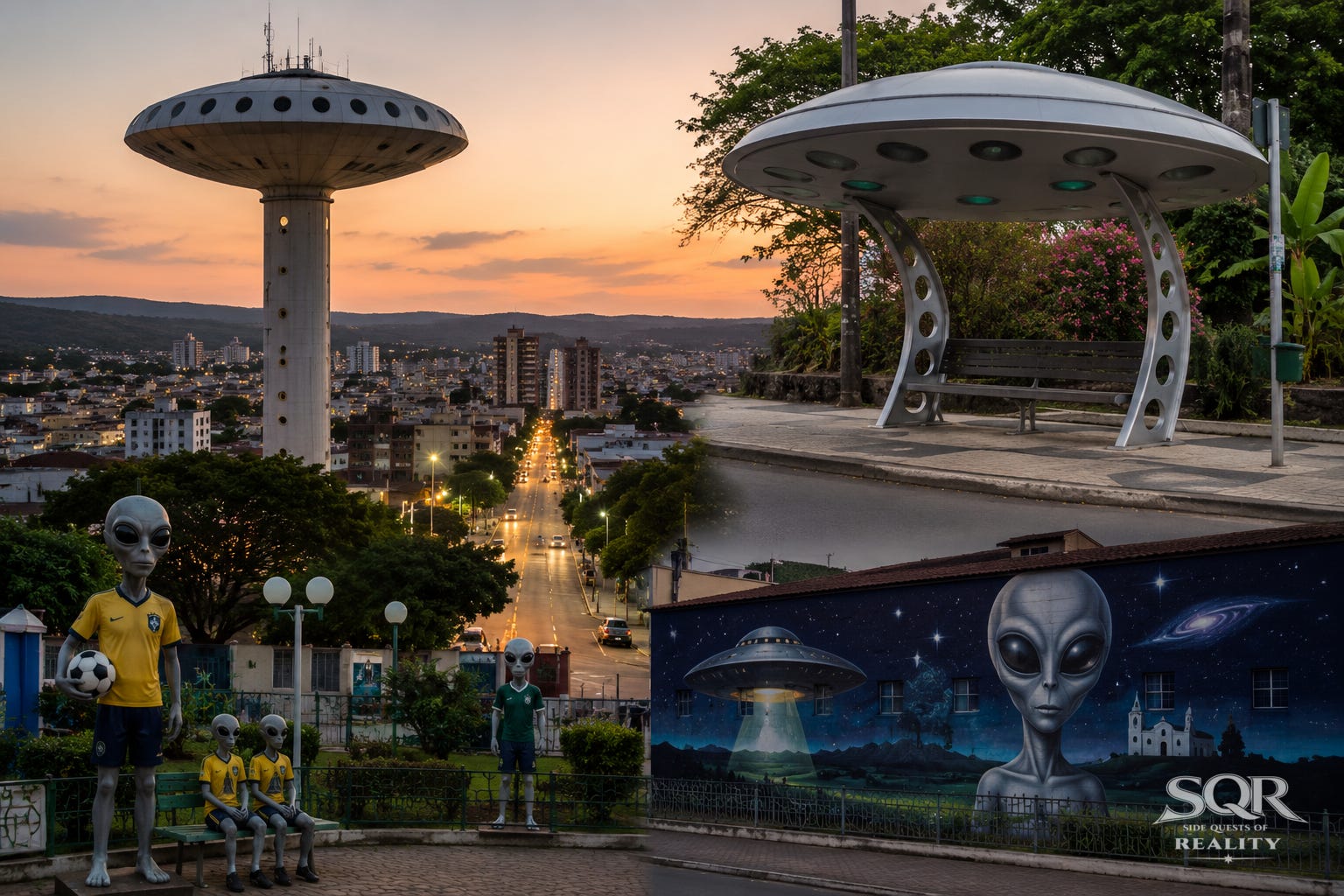
Varginha is a city of roughly 100,000 people in the landlocked state of Minas Gerais in southeastern Brazil, known primarily for coffee production and for being, as of January 1996, entirely unremarkable. The state has a long history of anomalous reports, but Varginha itself had no particular reputation before the events that would transform it permanently.
What the city has now is bus stops shaped like spacecraft, a 20-metre water tower with a disc-shaped reservoir called the Nave Espacial de Varginha, grey alien dolls in football uniforms, and a tourism industry built entirely on what a small group of witnesses claim they saw over the course of one week in January 1996.
Whether that tourism industry is built on something real is the question this case has been asking for thirty years.
January 13: The First Witness
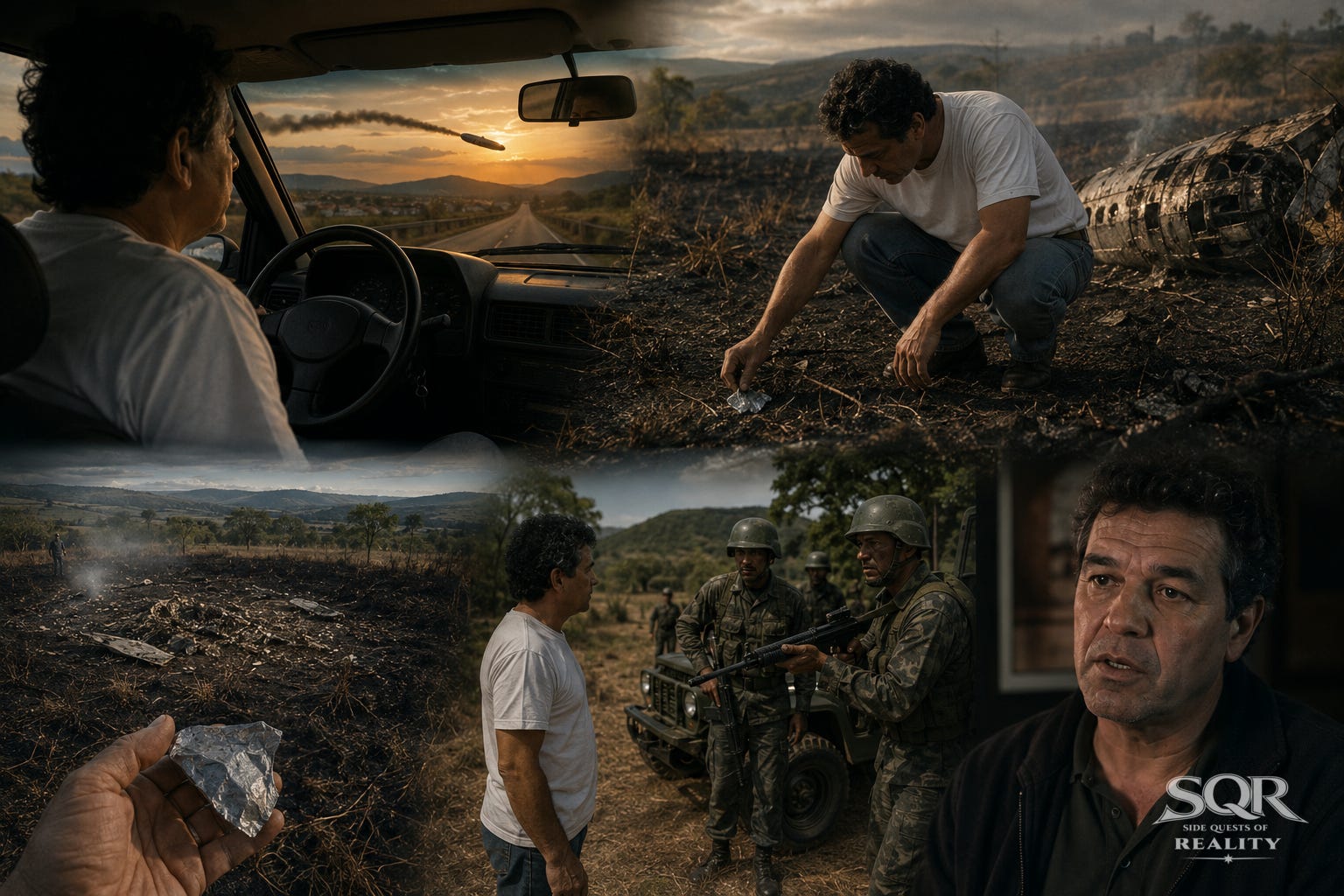
The incident did not begin on January 20. It began a week earlier, on January 13, when Carlos de Sousa, a geography teacher and ultralight pilot, was driving from São Paulo to Minas Gerais. During his journey he observed a cigar-shaped object trailing smoke, losing altitude, and eventually crashing into a field.
De Sousa pulled over and approached the site. He found burned grass in a roughly 40-metre diameter around the impact point. The craft, he said, was approximately the size of a school bus, and there was debris scattered around it. The area smelled strongly of ammonia. He picked up a piece of debris that felt like aluminum foil but returned to its original shape when dropped.
Then the military arrived from the opposite direction and ordered him to leave at gunpoint.
De Sousa gave one brief statement to a UFO researcher in the late 1990s and then effectively disappeared for twenty-six years. When filmmaker James Fox finally located him for the 2022 documentary Moment of Contact, the search had taken nearly two years. De Sousa described the events of January 1996 as a scene from a movie that plays in his head all the time.
January 20: The Three Women
The encounter that defined the case happened one week later, at around 3:30 in the afternoon.
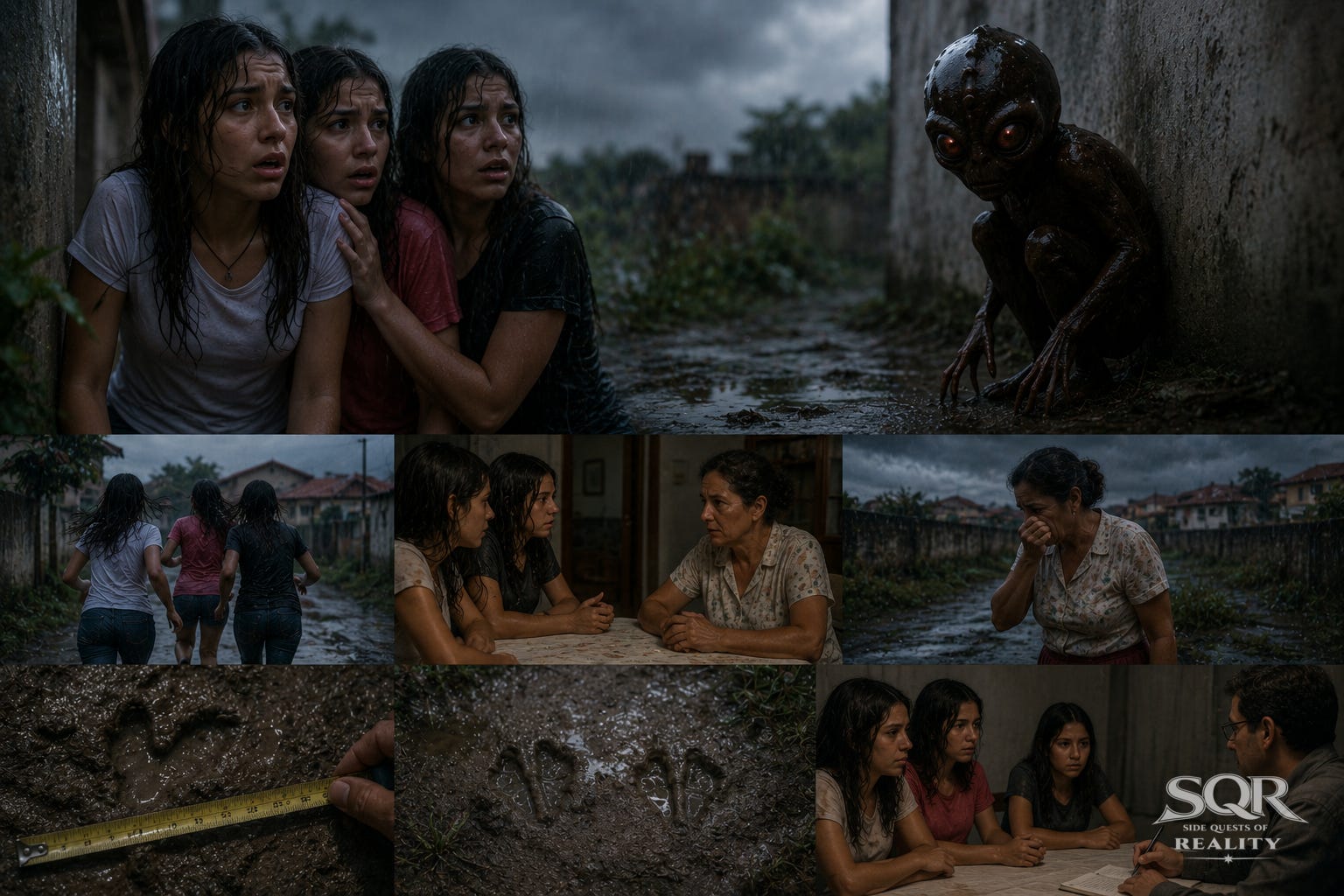
Liliane Silva, 16, her sister Valquíria Fátima Silva, 14, and their friend Kátia Andrade Xavier, 21, were taking a shortcut home through a vacant lot during heavy rain. About fifty feet away, crouched against a wall, they saw something.
What they described has remained consistent across nearly three decades of interviews: a creature approximately four to five feet tall, with a disproportionately large head, dark brown oily skin, large red glowing eyes, three protuberances on the top of its skull, and small hands with three extremely long fingers. It was crouched, appeared unsteady, and seemed as frightened of them as they were of it.
The smell hit them before they fully registered what they were seeing. A strong ammonia odor, thick enough to be physical.
They ran home and told their mother, Luiza, they had seen the devil. Luiza did not believe them. Then she went to the vacant lot and experienced the odor herself. She found unusual footprints at the location. She believed them.
What Luiza and the investigators who later interviewed the family documented was not the behavior of witnesses embellishing a story. The girls were distressed, consistent, and reluctant. Their accounts did not grow more dramatic over time. They grew more detailed, and the details did not change.
The Military Response
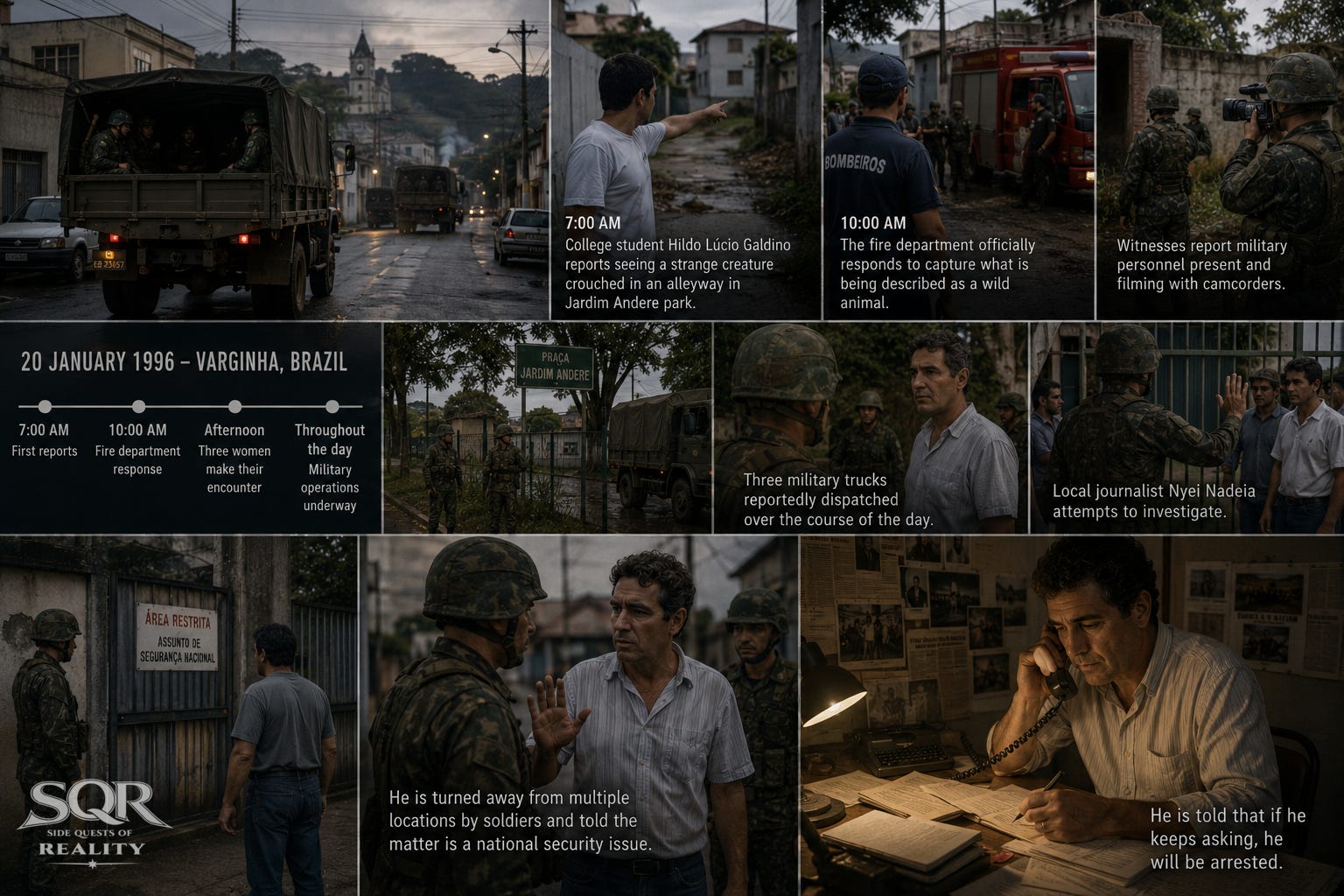
By the morning of January 20, before the three women made their afternoon encounter, the streets of Varginha were already filling with military vehicles.
At around 7:00 in the morning, the fire department received the first calls about a strange animal in Jardim Andere park. College student Hildo Lúcio Galdino reported seeing a creature with oily dark brown skin crouched in an alleyway. By 10:00 in the morning, the fire department had officially responded to capture what was being described as a wild animal, with witnesses reporting military personnel present and filming with camcorders.
This is the timeline that matters. Military operations were already underway hours before the three women walked through that vacant lot in the afternoon. Whatever was being collected in Varginha that day, the military knew about it before the civilians did.
Three military trucks were reportedly dispatched over the course of the day. Local journalist Nyei Nadeia, who learned of the events and attempted to investigate, was turned away from multiple locations by soldiers and told the matter was a national security issue. He was told that if he kept asking, he would be arrested.
Marco Chereze
This is the part of the Varginha case that resists the most convenient explanations.
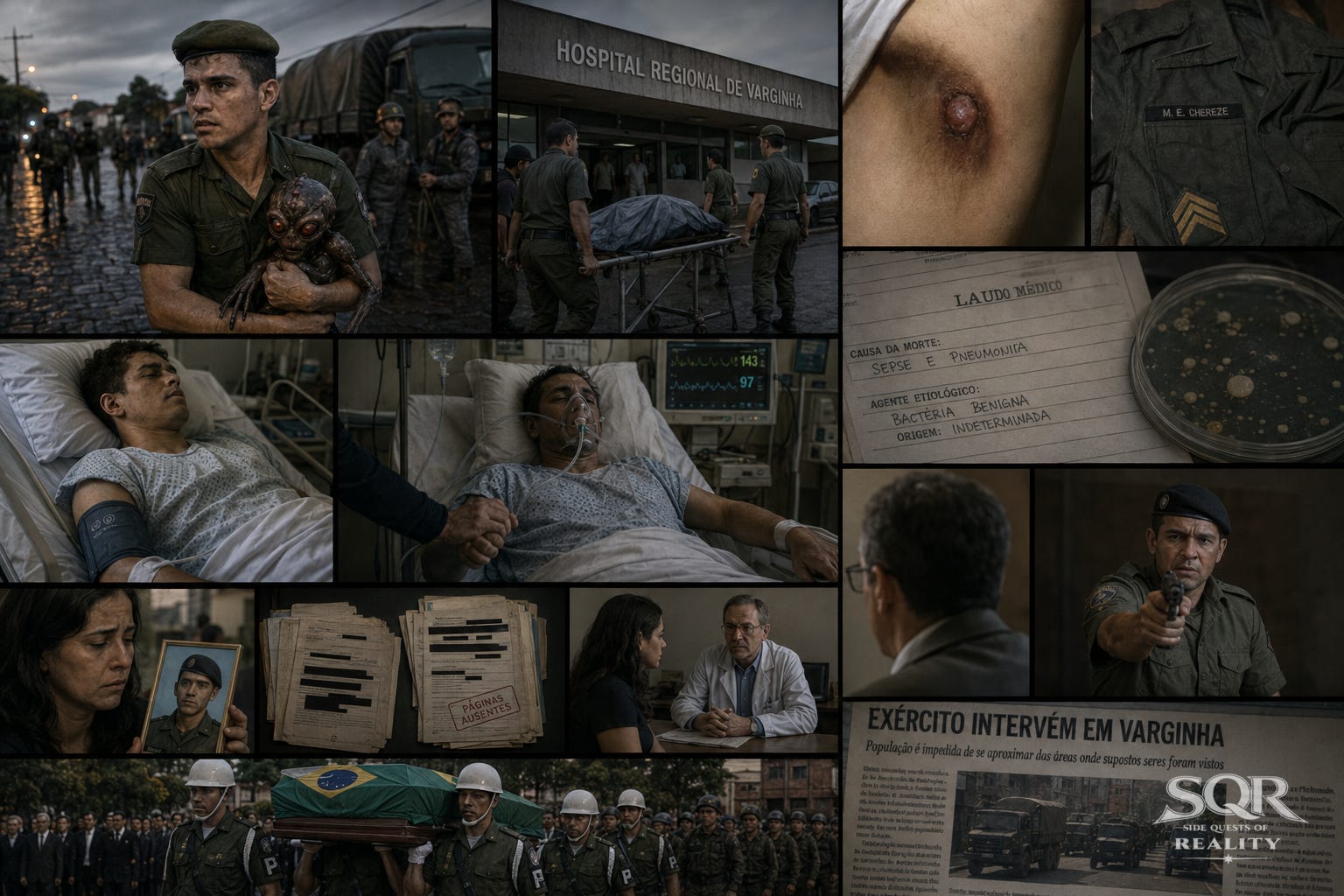
At around 5:30 in the afternoon of January 20, Military Police Corporal Marco Eli Chereze, 23 years old, allegedly captured one of the creatures with his bare hands and transported it to Varginha’s Regional Hospital.
What followed was documented by his family, his widow, and the doctors who treated him. Chereze developed a small abscess under his armpit that required surgical removal. His clothes retained a persistent odor. His body became, in the words of witnesses, greasy and sticky. He was hospitalized on February 12 with high fever and severe pain. On February 15, less than five hours after being transferred to intensive care, he died.
The official cause of death was sepsis and pneumonia, caused by what doctors described as a benign bacterium whose source was never determined. The bacterium was described by medical personnel as highly virulent and resistant to multiple drug treatments. Samples were sent for analysis. The results have not been made public.
His widow, Valeria, was denied complete medical records. Pages were missing from the documents she received.
According to accounts documented by investigators, Chereze allegedly confessed on his deathbed to a doctor that he had participated in capturing an extraterrestrial being. Corporal Eric Lopes, identified as the last surviving member of the squad involved in the operation, was approached by investigators years later. He pulled a gun and said he did not know anything.
A healthy 23-year-old soldier, with no prior illness, died of an unidentified bacterium 26 days after allegedly handling something that had never been classified. The source of the infection was never found. The records are incomplete. The other witness is still armed and still silent.
The Doctor
For nearly thirty years, Dr. Italo Venturelli said nothing publicly about what he saw in Varginha’s Regional Hospital on January 20, 1996.
He broke his silence after suffering a near-fatal heart attack. The decision to speak, he said, came from the awareness that he might not have another opportunity.
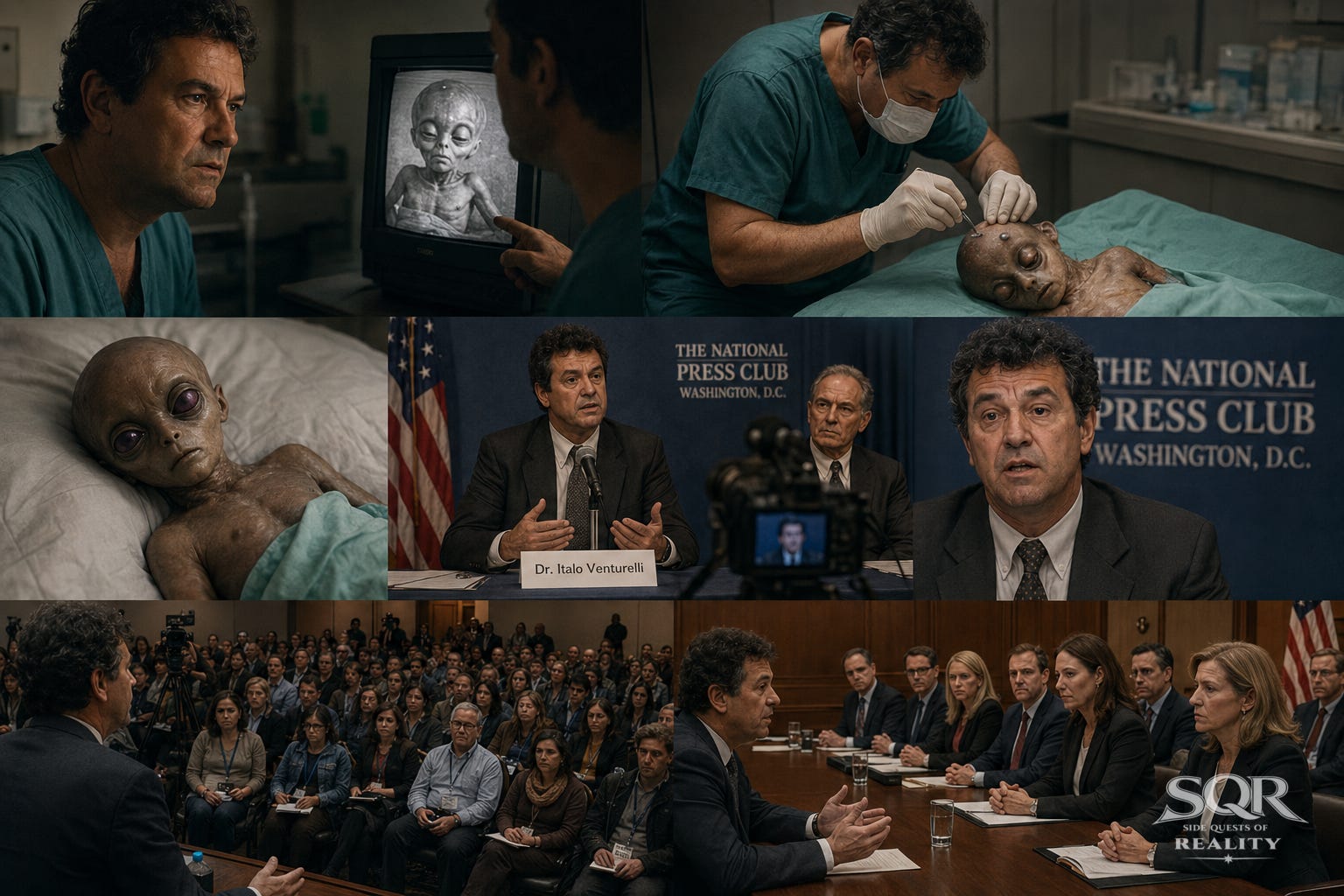
Dr. Italo was a neurosurgeon on duty at the Regional Hospital that day. A colleague pulled him into a room and showed him a brief black and white video of what appeared to be a child with a severe case of hydrocephalus. He was then directed to a second room and to the bed where the patient was lying.
What he saw, he said, looked like a small child of around seven years old. He spent three to four minutes at its bedside. His colleague, Dr. Marcos Vinico Neves, had already sutured a wound on the being’s cranium. No medical records were kept of this procedure. Neves died in 2018.
At a press conference at the National Press Club in Washington on January 20, 2026, exactly thirty years after the incident, Dr. Italo described the moment the being looked directly at him. He said that when it looked at him, he was no longer there as a doctor. It was looking at everything happening around it as if it were taking notes, like a great observer. It transmitted peace.
He said its eyes were large and lilac-colored.
This testimony was delivered in person, in a closed session, to members of the United States Congress nine days before the public press conference. The attending members included the chairwoman of the House Task Force on the Declassification of Federal Secrets.
The American Dimension
The Varginha case does not stay within Brazilian borders, and this is one of its most difficult elements to account for.
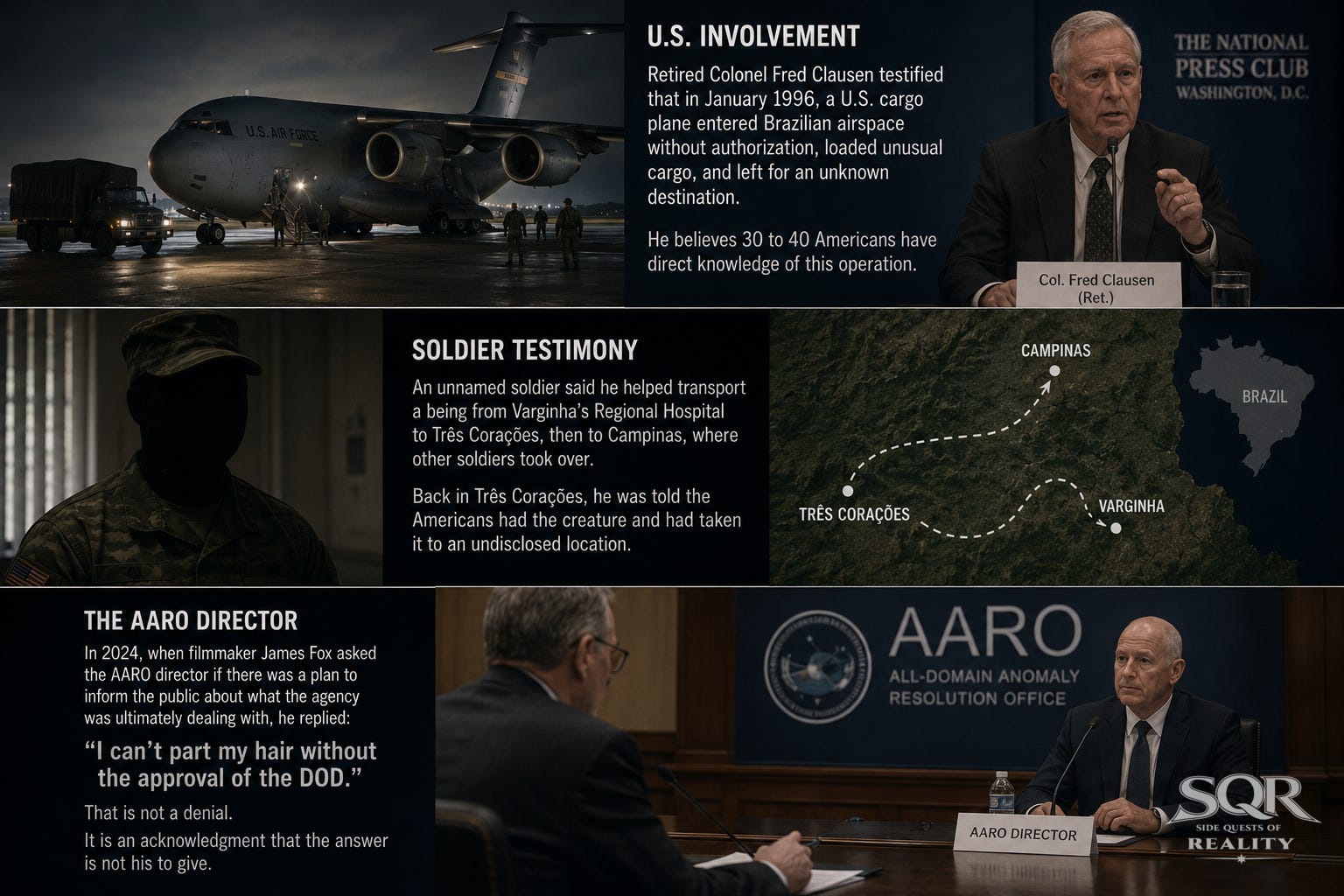
Retired Colonel Fred Clausen, a former fighter pilot, testified at the 2026 National Press Club event that in January 1996, a U.S. cargo plane secretly entered Brazilian airspace without authorization from Brazilian authorities, loaded what he described as unusual cargo, and departed to an unknown location. He estimated that 30 to 40 Americans would have direct knowledge of this operation and called on them to come forward.
An unnamed soldier whose face was obscured in his testimony described participating in transporting a being from Varginha’s Regional Hospital to the city of Três Corações, and from there to Campinas, where other soldiers took over. Upon returning to Três Corações, he said, there was talk that the Americans had the creature and had transported it to an undisclosed location.
The AARO director, when filmmaker James Fox asked him in 2024 whether there was a plan to inform the public about what the agency was ultimately dealing with, replied: “I can’t part my hair without the approval of the DOD.”
That is not a denial. It is something more precise than a denial: an acknowledgment that whatever the answer is, it does not belong to the person being asked.
The Harassment
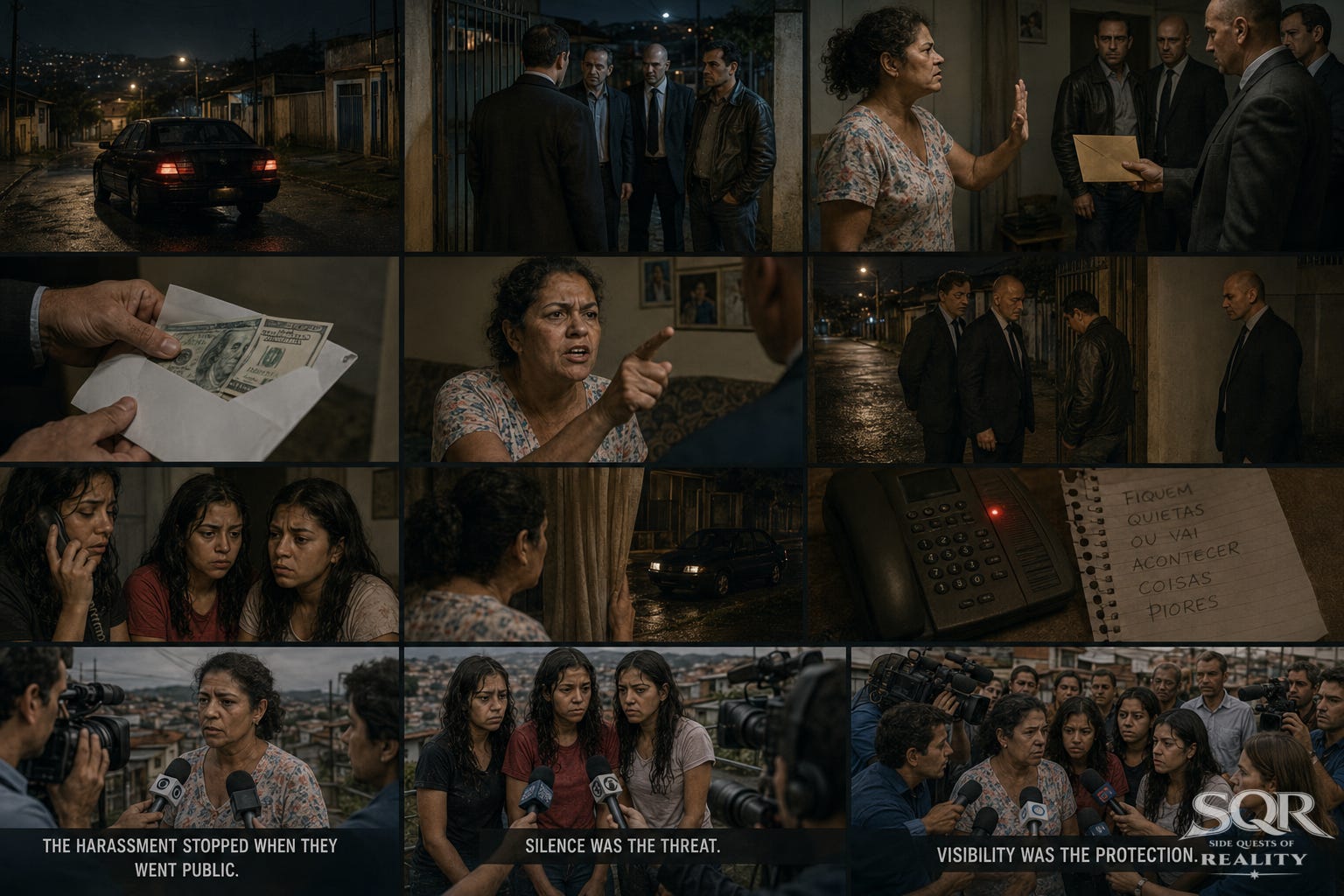
Four months after the encounter, approximately five men arrived at the home of the Silva family at around 10 o’clock at night. They offered money to record statements in which the girls would deny what they had seen.
Luiza turned them down and threatened to call the police. The men, who she said were foreigners, left.
The family subsequently reported mysterious surveillance and threatening phone calls that ceased only after the girls gave interviews to the press. This is a notable detail: the harassment did not stop when they stayed quiet. It stopped when they went public. Silence was the threat. Visibility was the protection.
The Explanations
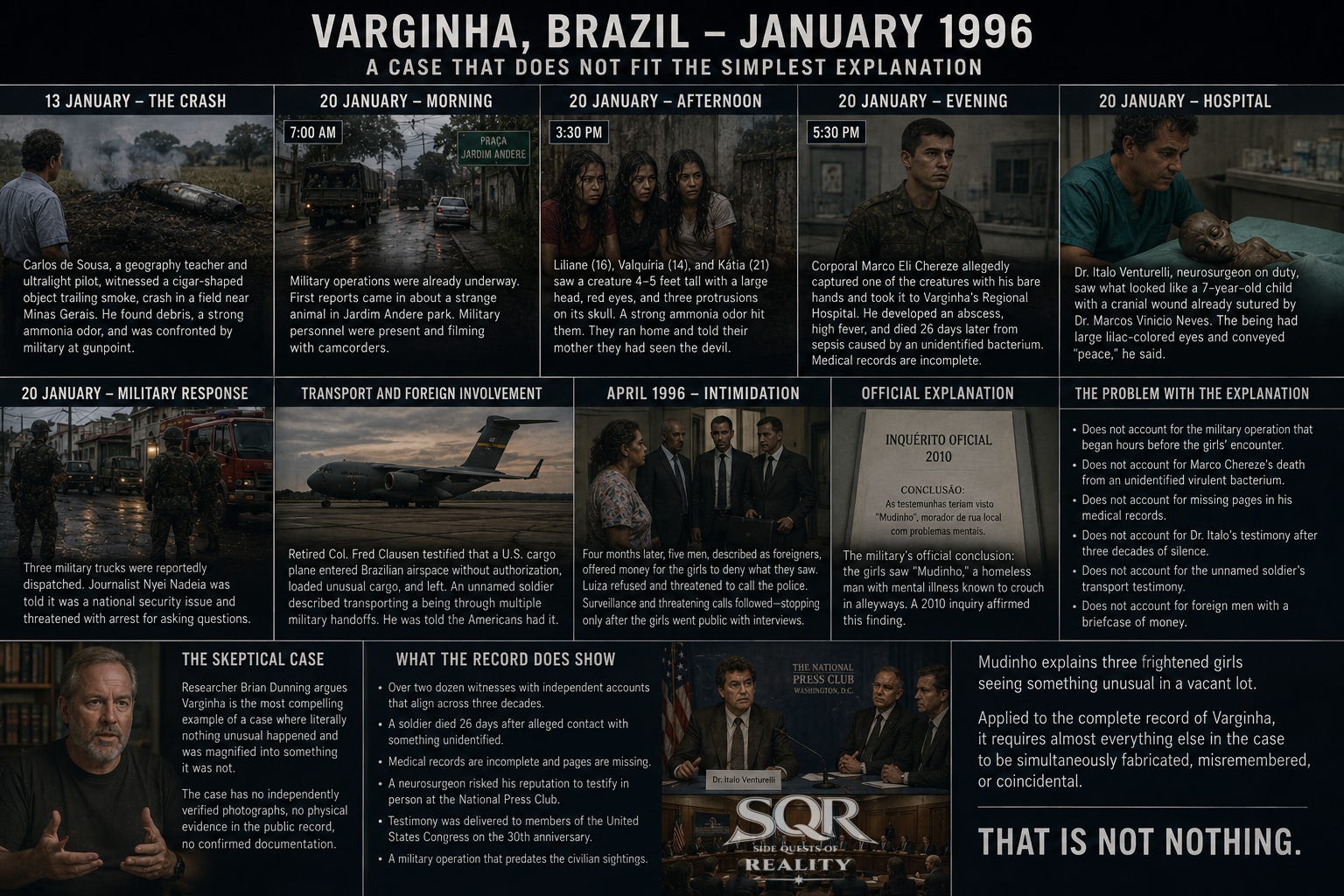
The Brazilian military conducted a formal investigation and reached a clear conclusion: the girls had encountered a local homeless man nicknamed Mudinho, who suffered from a mental illness and was known to crouch in alleyways covered in mud. A 2010 official inquiry affirmed this finding.
The Mudinho explanation has the advantage of being verifiable in principle. It has the disadvantage of not accounting for the rest of the record.
It does not account for the military operation that began at 7:00 in the morning, hours before the girls’ encounter. It does not account for Marco Chereze’s death from an unidentified virulent bacterium 26 days after his alleged contact. It does not account for the missing pages from his medical records. It does not account for Dr. Italo Venturelli spending three decades deciding whether to describe what he saw in a hospital room, and then doing so in front of members of Congress. It does not account for the unnamed soldier who described transporting a being through multiple military handoffs. It does not account for the foreign men who showed up at a teenager’s home with a briefcase of money.
Mudinho explains three frightened girls seeing something unusual in a vacant lot. Applied to the complete record of Varginha, it requires almost everything else in the case to be simultaneously fabricated, misremembered, or coincidental.
The skeptical case, made most forcefully by researcher Brian Dunning, argues that Varginha is the most compelling example of a case where literally nothing unusual happened and was magnified into something it was not. That argument deserves to be taken seriously. The case has no independently verified photographs, no physical evidence in the public record, no confirmed documentation.
What it does have is over two dozen witnesses providing independent accounts that fit together across thirty years. It has a dead soldier with missing medical records and an unidentified infection. It has a neurosurgeon who spent three decades deciding whether to talk. It has a military operation that predated the civilian sightings. It has testimony delivered to the United States Congress on the thirtieth anniversary of the events.
That is not nothing.
What Varginha Is

The Varginha incident is unlike any other case in this series. It is not a lights-in-the-sky event. It is not a radar anomaly or a military documentation exercise. It involves beings on the ground, in a city, in daylight, encountered by civilians and allegedly handled by military personnel and medical staff. If it is real, it is the most direct contact event in the modern record.
If it is not real, it requires a more elaborate explanation than any of the official accounts have provided.
What remains after three decades is a city transformed by a week in January 1996, a dead soldier whose infection was never sourced, a neurosurgeon whose account has not changed since the day he chose to give it, a military operation documented by its own timeline, and a Congress that in 2026 sat in a closed room and asked a Brazilian doctor to take them through what happened from point A to point B.
The briefcase was turned down. The girls went public. The records are still incomplete.
And the AARO director cannot part his hair without approval.
Varginha remains, thirty years later, exactly where the three women left it.
In a vacant lot in Minas Gerais.
Unresolved.
That’s all this is. Careful attention. Sustained over time.
Welcome to Side Quests of Reality.