
Case Study SQR-UFO-007: The Foo Fighters of World War Two
Side Quest of Reality · UFO Investigation · Paranormal Podcast

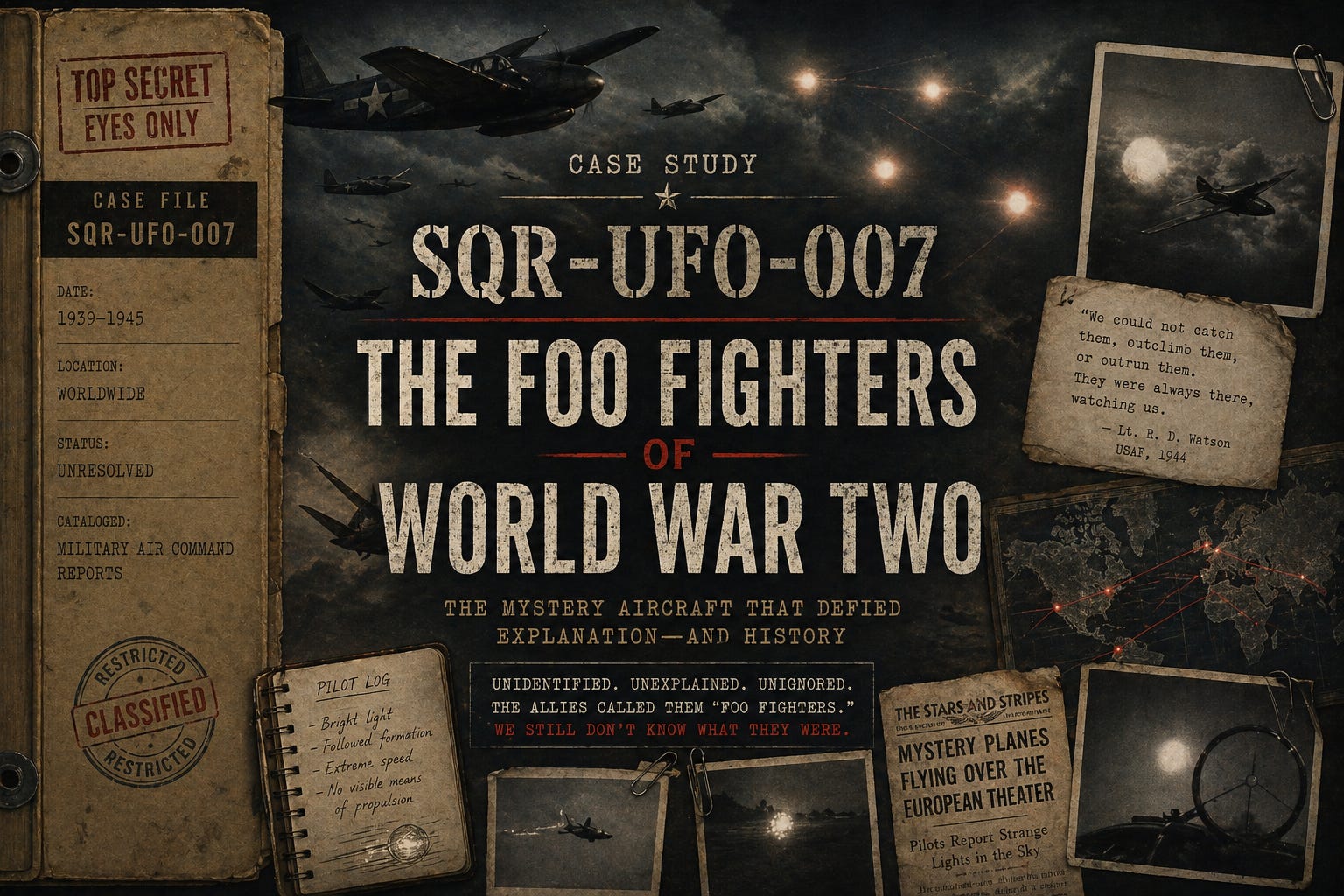
This case is different from every other in this series in one specific and important way.
Every other case we have examined was witnessed by one group of people. The residents of Phoenix. The Navy divers at Shag Harbour. The USAF personnel at Rendlesham. The ranchers and officers at Roswell. In each case, a defined set of observers encountered something they could not explain, and the question is whether to believe them.
The Foo Fighters were witnessed by everybody.
American pilots saw them over the Rhine Valley. British RAF crews saw them over France and the English Channel. German Luftwaffe pilots saw them over their own occupied territory. Japanese aviators saw them over the Pacific. Every air force engaged in the largest war in human history, flying in opposition to each other, reporting to entirely separate chains of command, with no opportunity to compare accounts or coordinate descriptions, saw the same thing.
They were all frightened by it.
None of them had any idea what it was.
And every investigation that followed, from wartime intelligence inquiries to postwar scientific panels, concluded the same thing.
Unidentified.
The First Night


Late November 1944. A Bristol Beaufighter from the 415th Night Fighter Squadron is flying along the Rhine River north of Strasbourg. The crew consists of pilot Lieutenant Edward Schlueter, radar observer Lieutenant Donald Meiers, and intelligence officer Lieutenant Fred Ringwald, riding as observer.
Ringwald is the first to speak. He says, quietly: I wonder what those lights are, over there in the hills.
Schlueter looks. He sees eight to ten bright orange lights off the left wing, moving at high speed through the air. He turns the aircraft toward them. They disappear. The crew continues the mission. Later, the lights appear again, farther away. The display continues for several minutes. Then it stops.
Back at base, Meiers sits down at the debriefing. He is agitated in a way that trained combat pilots are not usually agitated. He pulls a copy of the Smokey Stover cartoon strip from his back pocket. Smokey Stover is a comic about a firefighter. The cartoonist had peppered it with the nonsense word foo. Meiers slams it on the desk.
He says something unprintable, followed by: another one of those foo fighters.
The name stuck.
In the weeks that followed, the 415th kept flying and the lights kept appearing. Intelligence Officer Ringwald compiled a formal report listing fourteen separate incidents in December 1944 and early January 1945. He sent it up the chain of command. The 64th Fighter Wing had no answers. They sent it to XII Tactical Air Command. XII TAC had no answers. They sent it to Supreme Headquarters Allied Expeditionary Force in Paris.
SHAEF had no knowledge of the phenomenon. They asked the British Air Ministry in London.
The Air Ministry could not explain it either.
What the Pilots Described
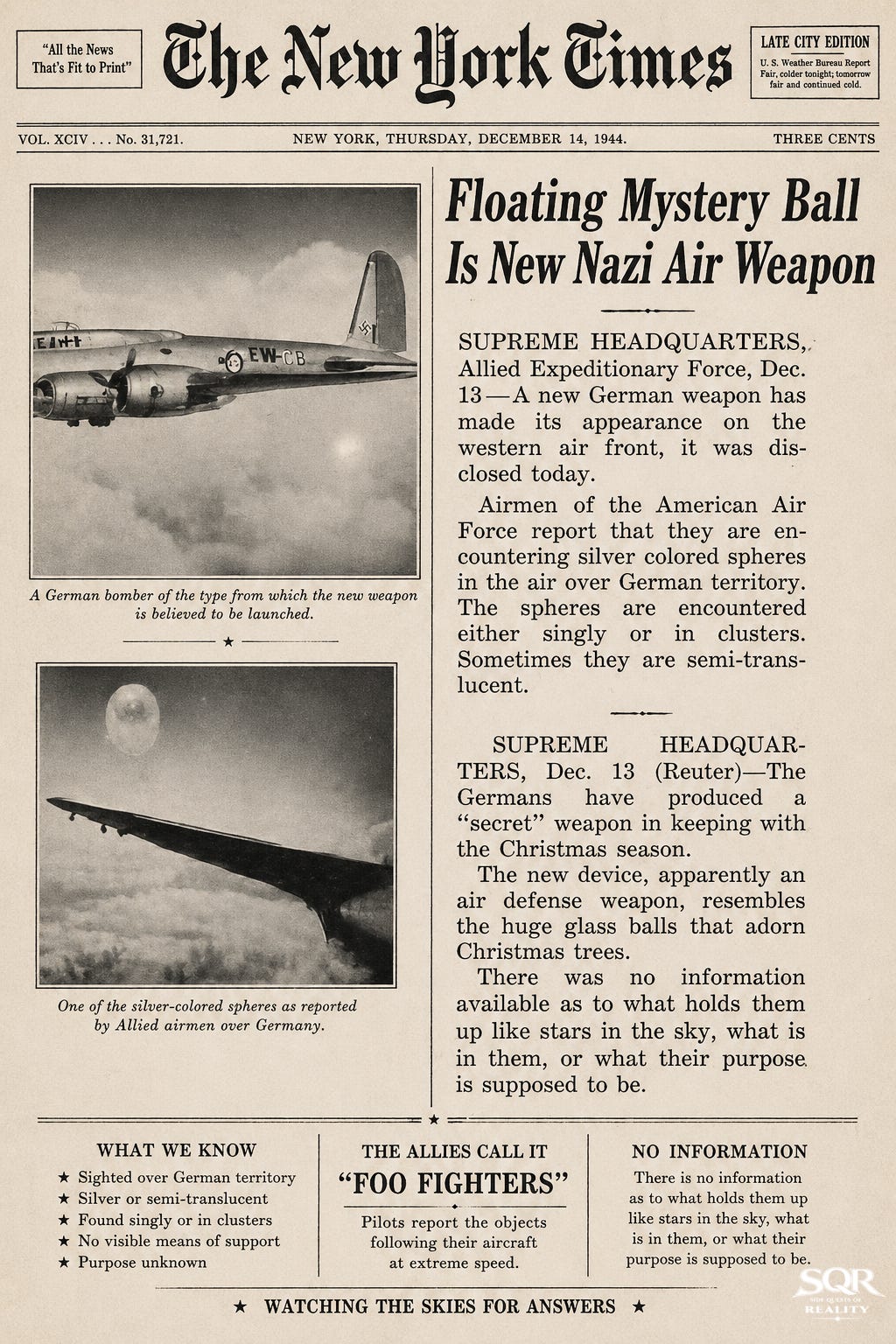
The accounts vary in detail but converge on a consistent set of behaviors that no conventional explanation accounts for cleanly.
The objects appeared as glowing spheres or balls of light, ranging in color from fiery orange to red, white, and occasionally green or blue. Their size was estimated at anything from basketball-sized to much larger. They appeared singly and in groups, sometimes in formation.
They followed aircraft.
This is the detail that the pilots found most disturbing. The objects did not drift or float randomly through the airspace. They tracked. When a pilot changed course, the object changed course. When a pilot accelerated, the object accelerated to match. When a pilot dove, the object dove with him.
Lieutenant Meiers described an encounter in which he turned to starboard and two balls of fire turned with him. He turned to port and they turned with him. He was flying at 260 miles per hour and the objects kept pace without apparent effort.
Lieutenant Samuel Krasney reported a wingless, cigar-shaped object glowing red, hovering a few yards off his wingtip. He instructed the pilot to attempt evasive maneuvers. The object stayed beside them for several minutes before flying off and disappearing.
Senator Ted Stevens, then a US Air Force fighter pilot, described to a colleague decades later: I was flying and there was an object next to me. I couldn’t get rid of it. I slowed up, it was there. I sped up, it was there. I would dive, it would be there. I called. Nothing on radar.
Nothing on radar.
This detail appears across accounts from multiple theaters and multiple air forces. The objects were visually present, sometimes close enough that pilots could observe their color and shape in detail. And they registered on nothing. No airborne radar. No ground control radar. No detection system of any kind picked them up.
They could be seen. They could not be measured.
One B-29 gunner in the Pacific managed to hit one with gunfire. It broke into several large pieces that fell on buildings below and set them on fire. This is the only confirmed case of physical interaction with the phenomenon producing a physical result. It is also the only case where the object broke apart, suggesting it had some kind of structural integrity, some kind of composition that could be destroyed, that could burn.
Whatever it was, some of it was real enough to fall on buildings.
Both Sides
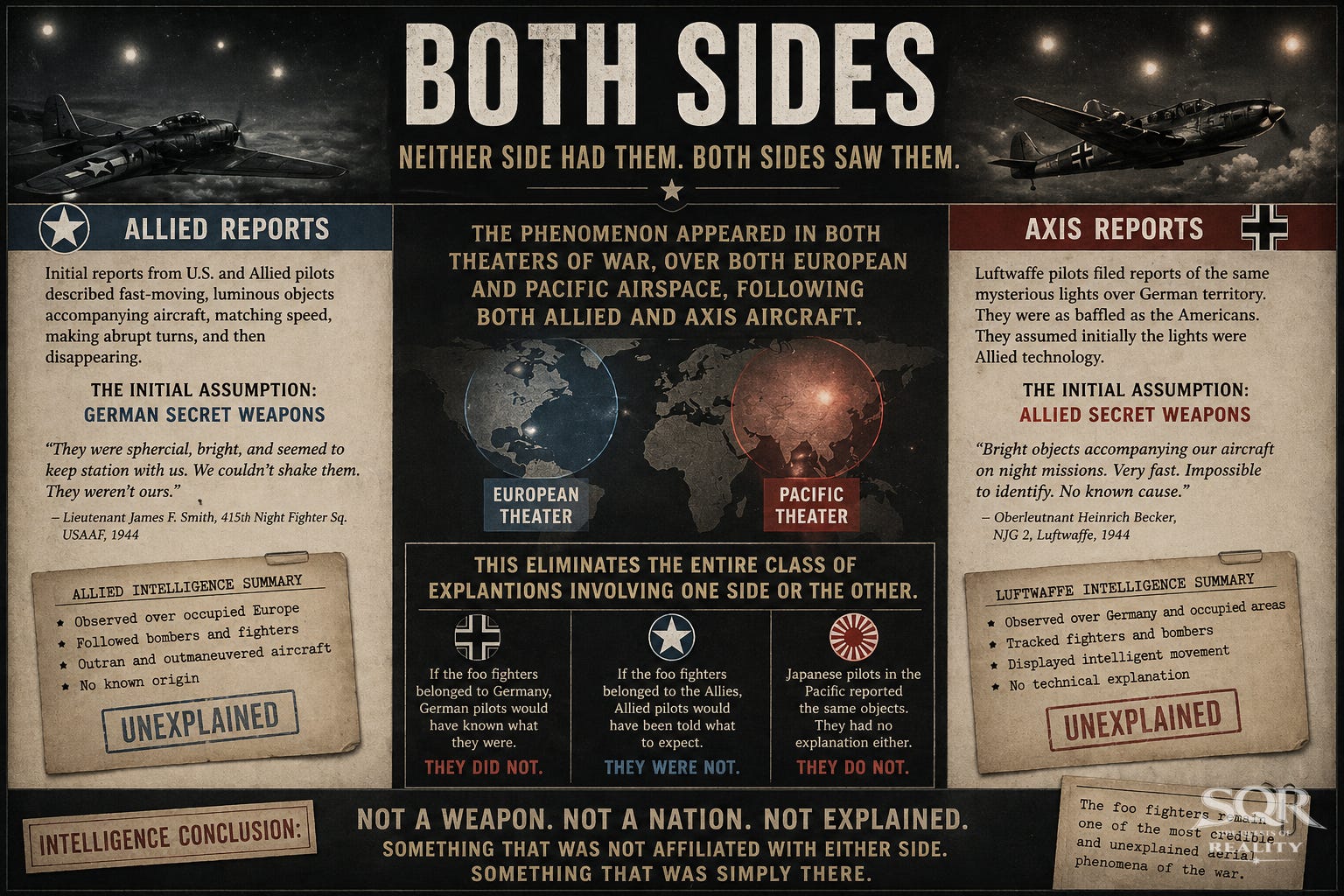
The initial Allied assumption was that the foo fighters were German secret weapons. This was the obvious explanation. Germany was developing advanced technology throughout the war. The V-1 and V-2 rockets were genuine innovations. The Me 262 jet aircraft was flying in 1944. A new form of guided aerial weapon, designed to harass Allied aircraft without engaging them directly, was not implausible.
The assumption was shattered when intelligence reports revealed that German pilots were seeing them too.
The Luftwaffe had been filing reports of the same phenomenon over their own territory. German pilots were as baffled as the Americans. They had assumed, initially, that the lights were Allied secret weapons. They were not. The Allied pilots assumed they were German secret weapons. They were not.
Japanese pilots in the Pacific were also reporting them. The phenomenon appeared in both theaters of the war, over both European and Pacific airspace, following both Allied and Axis aircraft.
This is the detail that eliminates the entire class of explanations involving one side or the other.
If the foo fighters belonged to Germany, Germany’s own pilots would have known what they were. They did not.
If the foo fighters belonged to the Allies, Allied pilots would not have been filing intelligence reports expressing genuine alarm about them. They would have been told what to expect.
Neither side had them. Both sides saw them.
This is the logical structure of the phenomenon and it is not the logical structure of any secret weapons program. It is not the logical structure of any conventional aerial phenomenon. It is the logical structure of something that was not affiliated with either side. Something that was simply there, in the airspace of a world at war, observing.
What Was Proposed
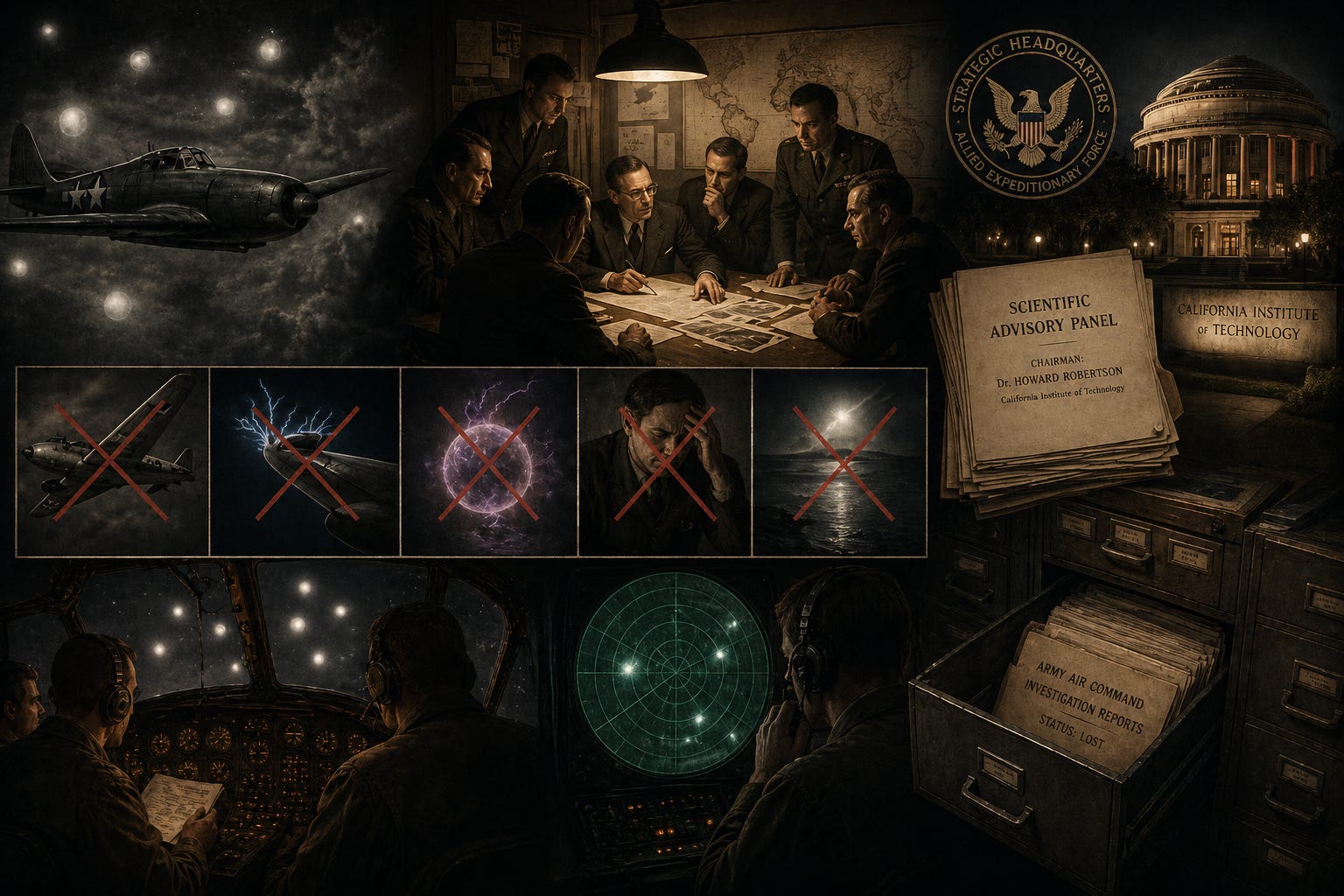
The military did not dismiss the foo fighters. The 415th’s reports went to SHAEF. SHAEF consulted the British Air Ministry. After the war, the CIA convened a panel of six senior scientists, including physicists and aviation specialists, chaired by Caltech physicist Howard Robertson. The Robertson Panel examined the phenomenon as a potential national security threat.
The Robertson Panel offered no official conclusion.
The explanations that were proposed and then discarded in sequence tell their own story.
German secret weapons: eliminated when German pilots confirmed they were seeing the same thing.
St. Elmo’s Fire: a real atmospheric phenomenon producing light at the tips of aircraft in electrical fields. Pilots who had seen St. Elmo’s Fire rejected this explanation. St. Elmo’s Fire is a static discharge. It does not move independently of the aircraft generating it. It does not pursue other aircraft. It does not match speed and heading with a target over sustained periods. It does not hover and turn and accelerate and vanish.
Ball lightning: a real and poorly understood phenomenon producing spherical luminous objects in the atmosphere. Ball lightning is typically short-lived, erratic, and unresponsive to external stimuli. The foo fighters sustained themselves for minutes. They followed deliberately. They responded to the movements of the aircraft they accompanied. Ball lightning does not behave this way.
Combat fatigue and hallucination: this explanation ran directly into the problem that multiple crew members on the same aircraft reported the same objects simultaneously. Hallucinations are individual. If the pilot, the radar observer, and the intelligence officer in the same cockpit all describe the same object independently, hallucination requires a coincidence of identical individual delusions that strains the concept past its usefulness.
Reflections and optical phenomena: the objects appeared at night, in clear conditions as well as cloudy ones, at various altitudes and bearings, from multiple positions relative to the aircraft, and were tracked over sustained periods of complex maneuver. Reflections do not pursue aircraft at 260 miles per hour and match every course change.
After the war ended and Allied forces gained access to German military technology, scientists and engineers went through the entire inventory of German aviation research. Nothing was found that matched the description or capabilities of the foo fighters. No prototype. No document. No engineer who claimed involvement in a program that could have produced them.
The Army Air Command had sent its own officers to investigate during the war. Their research was lost after it ended.
An investigation that produced no conclusions, the records of which subsequently disappeared. This is a pattern that readers of this series will recognize.
The Behavior That Resists Explanation
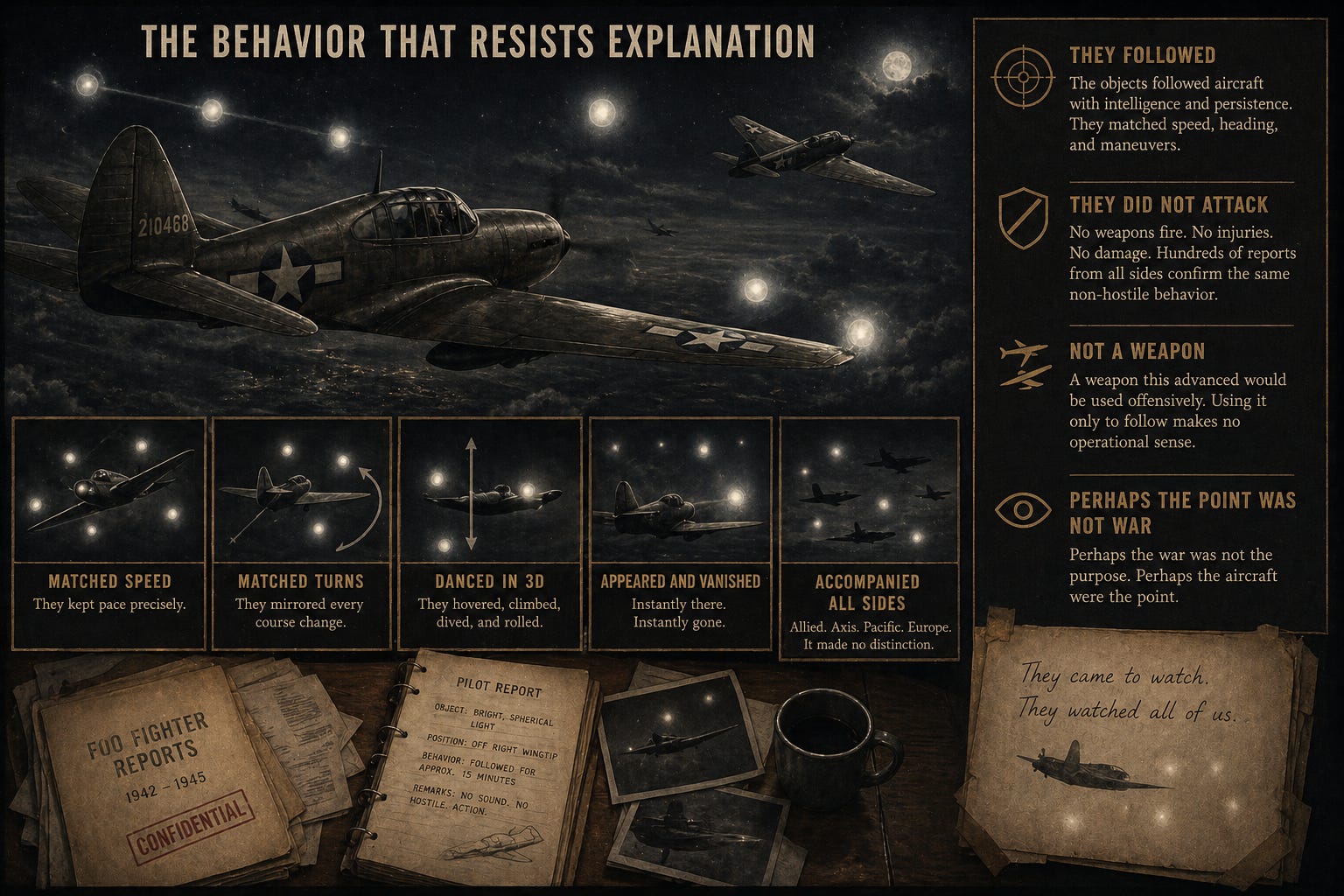
Set aside the question of origin for a moment and focus only on the behavior.
The objects followed aircraft. This is the core behavior and it is the one that every proposed explanation has the most difficulty with. Following is a purposeful action. It implies awareness of the target. It implies the capacity to track and respond. It implies something that is, at minimum, functionally oriented toward the aircraft it accompanies.
The objects did not attack. Across hundreds of reports from multiple air forces over multiple years, no foo fighter ever fired on an aircraft. No pilot was injured by one. No aircraft was damaged by one. The phenomenon was entirely non-hostile.
This is strange if the objects were weapons. Weapons are designed to do something harmful. A weapon capable of matching the speed and maneuverability of a military aircraft, operating without detection by radar, evading all evasive action, and sustaining itself through extended engagements, would be the most advanced aerial weapon ever developed. Using it only to follow aircraft, without ever deploying it offensively, would be an operational absurdity.
Unless following was the point.
Unless whatever was generating the foo fighters was not a weapons program but something else entirely. Something that used the concentrated aerial activity of a world war as an opportunity to observe. That accompanied the aircraft of all sides because it was not interested in sides. That appeared at the wingtips of pilots going to their deaths and matched their speed and watched and then withdrew.
Something that was present during the most intense display of human aerial technology in history up to that point and seemed interested in it.
This is speculation. It has no evidentiary weight.
But it is the speculation that fits the behavior better than any of the conventional explanations that have been tried and discarded.
Where It Fits in the Series
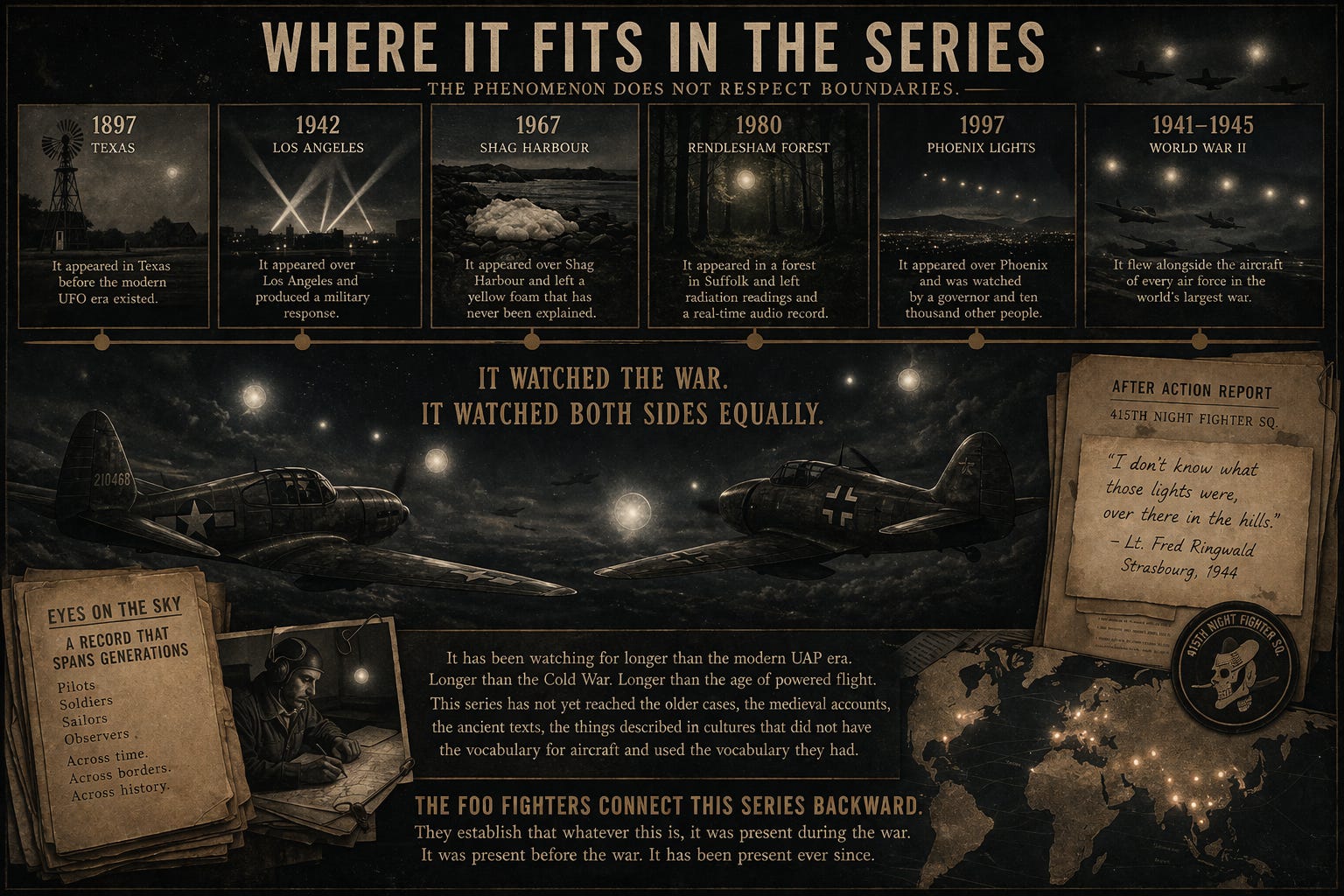
This series has been building, piece by piece, toward the observation that the phenomenon does not respect boundaries.
It appeared in 1897 in Texas before the modern UFO era existed. It appeared in 1942 over Los Angeles and produced a military response. It appeared over Shag Harbour and left a yellow foam that has never been explained. It appeared in a forest in Suffolk and left radiation readings and a real-time audio record. It appeared over Phoenix and was watched by a governor and ten thousand other people.
And between 1941 and 1945 it flew alongside the aircraft of every air force in the world’s largest war, followed their pilots through dogfights and night missions, registered on no radar, harmed no one, and disappeared at the end of each encounter without leaving a trace.
The phenomenon watched the war.
It watched both sides equally.
It has been watching for longer than the modern UAP era. Longer than the Cold War. Longer than the age of powered flight. The series has not yet reached the older cases, the medieval accounts, the ancient texts, the things described in cultures that did not have the vocabulary for aircraft and used the vocabulary they had.
But the foo fighters connect this series backward. They establish that whatever this is, it was present during the war. It was present before the war. It has been present through the entire period of human technological development in which we built the machines that allowed us to go up and meet it in the air.
Every pilot who filed a report about those lights was putting something into the record.
The record is longer than most people realize.
It begins well before the night a 415th Night Fighter Squadron crew flew north of Strasbourg and a man named Ringwald looked out the window and wondered what those lights were, over there in the hills.
But Strasbourg is a good place to start reading it.
This case is filed as SQR-UFO-007.
If you want to be notified when SQR-UFO-008 drops, and when the cases start talking to each other in ways that are difficult to explain, subscribe below.
That’s all this is. Careful attention. Sustained over time. Welcome to Side Quests of Reality.