
Case Study SQR-UFO-006 : The Battle of Los Angeles
Side Quest of Reality · UFO Investigation · Paranormal Podcast

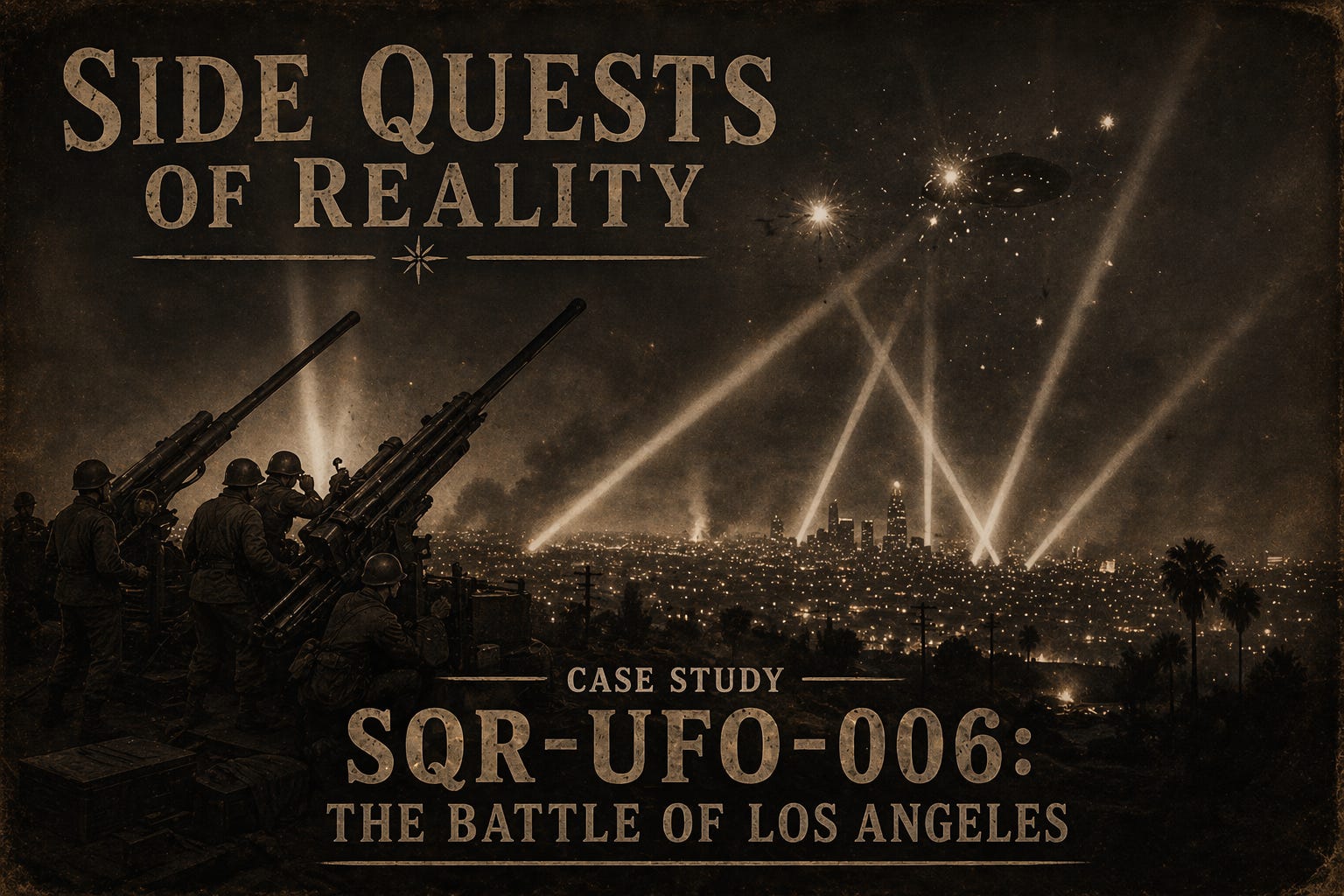
In the early hours of February 25, 1942, the United States Army fired more than 1,400 anti-aircraft shells into the sky above Los Angeles.
They fired for nearly an hour.
They hit nothing.
No enemy aircraft were shot down. No wreckage was found. No pilots were captured. No bombs were dropped. No Japanese aircraft of any kind were ever confirmed over the city that night. After the war ended, Japan stated categorically that it had flown no aircraft over Los Angeles during the engagement.
The Army fired 1,400 shells at something for an hour in the dark, and whatever it was, it flew away.
That is the documented core of the Battle of Los Angeles. Everything else, the explanations, the contradictions between officials, the photograph, the cover story and the counter-story, sits on top of that core like sediment on a question that has never been answered.
What did they shoot at?
The Context
To understand what happened on February 25, 1942, you have to understand what it felt like to be in Los Angeles in February 1942.
Pearl Harbor had happened ten weeks earlier. The United States was in the war. The Pacific coast was understood to be vulnerable in a way that no part of the American mainland had been vulnerable since the Civil War. Japanese submarines were not a theoretical threat. They were actively sinking ships within sight of the California coast. In the weeks before February 25, a string of merchant vessels had been attacked in Pacific coastal waters. Americans along the West Coast went to sleep every night not knowing whether they would wake to the sound of naval bombardment.
On February 19, President Roosevelt signed Executive Order 9066, authorizing the internment of Japanese Americans. The country was operating in a state of fear that is difficult to reconstruct from the distance of eight decades.
Then, on the evening of February 23, a Japanese submarine surfaced near Santa Barbara and shelled the Ellwood oil field. It was the first enemy attack on the continental United States since the War of 1812. Thirteen shells hit the facility. Damage was minor. The psychological effect was not.
The next day, February 24, naval intelligence issued a warning that an attack on mainland California could be expected within the following ten hours. Anti-aircraft batteries across the Los Angeles area were placed on heightened alert. The men manning those batteries were young, undertrained, and operating in a city that had just watched an enemy submarine shell its neighbor the night before.
The conditions for what followed were not mass hysteria in the clinical sense. They were a rational fear of a real threat, heightened past the point where the perceptual system can be relied upon to distinguish clearly between what is there and what the mind expects to find.
The Night
At 2:25 AM on February 25, air raid sirens sounded across Los Angeles County. A total blackout was ordered. Thousands of air raid wardens moved to their positions. Searchlights swept the sky.
Military radar had picked up what appeared to be an unidentified contact approximately 120 miles west of the city. The contact tracked toward the coast. At 2:21 AM, the regional controller ordered the blackout. Then, puzzlingly, the mysterious object tracked in from sea and seemed to vanish. The information center was flooded with reports of enemy planes even though the primary radar contact had disappeared.
At 2:43 AM, planes were reported near Long Beach. A few minutes later, a coast artillery colonel reported spotting approximately 25 planes at 12,000 feet over Los Angeles.
At 3:06 AM, a balloon carrying a red flare was seen over Santa Monica. Four batteries of anti-aircraft artillery opened fire.
What happened next was described by one official report as the air over Los Angeles erupting like a volcano. The firing spread from battery to battery across the city. Searchlights, already sweeping the sky, converged on objects that gunners reported seeing. Tracer rounds streamed upward. The thunder of anti-aircraft fire rolled across residential neighborhoods where people were hiding in basements and emerging in bathrobes to look up at the flashing sky.
The barrage continued until 4:14 AM. An hour of sustained fire.
Residents reported seeing aircraft. They reported seeing lights that moved in ways aircraft should not be able to move. They reported objects that appeared to absorb the shellfire without damage. Eyewitness accounts described anything from a single large glowing object moving slowly to swarms of planes numbering in the dozens, flying at altitudes ranging from a few thousand to over 20,000 feet, at speeds varying from very slow to over 200 miles per hour.
The official Army Air Forces history would later note drily that these mysterious forces dropped no bombs and, despite the fact that 1,440 rounds of anti-aircraft ammunition were directed against them, suffered no losses.
The Morning After
The contradictions began almost immediately.
Secretary of the Navy Frank Knox held a press conference within hours of the engagement ending. He called the entire incident a false alarm, the result of anxiety and war nerves. Nothing had been there. The guns had fired at shadows.
The next day, Secretary of War Henry Stimson contradicted him. Stimson stated that as many as fifteen unidentified aircraft had appeared over Los Angeles. He suggested they might be commercial planes operated by enemy agents from secret airfields in Mexico.
These two senior Cabinet officials, representing the Navy and the Army respectively, gave mutually exclusive accounts of the same event within 24 hours. One said nothing had been there. The other said fifteen aircraft had been there.
Both then went silent on the matter.
The Los Angeles Times ran front-page coverage declaring that foreign aircraft had flown over Southern California and drawn heavy barrages of anti-aircraft fire, the first ever to sound over United States continental soil against an enemy invader. The paper was confident something had been there.
An editorial in the Long Beach Independent noted that there is a mysterious reticence about the whole affair and it appears that some form of censorship is trying to halt discussion on the matter.
The New York Times wrote that the more the whole incident of the early morning of February 25 is examined, the more incredible it becomes.
Congress called for an investigation. Representative Leland Ford of Santa Monica said that none of the explanations offered removed the episode from the category of complete mystification.
The investigation did not produce clarity. The official position settled into silence, then shifted over time toward the explanation that would eventually be formalized in 1983.
The Official Explanation
In 1983, the US Office of Air Force History published its analysis of the incident. Its conclusion was that the initial alarm had most likely been triggered by a weather balloon. The balloon, carrying a red flare, had been spotted over Santa Monica. The nervous gun crews had opened fire. The disorienting combination of searchlights, smoke, and anti-aircraft flak had led other gunners to believe they were firing on enemy planes. The whole engagement was war nerves and a lost balloon.
This explanation has the advantage of simplicity and the disadvantage of requiring several uncomfortable adjustments to the record.
A weather balloon does not appear on radar 120 miles offshore and track toward the coast. A balloon does not move at controlled speeds and change direction. A balloon does not produce the variety of descriptions offered by witnesses across the city. A balloon does not cause a coast artillery colonel to report 25 aircraft at 12,000 feet. And a balloon, struck by 1,400 rounds of anti-aircraft fire over the course of an hour, does not survive and fly away.
The balloon explains the red flare over Santa Monica. It does not explain the radar contact, the sustained firing, the official Army claim that fifteen unidentified aircraft were present, or the complete absence of any debris, wreckage, or physical trace of anything in the sky that night.
The 1983 official explanation accounts for one element of the event and presents itself as an explanation for the whole.
The Photograph
The most famous artifact of the Battle of Los Angeles is a photograph published in the Los Angeles Times on February 26, 1942.
It shows searchlights converging in the night sky. At the point where they converge, a bright object is visible. The object appears roughly oval or disc-shaped. UFO researchers have cited the photograph for decades as visual evidence that the searchlights were illuminating an actual craft.
The honest position on the photograph is complicated.
Photo editing in 1942 was not digital but it was standard. Newspaper darkroom technicians routinely enhanced contrast and brightness in photographs to improve their reproduction quality on newsprint. The original, unretouched photograph from the event is less dramatic than the version published in the Times. The bright central object in the published version is significantly more defined and disc-shaped than what appears in the unretouched original, where the convergence point of the searchlights is a diffuse glow rather than a clear shape.
The photograph, as published, was altered. That does not mean nothing was there. It means the photograph cannot be used as direct evidence of what was there.
What is interesting about the photograph is not the object itself but the behavior of the searchlights. Multiple independent batteries, operating without coordination, all converged on the same point in the sky. That convergence implies that the operators of those searchlights all identified the same target simultaneously. Something was where those lights pointed.
Whether that something was a weather balloon, an enemy aircraft, a classified craft, or something else entirely, the searchlights agreed on its location.
What Japan Said
After the war ended, Japanese military authorities were debriefed extensively by American investigators on the full scope of their Pacific operations. In those debriefings, Japan confirmed that it had flown no aircraft over Los Angeles on the night of February 24 to 25, 1942.
This confirmation removed the most obvious explanation for what the Army’s guns were firing at. If Japan had no aircraft there, the Army was not firing at Japanese aircraft. The Army secretary’s claim of fifteen unidentified planes became even stranger. Fifteen unidentified planes that were not Japanese, not American, apparently indestructible to anti-aircraft fire, and which left no trace.
The balloon explanation was adopted in part because after Japan denied presence, something mundane had to fill the space where the enemy had been. A false alarm caused by a balloon is a more comfortable conclusion than the alternative, which is that the United States Army fired 1,400 shells at something it could not identify, could not damage, and could not explain.
What the Record Holds
The Battle of Los Angeles is the only case in this series where a government actually fired weapons at the phenomenon it could not explain.
Not investigated it. Not classified it. Not issued a press release about it.
Fired 1,400 shells at it over the course of an hour.
That response tells us something important regardless of what the object was. The military personnel on the ground that night believed, in real time, that they were engaging a genuine target. The colonel who reported 25 aircraft was not guessing. He was reporting what his trained observers had identified. The batteries that opened fire did not do so carelessly. Anti-aircraft artillery in wartime operates under specific protocols. You do not fire unless you have a target.
They had a target.
The target did not fall.
The Secretary of War said fifteen unidentified aircraft. The Secretary of the Navy said nothing was there. Two senior officials, representing two branches of the same military, gave contradictory public accounts within 24 hours and then both went silent.
When officials who disagree about a basic fact of an event both go silent simultaneously, the silence is itself information.
Six people died that night. Three in traffic accidents during the chaos of the blackout. Three from heart attacks attributed to the stress of the bombardment. The Army fired 1,400 shells that rained shrapnel across residential Los Angeles. Chunks of anti-aircraft ordnance landed in neighborhoods across the city.
The Army did that in response to a weather balloon.
Or it did that in response to something else.
The record does not tell us which.
What the record tells us is that something was in the sky above Los Angeles before dawn on February 25, 1942. That the United States military responded to it with everything available to them. That it did not fall. That Japan had nothing to do with it. That two senior Cabinet officials could not agree on whether it existed. That the explanation arrived forty years later and does not account for the full sequence of events.
And that the most powerful anti-aircraft barrage ever directed at an object over a continental American city produced no wreckage, no casualties on the other side, and no answer.
Just 1,400 empty shell casings on the streets of Los Angeles.
And the question, still open, of what the searchlights had found.
This case is filed as SQR-UFO-006.
If you want to be notified when SQR-UFO-007 drops, and when the cases start talking to each other in ways that are difficult to explain, subscribe below.
That’s all this is. Careful attention. Sustained over time. Welcome to Side Quests of Reality.