Case Study SQR-UFO-005: The Aurora, Texas incident of 1897
Side Quest of Reality · UFO Investigation · Paranormal Podcast

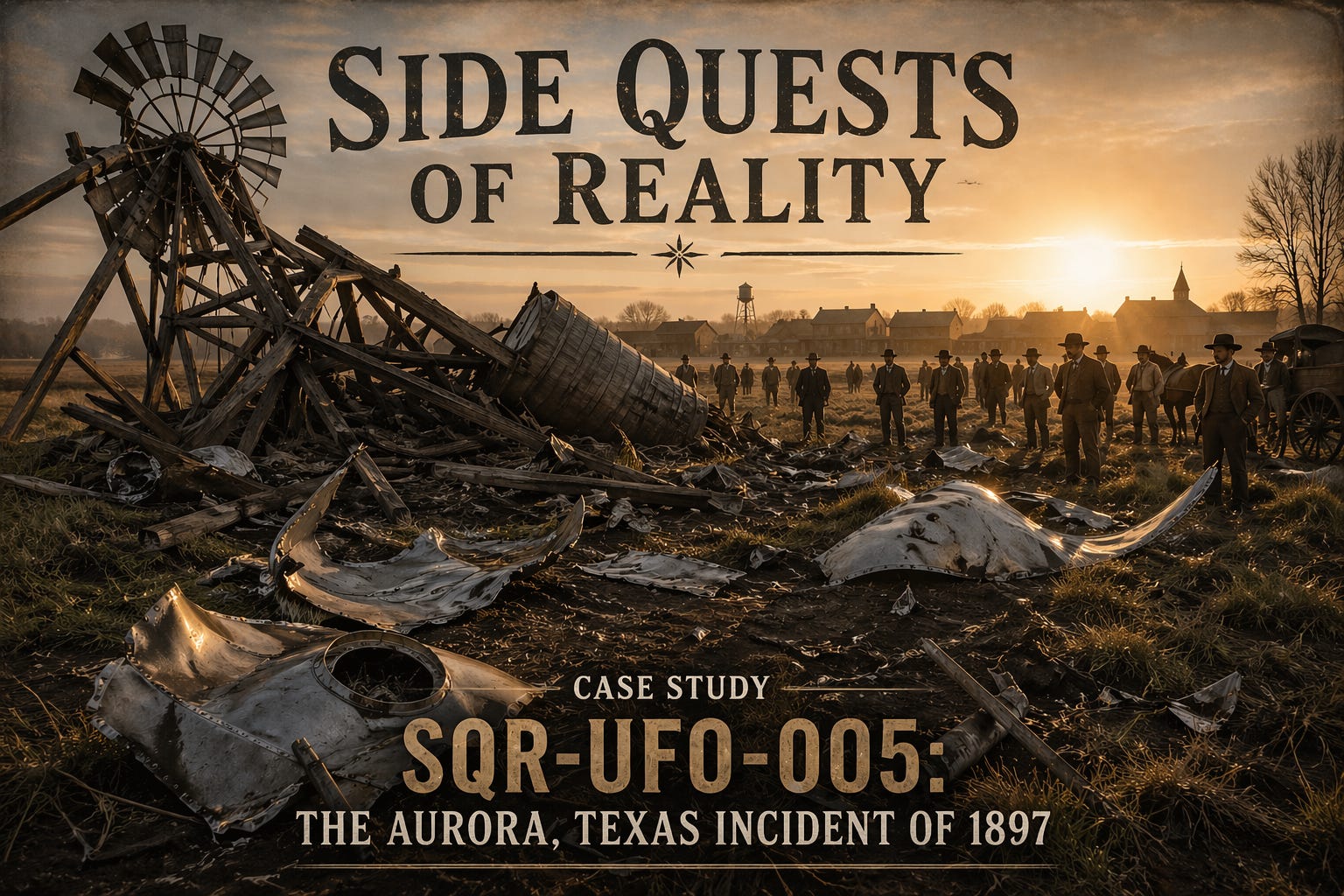
This case is different from the others in this series.
Roswell has a military officer who authorized a press release calling it a flying disc. Rendlesham has an audio recording made in real time by a deputy base commander. Shag Harbour has a Canadian government document that officially classified the object as of unknown origin and never changed that classification. The Phoenix Lights have a sitting governor and ten thousand witnesses.
Aurora, Texas has a newspaper article.
One article, written by one man, published two days after the alleged event, in a small regional paper in 1897. No military involvement. No official investigation. No government documents. No living witnesses. A grave that may or may not contain what people say it contains, in a cemetery that will not permit exhumation.
The honest position is that this case may be a hoax.
I am documenting it anyway. Not because I am certain something happened, but because of what surrounds it. Because the article appeared inside something much larger and much stranger than a single Texas newspaper story. And because the pattern the Aurora case fits, the pilot not of this world, the unknown metal, the hieroglyphic writing, the sudden retrieval and burial, preceded every element of the modern UFO crash narrative by fifty years, in an era when that narrative did not yet exist to be imitated.
That is either because Haydon invented it and every subsequent case echoes his invention.
Or because Haydon documented something real, and every subsequent case echoes the same reality.
Both possibilities are worth sitting with.
The Great Airship Wave
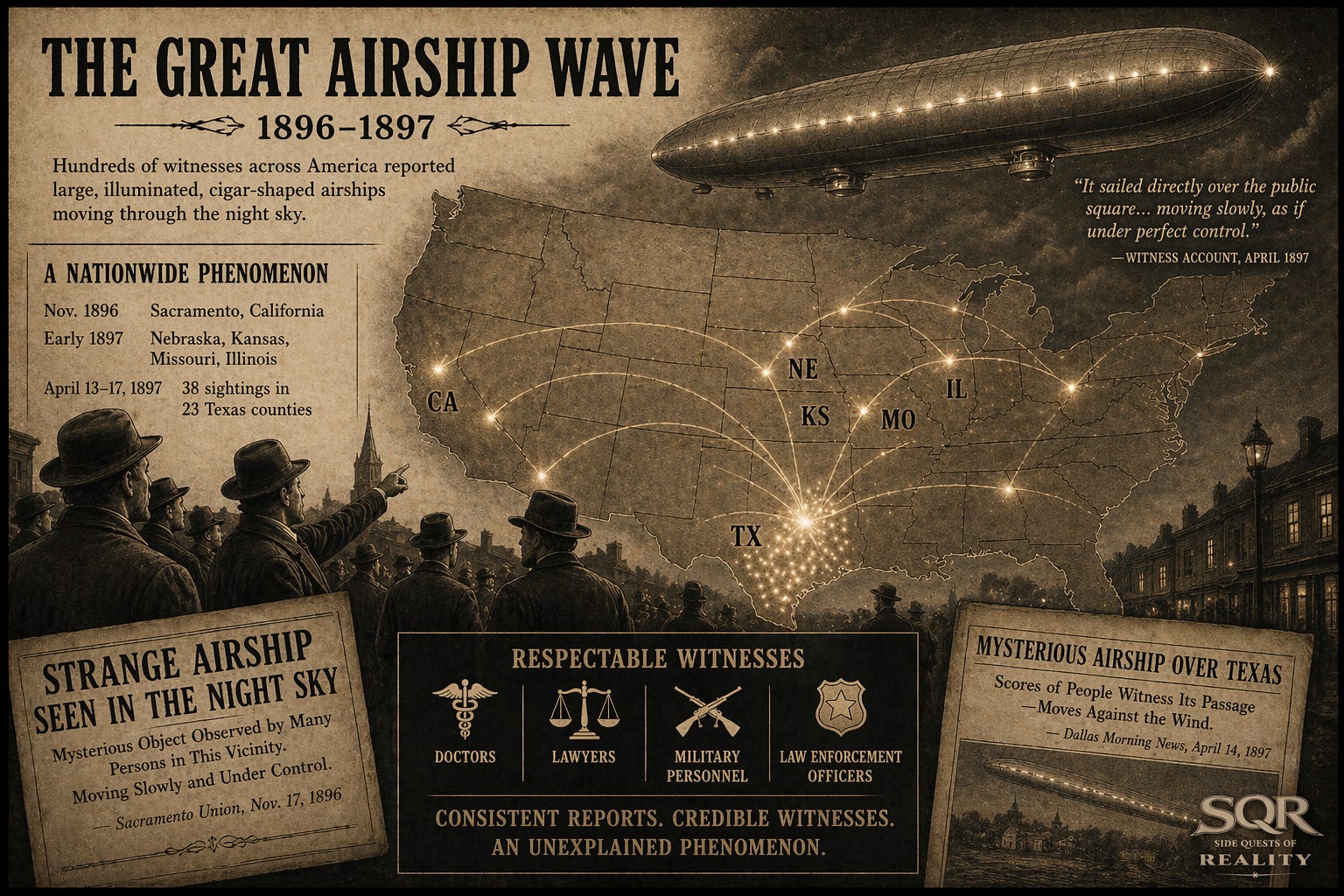
To understand Aurora you have to understand what was happening in American skies in the spring of 1897.
It began in California in November 1896. Witnesses across Sacramento and the surrounding region reported a large light moving slowly through the night sky at an estimated altitude of a thousand feet, exhibiting controlled behavior that suggested it was being steered. The reports spread. By early 1897 similar accounts were emerging from Nebraska, Kansas, Missouri, and Illinois. By April the wave had reached Texas.
Between April 13 and April 17, 1897, there were 38 reported sightings of cigar-shaped airships across 23 Texas counties in the space of five days. The witnesses were not, for the most part, the kinds of people who filed unreliable reports. They included doctors, lawyers, military personnel, and law enforcement officers. The accounts were consistent in their descriptions: large, illuminated, elongated craft moving at low altitude, sometimes slowly, sometimes rapidly, often exhibiting what appeared to be controlled directional changes.
This was six years before the Wright brothers flew at Kitty Hawk. No aircraft technology of the era could account for what was being described. Practical dirigibles capable of sustained controlled flight over long distances did not yet exist. Whatever people were seeing across hundreds of reports scattered over thousands of miles of American territory in 1896 and 1897, they were not misidentifying conventional aircraft, because no conventional aircraft of that kind existed.
The airship wave is itself an unresolved anomaly in American history, almost entirely forgotten now, sitting quietly in newspaper archives from the 1890s waiting for someone to take it seriously.
Aurora arrived at the peak of that wave.
The Article
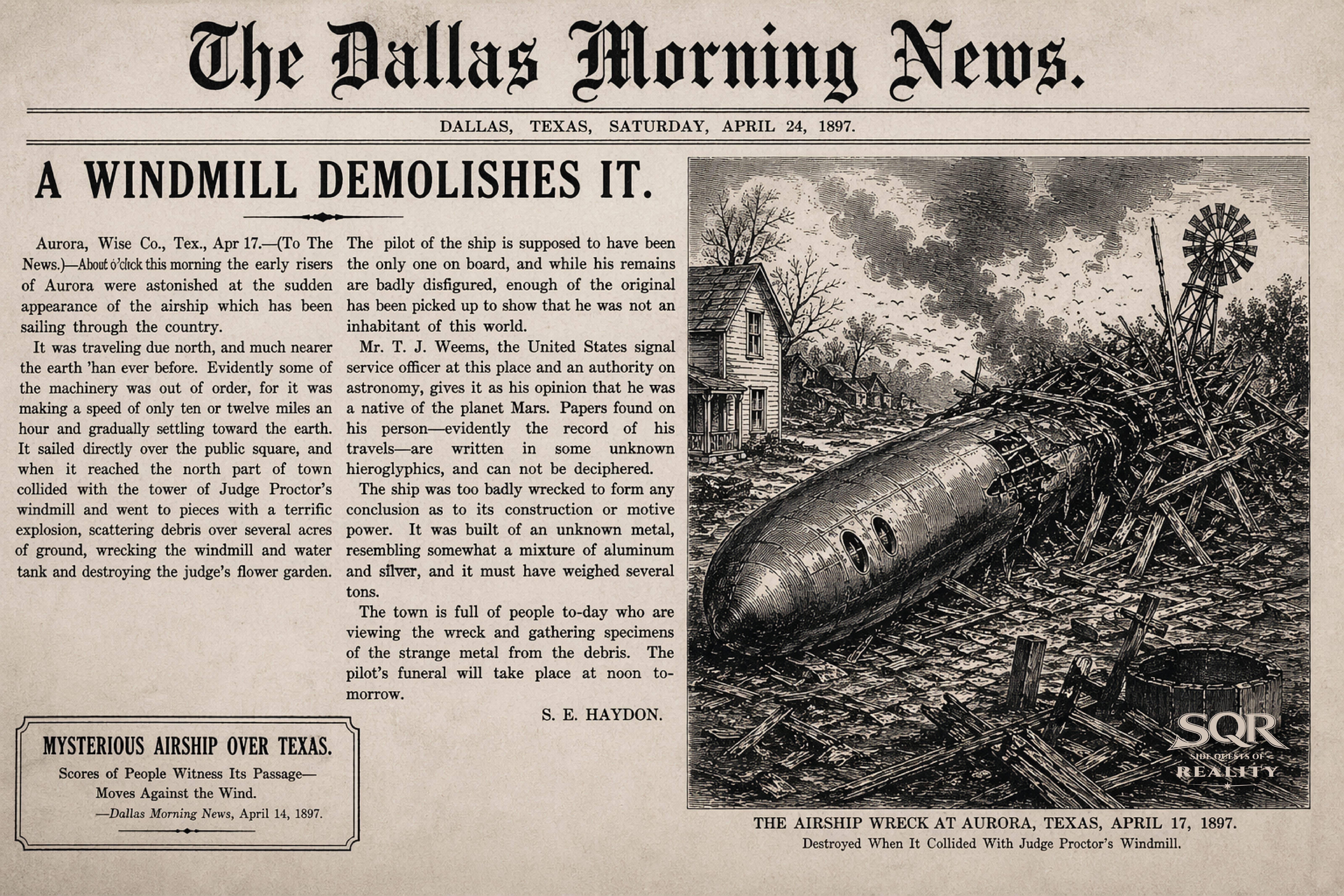
On April 19, 1897, the Dallas Morning News published a brief report from its Aurora correspondent, a local man named S.E. Haydon. The article was titled, with a certain dry Texas wit, A Windmill Demolishes It.
What it described was this.
On the morning of April 17, at around six o’clock, an airship that had been seen moving across the area appeared over Aurora, traveling north and moving lower than usual. It appeared to be in distress, its speed reduced to ten or twelve miles per hour, gradually settling toward the earth. It passed over the town square and reached the northern edge of Aurora, where it struck the windmill tower on the property of a Judge J.S. Proctor.
It exploded.
The debris scattered over several acres of ground, wrecking the windmill, destroying the water tank, and demolishing the judge’s flower garden.
Among the wreckage, the townspeople found the pilot.
Haydon wrote: while his remains are badly disfigured, enough of the original has been picked up to show that he was not an inhabitant of this world.
The ship, Haydon reported, was built of an unknown metal, resembling somewhat a mixture of aluminum and silver, and must have weighed several tons. Papers written in a strange form of hieroglyphics were found on the body. A local Army Signal Service officer named T.J. Weems examined the remains and offered his opinion that the pilot was a native of the planet Mars.
The townspeople gave the pilot a Christian burial in the Aurora Cemetery. A stone marker was placed at the head of the grave.
The article ends with a note that the town was buzzing with people viewing the wreckage and collecting specimens of the strange metal.
That is all there is. One article. Two days after the event. No follow-up. No photographs. No other newspapers in the region reported any such funeral. The story attracted no significant attention at the time, appeared briefly in the Dallas Morning News, and then vanished from the record for the better part of seventy years.
The Hoax Case
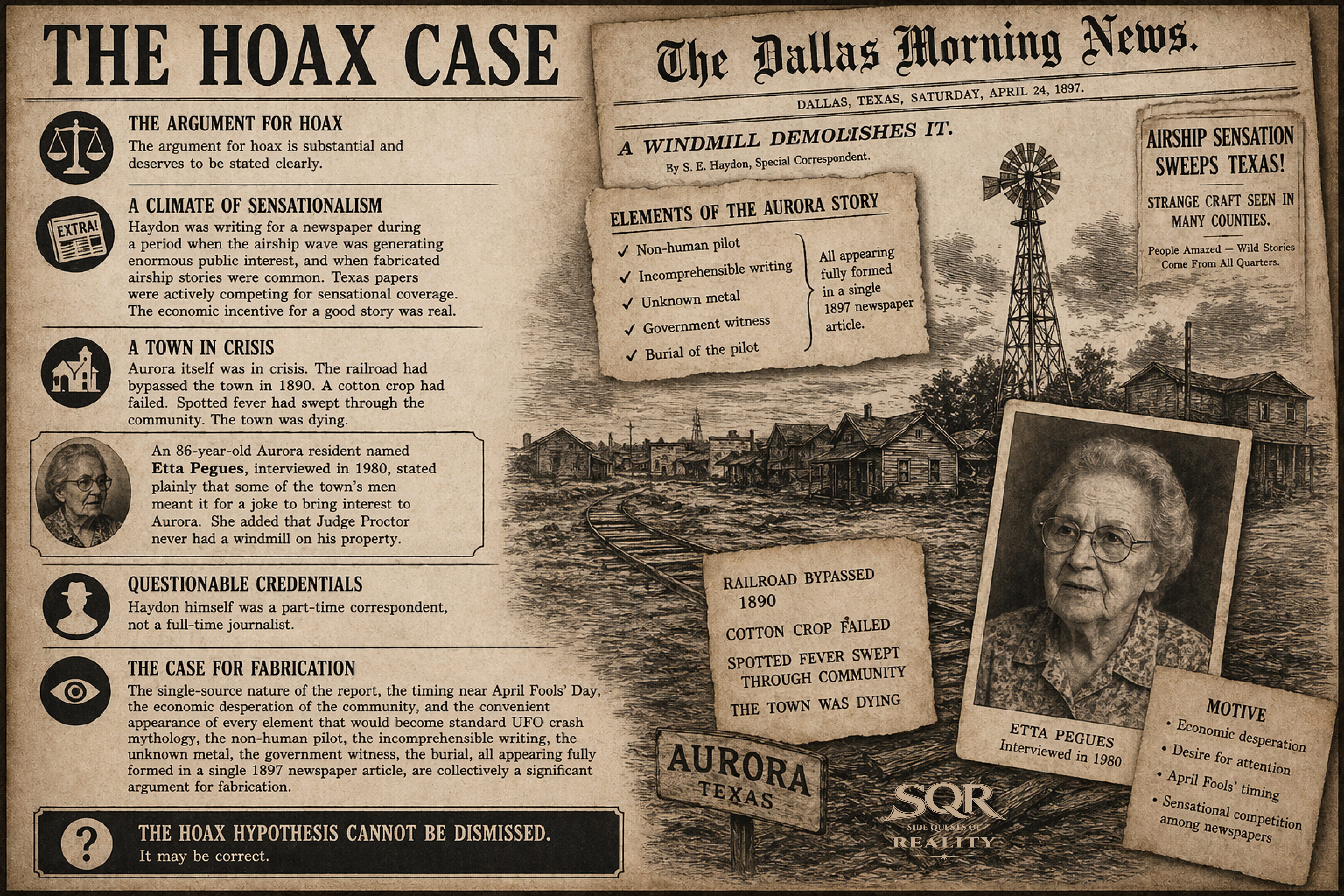
The argument for hoax is substantial and deserves to be stated clearly.
Haydon was writing for a newspaper during a period when the airship wave was generating enormous public interest, and when fabricated airship stories were common. Texas papers were actively competing for sensational coverage. The economic incentive for a good story was real.
Aurora itself was in crisis. The railroad had bypassed the town in 1890. A cotton crop had failed. Spotted fever had swept through the community. The town was dying. An 86-year-old Aurora resident named Etta Pegues, interviewed in 1980, stated plainly that some of the town’s men meant it for a joke to bring interest to Aurora. She added that Judge Proctor never had a windmill on his property.
Haydon himself was a part-time correspondent, not a full-time journalist. The single-source nature of the report, the timing near April Fools’ Day, the economic desperation of the community, and the convenient appearance of every element that would become standard UFO crash mythology, the non-human pilot, the incomprehensible writing, the unknown metal, the government witness, the burial, all appearing fully formed in a single 1897 newspaper article, are collectively a significant argument for fabrication.
The hoax hypothesis cannot be dismissed. It may be correct.
What Complicates the Hoax
Several things do not fit cleanly.
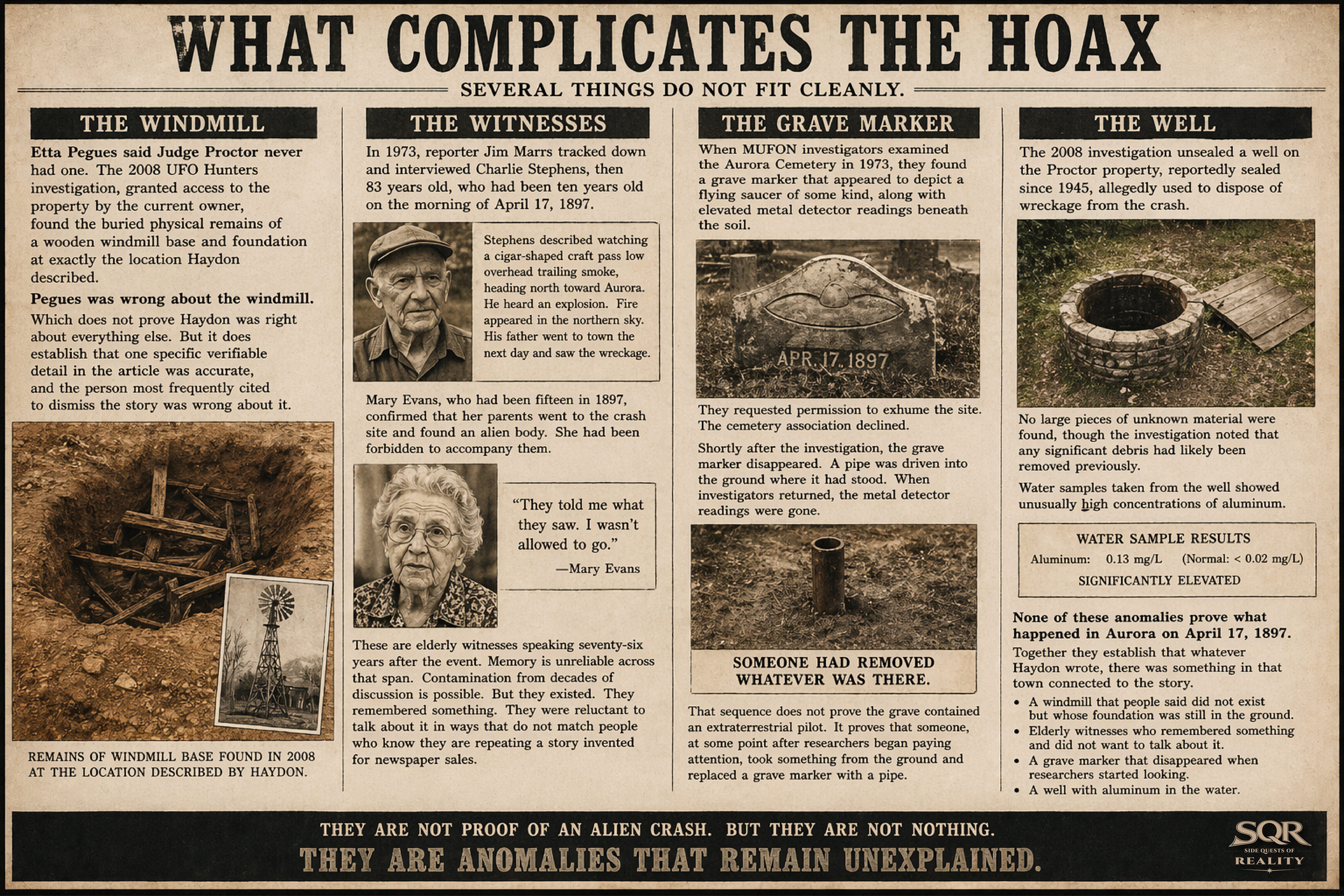
The windmill. Etta Pegues said Judge Proctor never had one. The 2008 UFO Hunters investigation, granted access to the property by the current owner, found the buried physical remains of a wooden windmill base and foundation at exactly the location Haydon described. Pegues was wrong about the windmill. Which does not prove Haydon was right about everything else. But it does establish that one specific verifiable detail in the article was accurate, and the person most frequently cited to dismiss the story was wrong about it.
The witnesses. In 1973, reporter Jim Marrs tracked down and interviewed Charlie Stephens, then 83 years old, who had been ten years old on the morning of April 17, 1897. Stephens had been reluctant to speak. After some time he described watching a cigar-shaped craft pass low overhead trailing smoke, heading north toward Aurora. He heard an explosion. Fire appeared in the northern sky. His father went to town the next day and saw the wreckage. Mary Evans, who had been fifteen in 1897, confirmed that her parents went to the crash site and found an alien body. She had been forbidden to accompany them.
These are elderly witnesses speaking seventy-six years after the event. Memory is unreliable across that span. Contamination from decades of discussion is possible. But they existed. They remembered something. They were reluctant to talk about it in ways that do not match people who know they are repeating a story invented for newspaper sales.
The grave marker. When MUFON investigators examined the Aurora Cemetery in 1973, they found a grave marker that appeared to depict a flying saucer of some kind, along with elevated metal detector readings beneath the soil. They requested permission to exhume the site. The cemetery association declined. Shortly after the investigation, the grave marker disappeared. A pipe was driven into the ground where it had stood. When investigators returned, the metal detector readings were gone.
Someone had removed whatever was there.
That sequence does not prove the grave contained an extraterrestrial pilot. It proves that someone, at some point after researchers began paying attention, took something from the ground and replaced a grave marker with a pipe.
The well. The 2008 investigation unsealed a well on the Proctor property, reportedly sealed since 1945, allegedly used to dispose of wreckage from the crash. No large pieces of unknown material were found, though the investigation noted that any significant debris had likely been removed previously. Water samples taken from the well showed unusually high concentrations of aluminum.
None of these anomalies prove what happened in Aurora on April 17, 1897.
Together they establish that whatever Haydon wrote, there was something in that town connected to the story. A windmill that people said did not exist but whose foundation was still in the ground. Elderly witnesses who remembered something and did not want to talk about it. A grave marker that disappeared when researchers started looking. A well with aluminum in the water.
The Deeper Question
Aurora sits inside a larger question that this series has been building toward from the beginning.
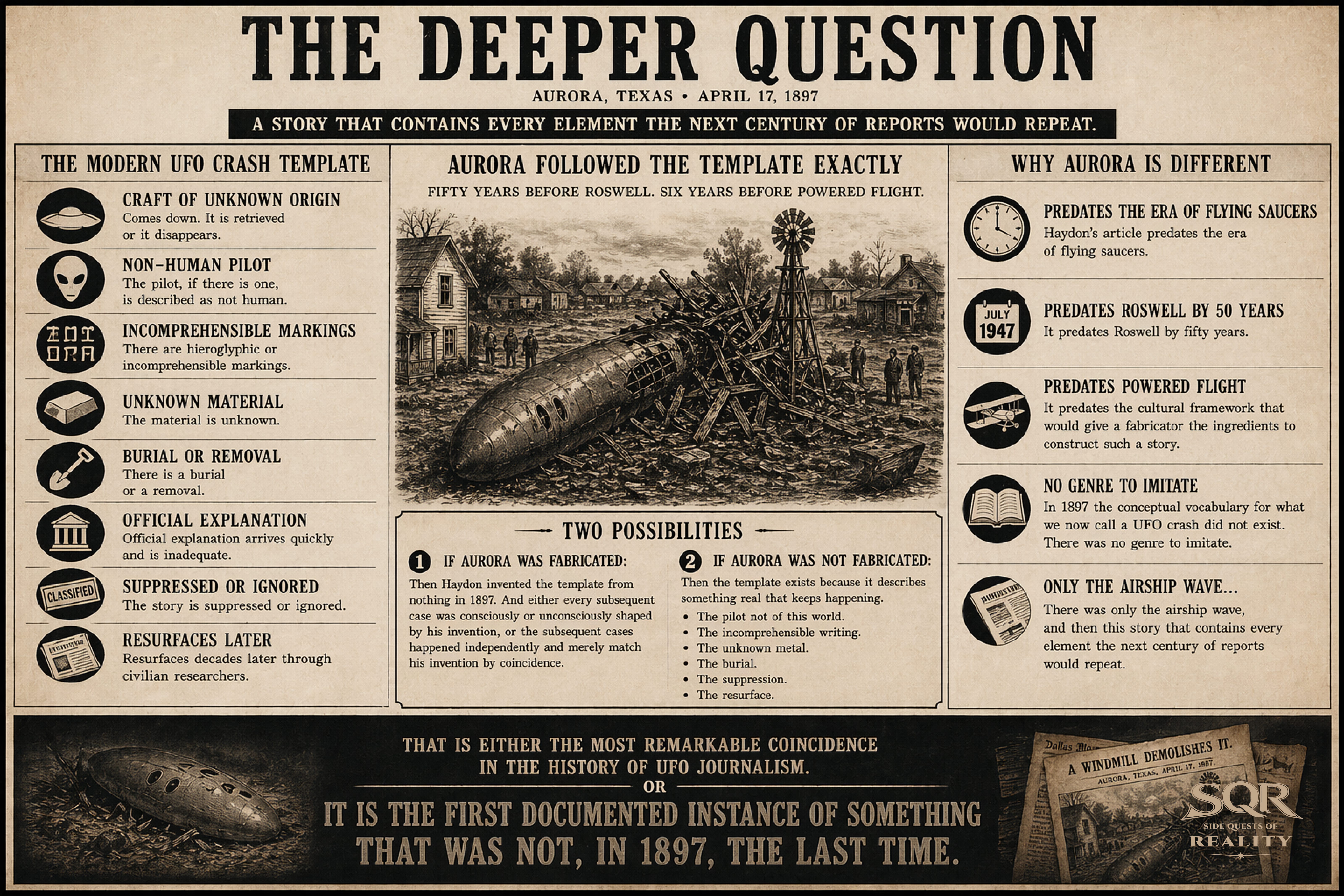
The modern UFO crash narrative has a template. A craft of unknown origin comes down. It is retrieved or it disappears. The pilot, if there is one, is described as not human. There are hieroglyphic or incomprehensible markings. The material is unknown. There is a burial or a removal. Official explanation arrives quickly and is inadequate. The story is suppressed or ignored and resurfaces decades later through civilian researchers.
Roswell follows this template. Rendlesham partially follows it. Aurora follows it exactly, fifty years before Roswell, six years before powered flight.
If Aurora was fabricated, then Haydon invented the template from nothing in 1897. And either every subsequent case was consciously or unconsciously shaped by his invention, or the subsequent cases happened independently and merely match his invention by coincidence.
If Aurora was not fabricated, then the template exists because it describes something real that keeps happening. The pilot not of this world. The incomprehensible writing. The unknown metal. The burial. The suppression. The resurface.
Haydon’s article predates the era of flying saucers. It predates Roswell by fifty years. It predates the cultural framework that would give a fabricator the ingredients to construct such a story. In 1897 the conceptual vocabulary for what we now call a UFO crash did not exist. There was no genre to imitate. There was only the airship wave, and then this story that contains every element the next century of reports would repeat.
That is either the most remarkable coincidence in the history of UFO journalism.
Or it is the first documented instance of something that was not, in 1897, the last time.
What Remains
A small cemetery in Wise County, Texas contains a grave.
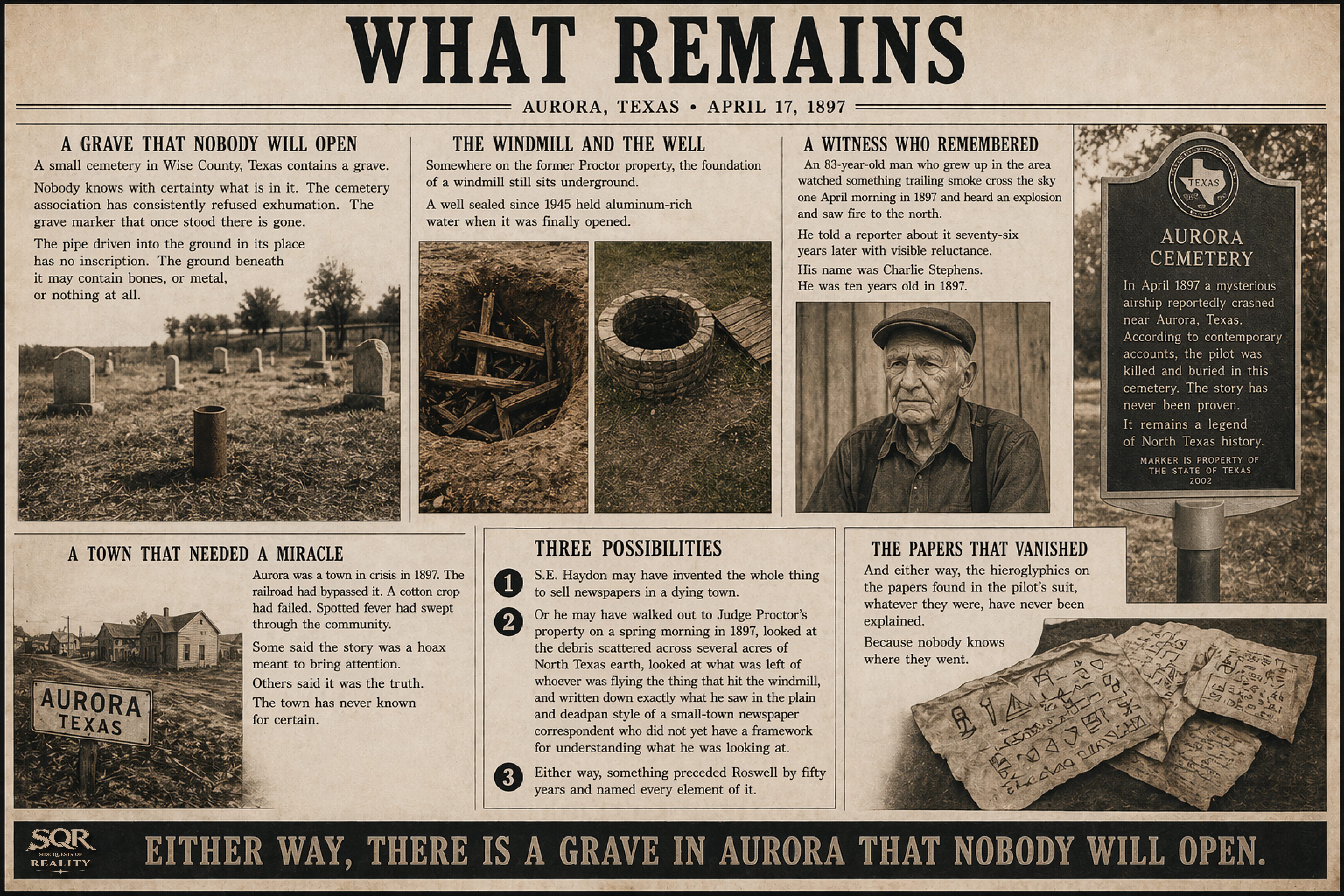
Nobody knows with certainty what is in it. The cemetery association has consistently refused exhumation. The grave marker that once stood there is gone. The pipe driven into the ground in its place has no inscription. The ground beneath it may contain bones, or metal, or nothing at all.
Somewhere on the former Proctor property, the foundation of a windmill still sits underground. A well sealed since 1945 held aluminum-rich water when it was finally opened. An 83-year-old man who grew up in the area watched something trailing smoke cross the sky one April morning in 1897 and heard an explosion and saw fire to the north and told a reporter about it seventy-six years later with visible reluctance.
The state of Texas has placed a historical marker at the Aurora Cemetery acknowledging the legend. The marker calls it a legend because that is the honest word for something that cannot be confirmed and has not been disproved.
S.E. Haydon may have invented the whole thing to sell newspapers in a dying town.
Or he may have walked out to Judge Proctor’s property on a spring morning in 1897, looked at the debris scattered across several acres of North Texas earth, looked at what was left of whoever was flying the thing that hit the windmill, and written down exactly what he saw in the plain and deadpan style of a small-town newspaper correspondent who did not yet have a framework for understanding what he was looking at.
Either way, something preceded Roswell by fifty years and named every element of it.
Either way, there is a grave in Aurora that nobody will open.
And either way, the hieroglyphics on the papers found in the pilot’s suit, whatever they were, have never been explained.
Because nobody knows where they went.
This case is filed as SQR-UFO-005.
If you want to be notified when SQR-UFO-006 drops, and when the cases start talking to each other in ways that are difficult to explain, subscribe below.
That’s all this is. Careful attention. Sustained over time. Welcome to Side Quests of Reality.