
Case Study SQR-UFO-008: The Place Bonaventure UFO Incident
SIDE QUESTS OF REALITY | SQR-UFO-008 | THE BONAVENTURE UFO INCIDENT
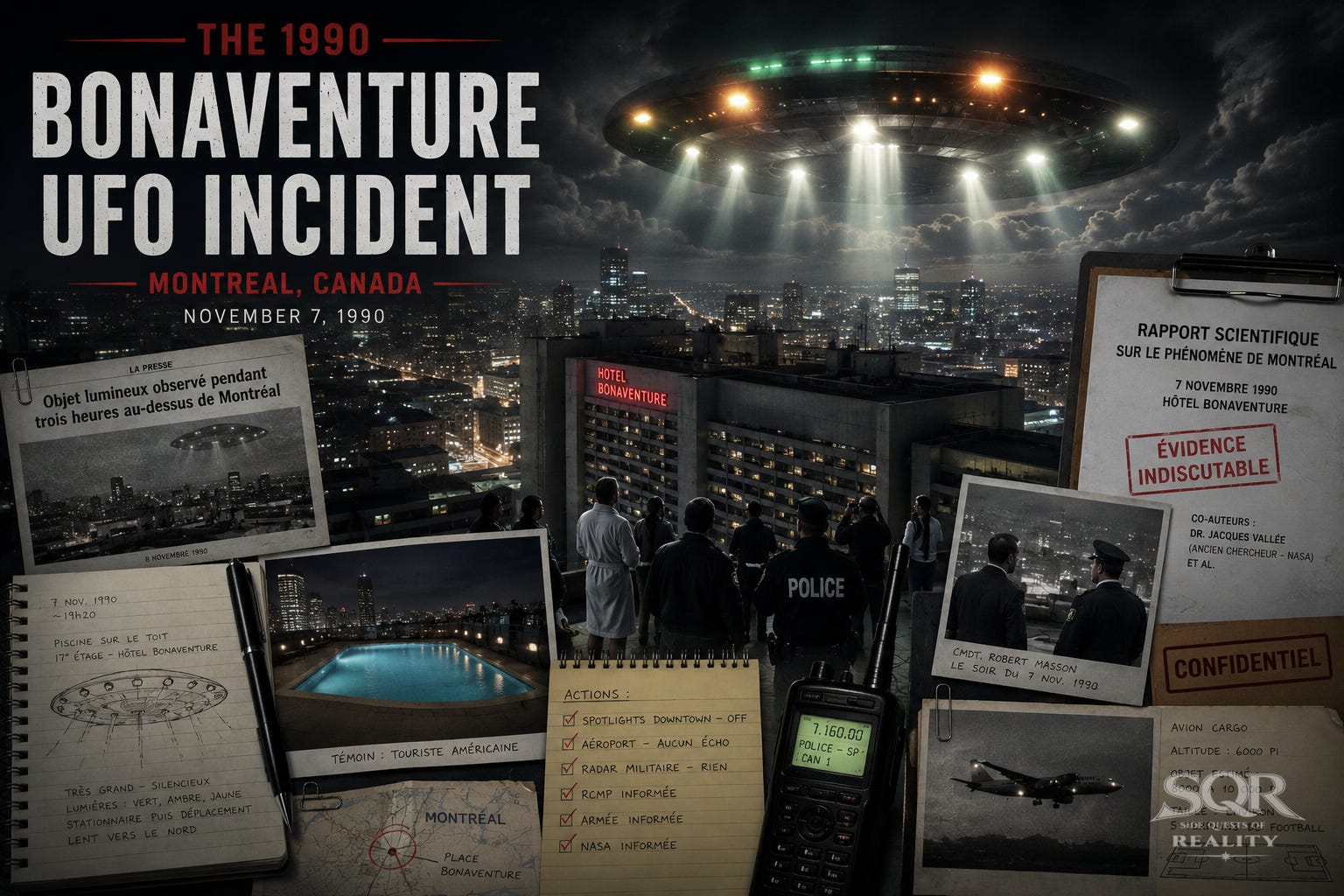
At approximately 7:20 in the evening on November 7, 1990, an American tourist floating on her back in a heated rooftop pool seventeen stories above downtown Montreal looked up at the cloudy night sky and saw something she could not account for.
This is where the ordinary part of the story ends.
What follows over the next three hours involves a police chief ordering every spotlight in downtown Montreal to be shut off, a cargo plane passing beneath a hovering object large enough to dwarf five football fields, journalists from La Presse watching it from the rooftop alongside officers who swore under their breath when they first looked up, and a 25-page scientific report co-authored by a former NASA researcher that concluded the evidence for the existence of a highly unusual, hovering, silent large object was indisputable.
It involves a police commander who spent the rest of his life convinced he had been lied to by the military.
What hovered above Place Bonaventure that night has never been officially identified. What it was is still not settled.
The Setting
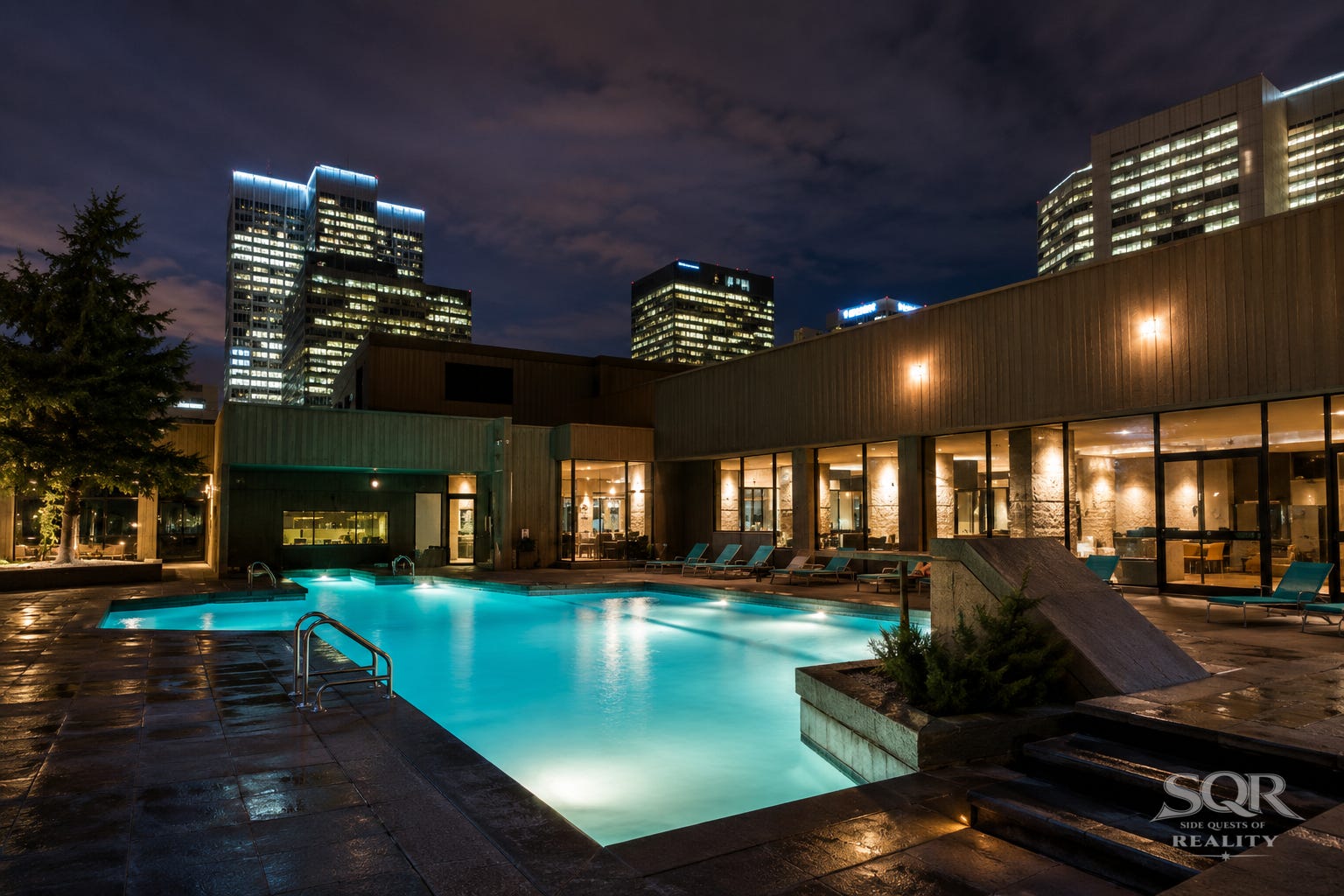
Place Bonaventure sits at the heart of downtown Montreal, a 17-storey concrete complex built in the Brutalist style that opened during the Expo ‘67 craze. At the time of its completion it was listed as the world’s largest building. Nestled on its upper floors is the Hotel Bonaventure, a four-star property with one of the more unusual amenities in the city: a heated rooftop pool, usable year-round, with a tunnel connecting the indoor and outdoor sections so guests can swim from inside the building out into the open air, floating beneath an unobstructed view of Montreal’s sky.
It is, as one writer later observed, the perfect place to spot a UFO.
November 7 was a Thursday. The temperature was cool. The sky was overcast and thickening through the evening. Whatever arrived over the hotel that night did so into conditions that made it difficult to photograph clearly and impossible to simply dismiss as a trick of light.
The First Witness
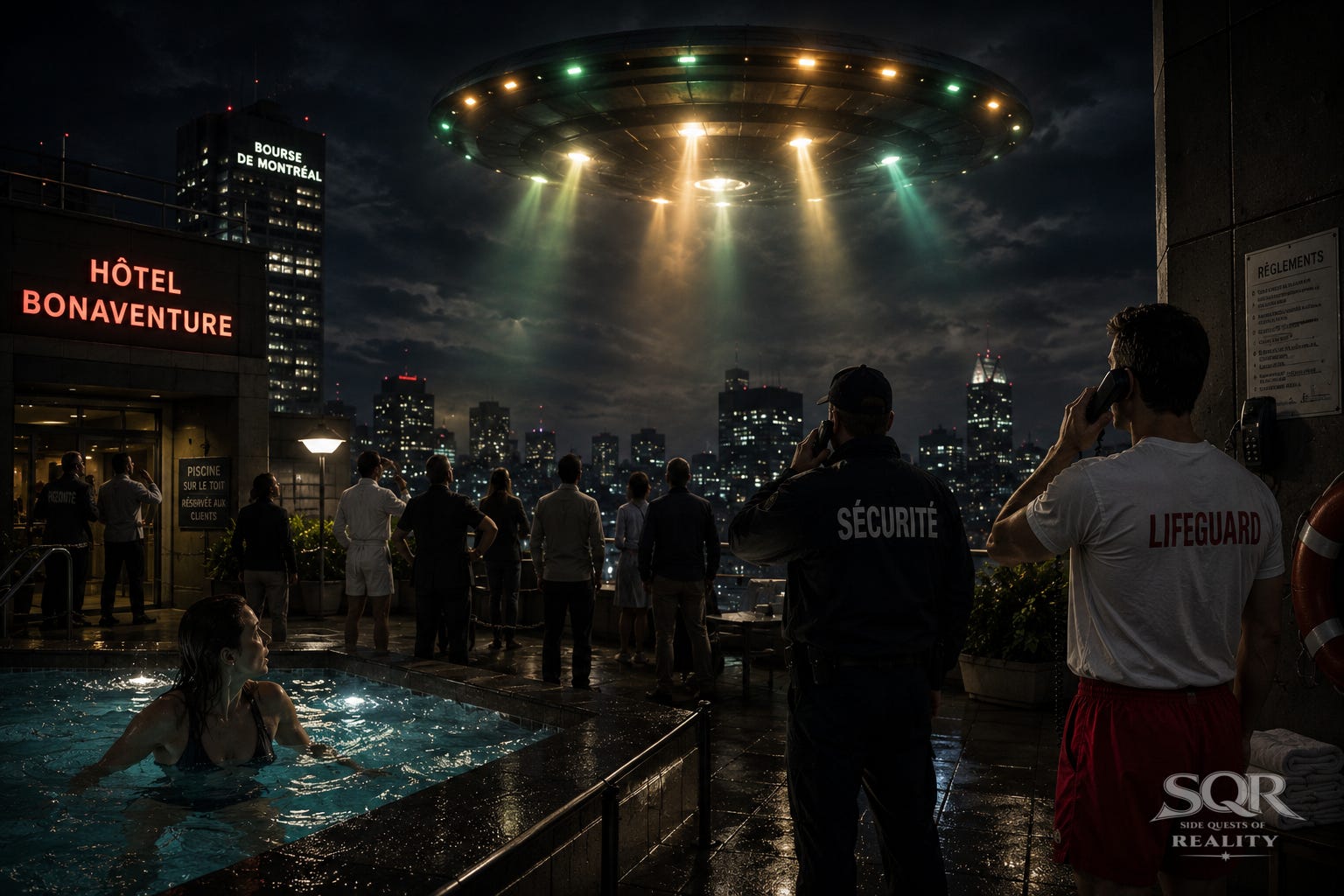
At around 7:20 p.m., an American tourist was enjoying a swim in the hotel’s rooftop pool, floating in the warm water surrounded by the property’s 2.5 acres of gardens. She suddenly spotted something unusual in the cloudy sky, gliding toward the hotel from the direction of the nearby Stock Market Building.
What she described was not subtle. A combination of green, amber, and yellow light beams appeared to emanate from a gigantic round, metallic object. The object coasted silently toward the hotel and then stopped, hovering directly overhead, almost without motion.
She alerted the lifeguard. The lifeguard called hotel security. Before long, around thirty people had made their way to the hotel’s roof to look. Hotel guests, staff, and management stood in amazement at the sight unfolding above them. Occasionally, the lights emanating from the object would appear to glow brighter.
Hotel management contacted the police.
The Police Response
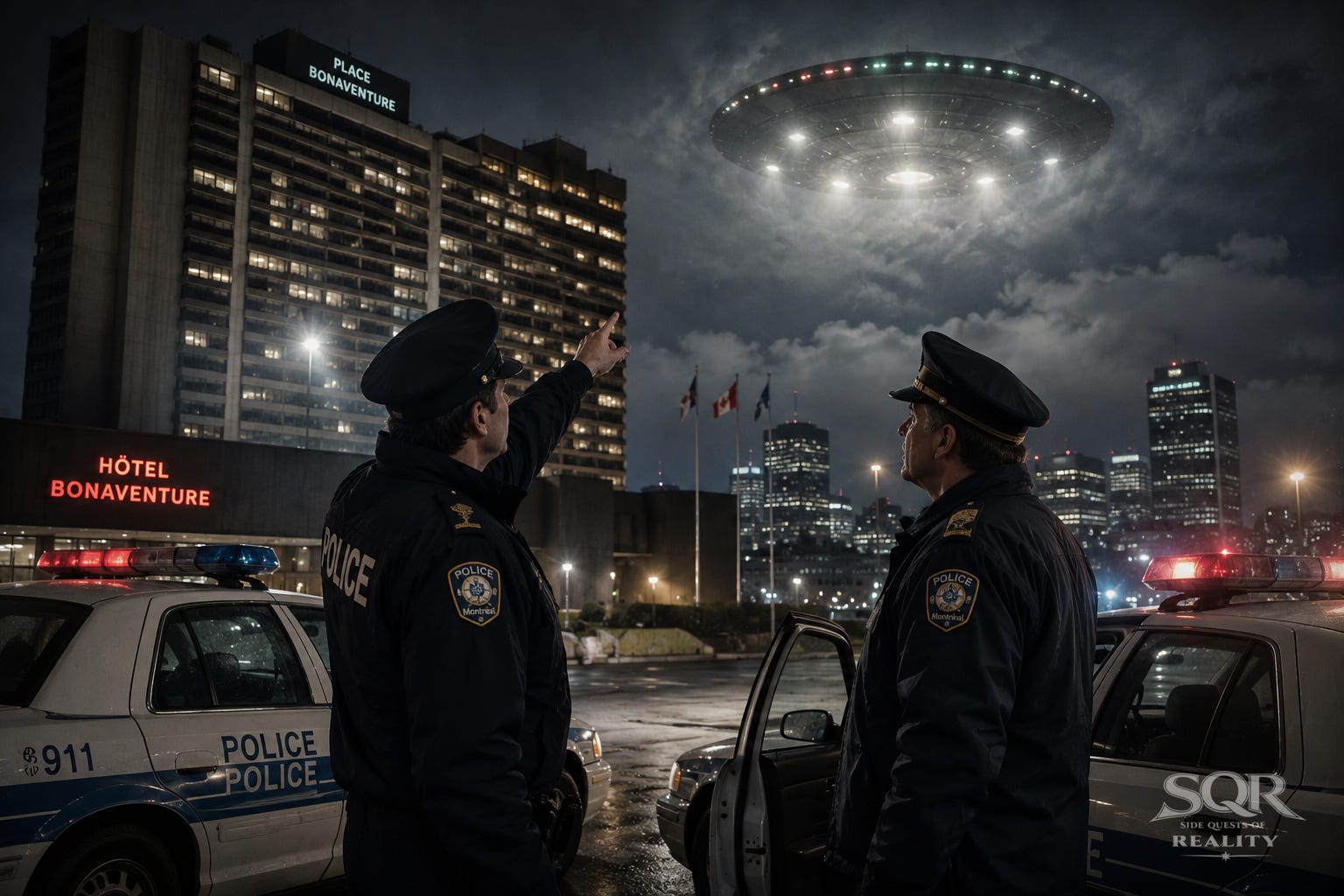
The first officer to arrive was François Lippé. Baffled by what he saw, he contacted his superiors and asked them to come look for themselves. His boss, neighbourhood post commander Robert Masson, soon arrived on the scene.
Masson would oversee the initial police investigation that evening. Thinking it could be an optical illusion, he immediately ordered all spotlights across downtown to be turned off lest they be creating some kind of reflection effect. The object in the sky remained.
This detail is worth pausing on. A police commander, confronted with an unexplained aerial phenomenon over a major city, had the presence of mind to eliminate artificial light sources as a possible explanation in real time. He ordered the elimination of a variable. The object did not go away.
Masson contacted both the local airport and a nearby military radar outpost. Neither facility claimed to have seen anything unusual on their radar. As news of the sighting spread, the RCMP, the military, and NASA all joined the investigation.
The chain of escalation is its own form of data. When a local police response calls in the national police, then the military, then the American space agency, the event has already exceeded the category of misidentification. Nobody calls NASA because they spotted a weather balloon.
The Size Problem
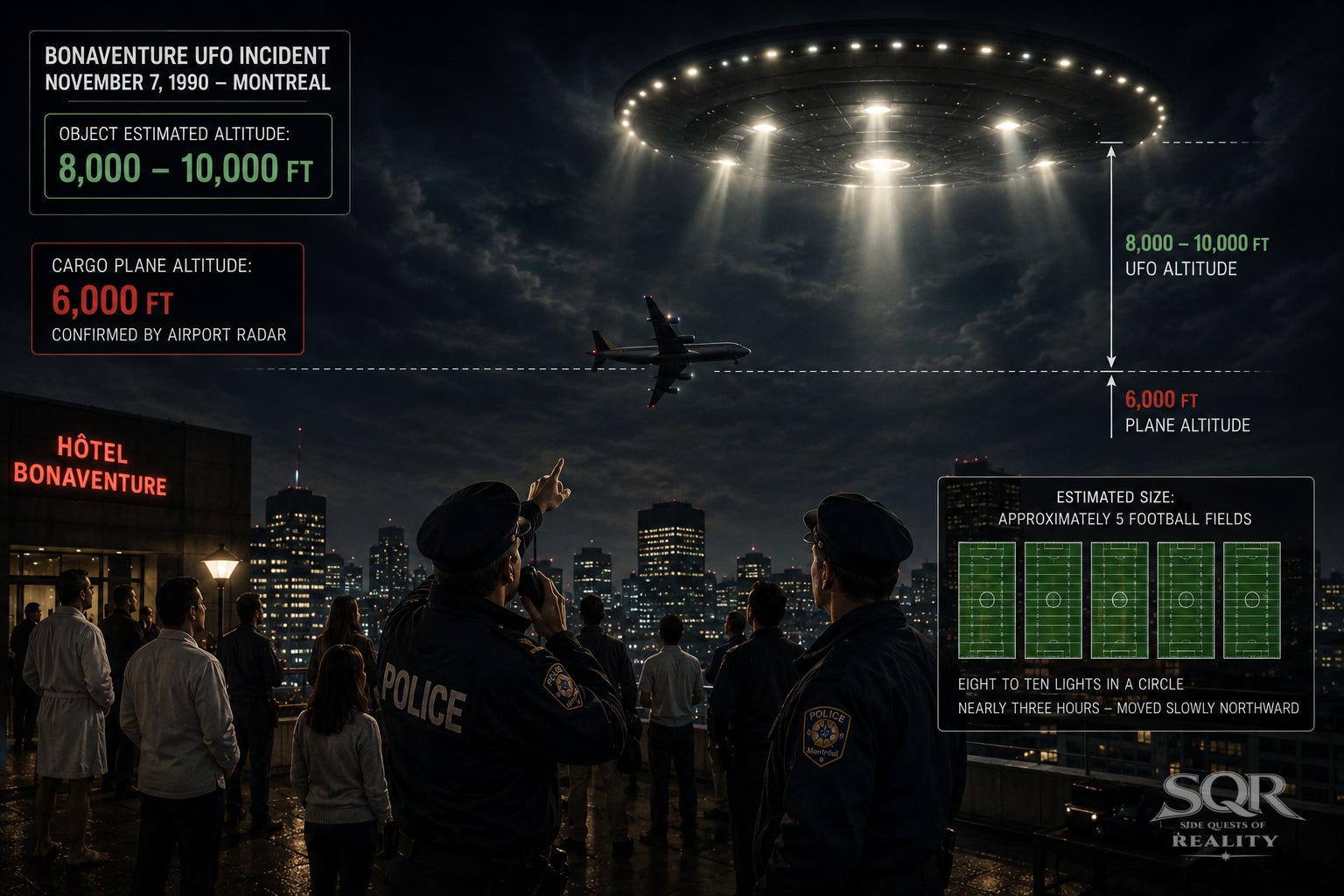
At one point in the evening, a cargo plane visible on airport radar passed between the roof of the hotel and the hovering object above. Knowing the cargo plane was flying at 6,000 feet, Masson estimated the object to be around 8,000 to 10,000 feet above the ground.
He then used the cargo plane as a reference point.
Judging by the size of the cargo plane compared to the object, he estimated it to be roughly the size of five full football fields.
This is not a fringe interpretation or a witness embellishing a dim memory years later. It is a trained police commander making a real-time size estimate using a known object as a reference, while a radar-tracked aircraft provided the altitude baseline. The methodology is sound. The conclusion it produced is extraordinary.
Eyewitnesses reported eight to ten lights forming a circle, giving off bright white rays. The phenomenon lasted nearly three hours and moved slowly northward.
The Press Arrives
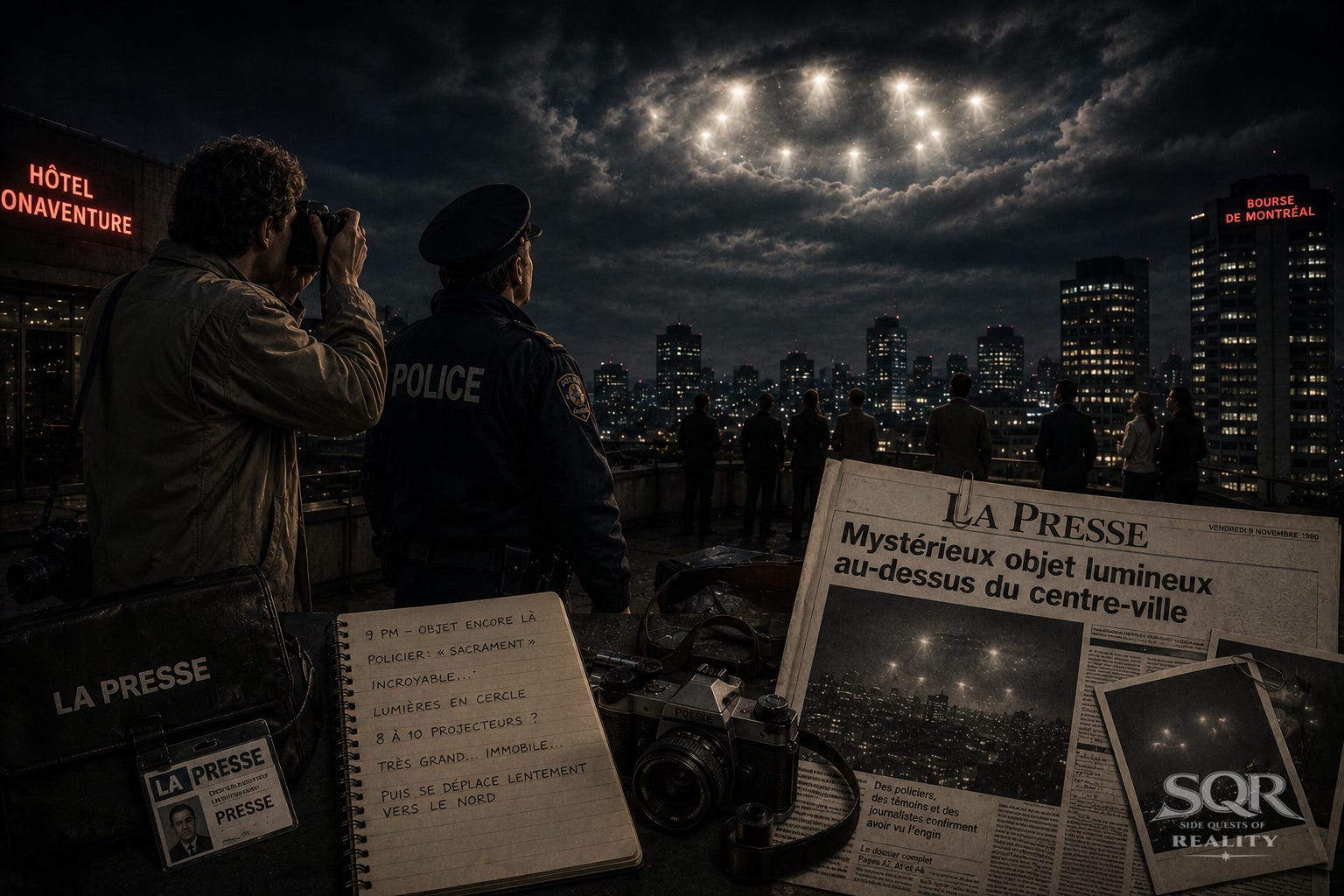
By 9 p.m., the press had caught wind of the situation at the hotel. The object was still there. La Presse reporters Jules Béliveau and Marcel Laroche witnessed it firsthand, their story and photographs landing in print the next morning.
In an interview with the CBC, Béliveau later described taking the elevator up to the hotel rooftop with a police officer, who joked about whether he should use his gun. When they arrived together on the roof, the officer looked into the sky and said “sacrament.” He was astonished, just as Béliveau was.
The photographs taken by Laroche that night remain the primary visual record of the event. They show a cluster of lights hovering in the cloudy sky above the city, indistinct but clearly present, clearly structured, and clearly not consistent with any conventional light source.
Finally, around 10 p.m., the clouds had become thick enough to obscure the object. It was never seen again.
The Classification
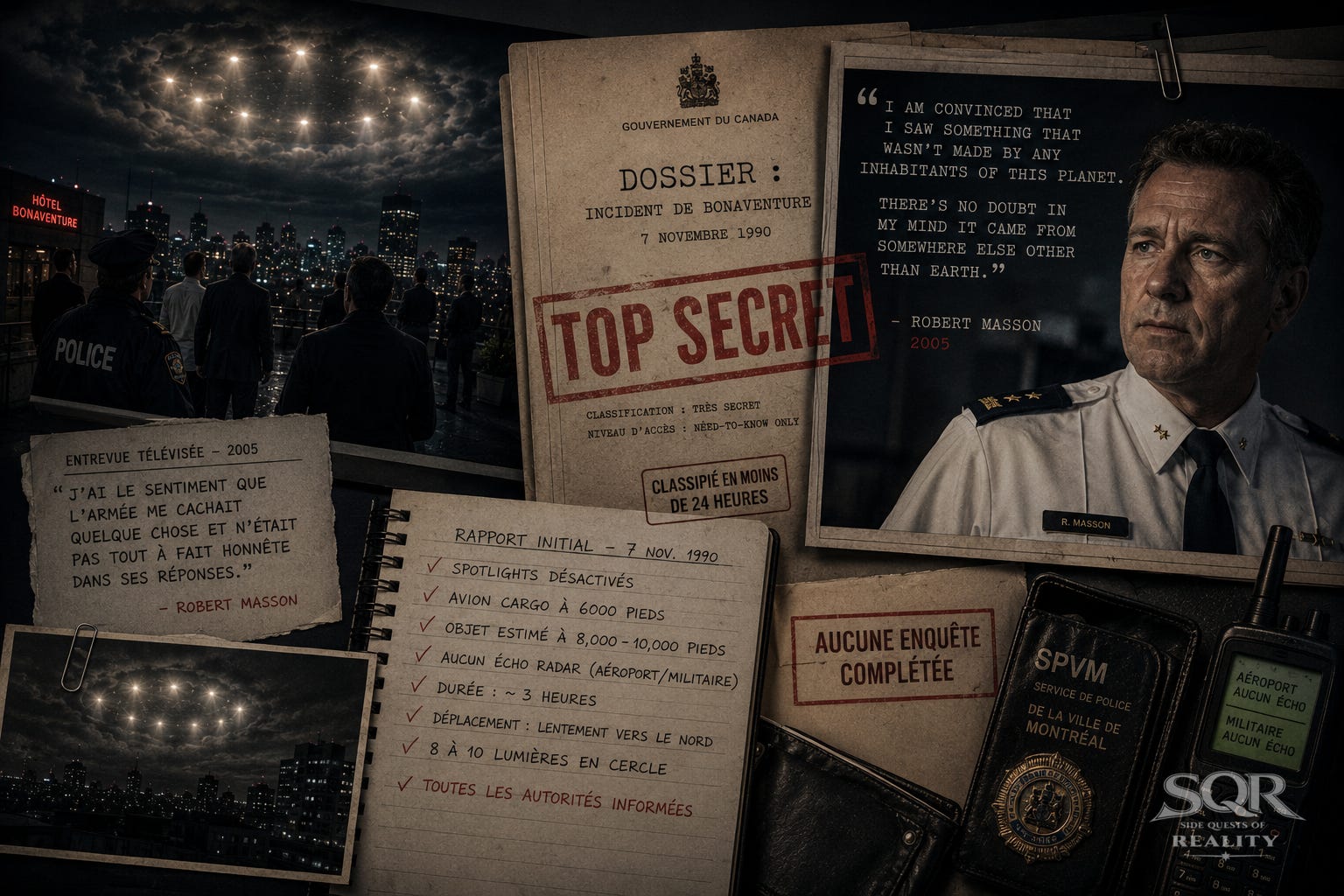
All official files related to the case were classified as Top Secret within less than 24 hours of the sighting.
Not reviewed. Not assessed. Not quietly filed. Classified, within a day, before any formal investigation could have been completed.
Several years later, Police Chief Robert Masson stated that he had the feeling the military was hiding something from him, and not being completely honest in answering his questions. In 2005, he told a Canadian television program: “I am convinced that I saw something that wasn’t made by any inhabitants of this planet. There’s no doubt in my mind it came from somewhere else other than Earth.”
This is not a fringe witness speaking. This is the police commander who oversaw the initial response, who ordered the spotlights turned off, who tracked the cargo plane as a size reference, who coordinated with radar stations and military authorities. He spent the subsequent fifteen years arriving at a conclusion he could not set aside.
The Report
In 1992, a 25-page report called “Details Surrounding a Large Stationary Object Above Montreal” was prepared by Bernard Guénette, a UFO researcher in Montreal, and Richard F. Haines, a former scientist with NASA.
The report suggested that some sort of huge physical object, about 540 metres wide, was responsible for the beams of light, but it failed to identify where the object came from or why it was over Montreal. The report concluded that the evidence for the existence of a highly unusual, hovering, silent large object was indisputable.
The Guénette-Haines report is the most rigorous document produced from this case, and it is unambiguous in its central finding. The question it does not answer is the one that matters: what was it.
📄Access the report here
The Explanations
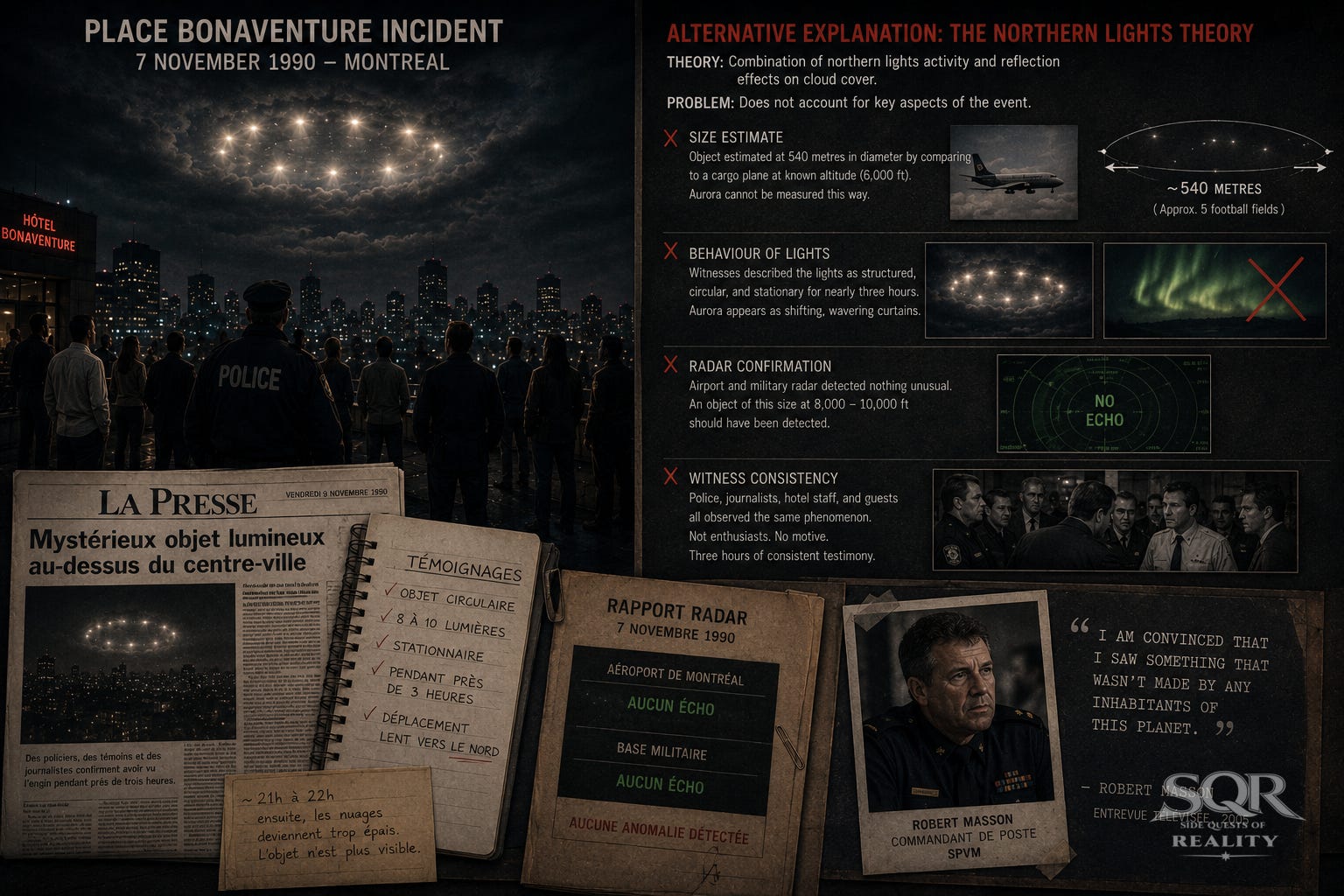
The official explanations for the Place Bonaventure incident have been limited and, where offered, unconvincing.
The most persistent alternative explanation is atmospheric: that the lights were produced by a combination of northern lights activity and reflection effects from the cloud cover. The northern lights theory has the advantage of accounting for colored lights visible over a wide area without requiring a physical object.
It does not account for the size estimate derived from the passing cargo plane. Northern lights do not have an edge that can be compared to a known aircraft at a known altitude to produce a measurement of approximately 540 metres.
It does not account for the behavior of the lights, which witnesses consistently described as structured, circular, and stationary rather than the shimmering, shifting curtains associated with aurora activity.
It does not account for the radar situation. Both the airport and the military radar outpost reported nothing unusual. If the object was large enough to be the size of five football fields and hovering at 8,000 to 10,000 feet, its absence from radar is itself a significant anomaly, one that the northern lights theory does not address.
According to the next day’s report in La Presse, while no one could identify the lights, few witnesses were ready to express a belief that they had been visited by aliens.
This is the civilian version of the Rendlesham response: something happened, but nobody wants to say what. The witnesses were not UFO enthusiasts looking for confirmation. They were a police commander, working journalists, hotel security staff, and guests who happened to be swimming. They had no investment in the outcome. What they had was three hours of sustained observation of something that did not behave like anything they had a category for.
What the Credibility Question Actually Means
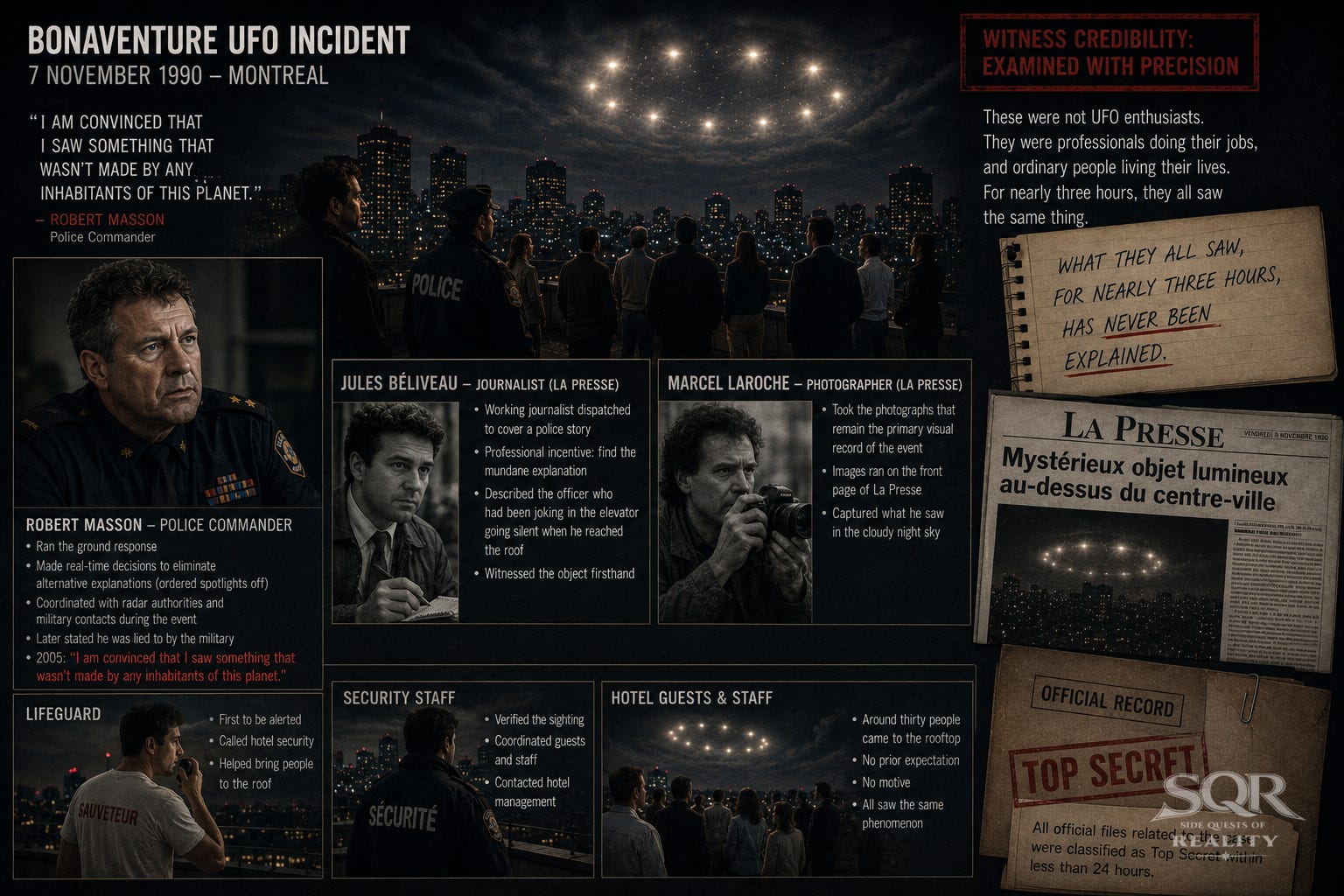
In UFO research, witness credibility is often invoked but rarely examined with precision. What it actually means in this case is the following.
Robert Masson was not an anonymous caller to a tip line. He was the police commander who ran the ground response, made real-time methodological decisions to eliminate alternative explanations, and coordinated with radar authorities and military contacts while the event was still ongoing. His later conviction that he was lied to by the military is not the conclusion of a credulous observer. It is the conclusion of a law enforcement professional who had access to the institutional response and found it insufficient.
Jules Béliveau and Marcel Laroche were working journalists dispatched to cover a police story. Their professional incentive was to find the mundane explanation, file a skeptical piece, and move on. Instead, Béliveau described an officer who had been joking in the elevator going silent when he reached the roof. Laroche photographed what he saw and the images ran on the front page.
The lifeguard, the security staff, the thirty guests who came to the rooftop: none of these people had a reason to see something that was not there.
What they all saw, for nearly three hours, has never been explained.
What the Coin Means
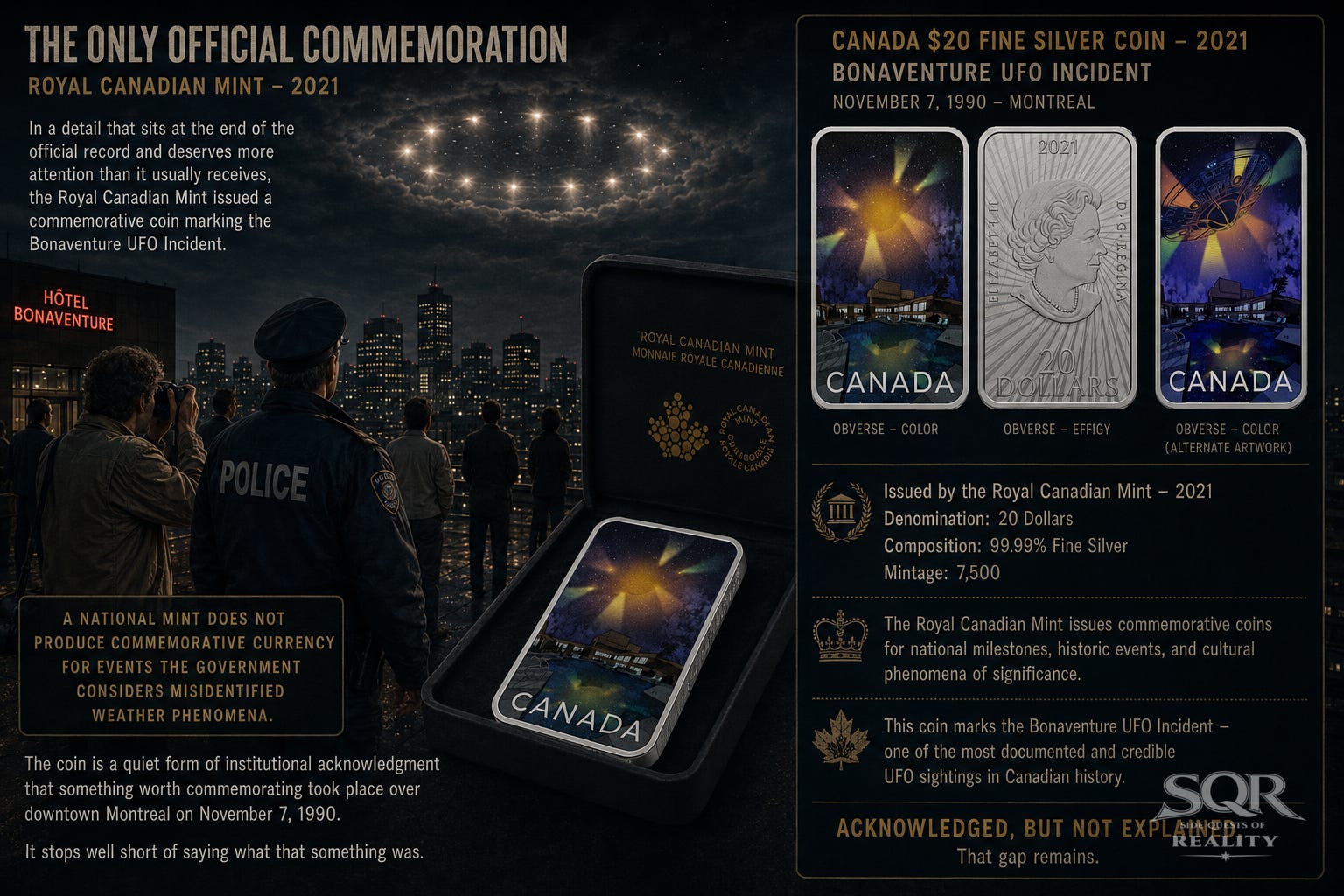
In a detail that sits at the end of the official record and deserves more attention than it usually receives, the Royal Canadian Mint issued a commemorative coin marking the incident.
A national mint does not produce commemorative currency for events the government considers misidentified weather phenomena. The coin is a quiet form of institutional acknowledgment that something worth commemorating took place over downtown Montreal on November 7, 1990. It stops well short of saying what that something was.
That gap, between acknowledgment and explanation, is where the case has lived for thirty-five years.
What Place Bonaventure Is
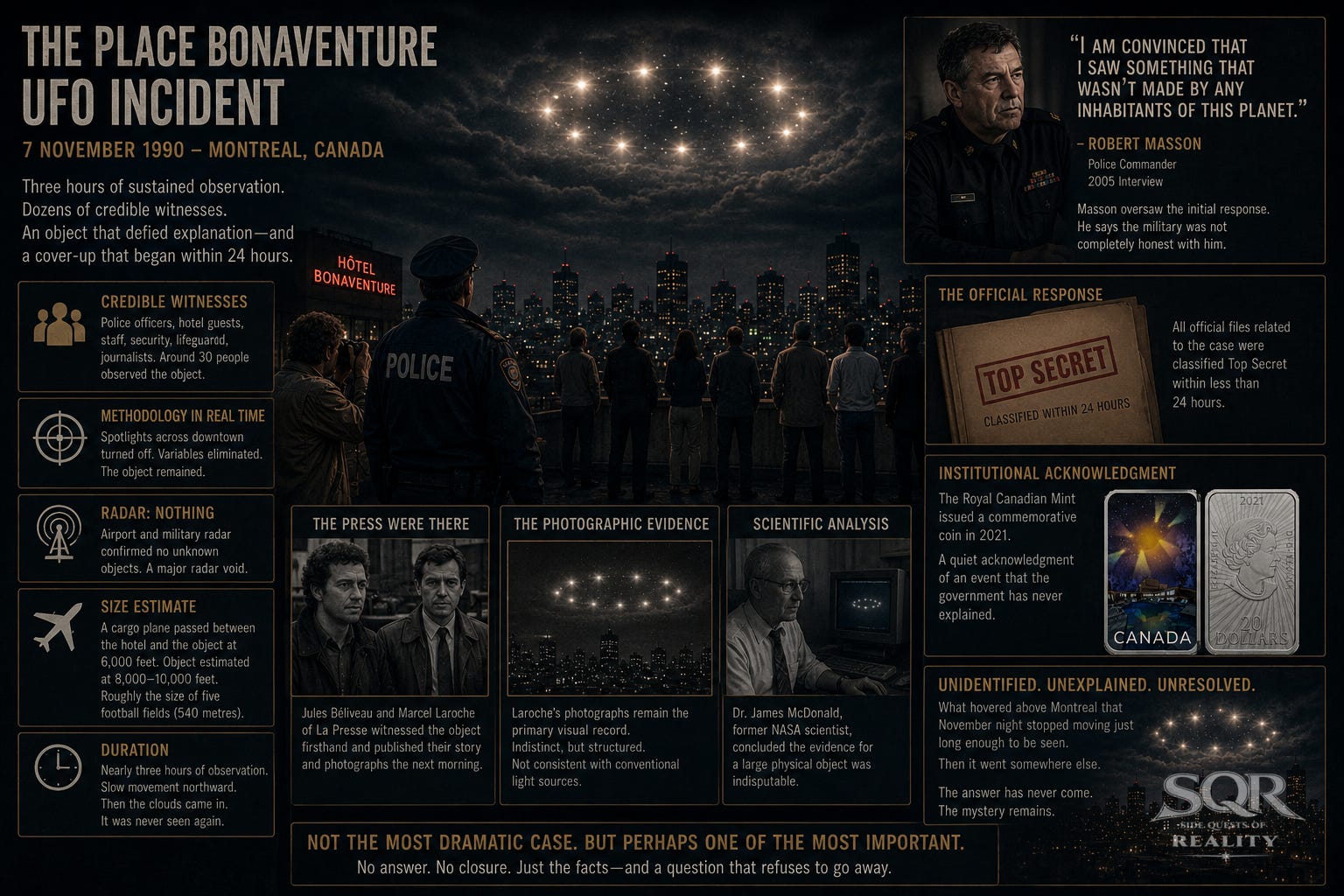
The Place Bonaventure incident is not the most dramatic event in the UFO record. It does not involve close-approach craft, physical contact, or the kind of multi-night military documentation that makes Rendlesham so difficult to set aside.
What it has is something rarer: an unbroken chain of credible institutional witnesses, real-time methodological elimination of alternative explanations, an independent scientific report that found the evidence for a large physical object indisputable, and a police commander who spent the rest of his life maintaining that the military had not been honest with him about what was there.
It has a radar void that has never been explained. A size estimate derived from a known aircraft at a known altitude. Three hours of sustained observation in the middle of a major North American city. Files classified within twenty-four hours. And a commemorative coin from the Royal Canadian Mint.
What it does not have is an answer.
What hovered above Montreal that November night stopped moving just long enough for thirty people on a rooftop to look up, for a police commander to start eliminating variables, for journalists to photograph it, and for a former NASA scientist to conclude years later that its existence was beyond reasonable dispute.
Then the clouds came in.
And whatever it was went somewhere else.
Unidentified. Unexplained. Unresolved.
This case is filed as SQR-UFO-008.
That’s all this is. Careful attention. Sustained over time.
Welcome to Side Quests of Reality.