
Case Study SQR-PAR-002: The Rosenheim Poltergeist, and what happens when physicists cannot explain a nineteen-year-old secretary
SIDE QUESTS OF REALITY | SQR-PAR-002 | THE ROSENHEIM POLTERGEIST
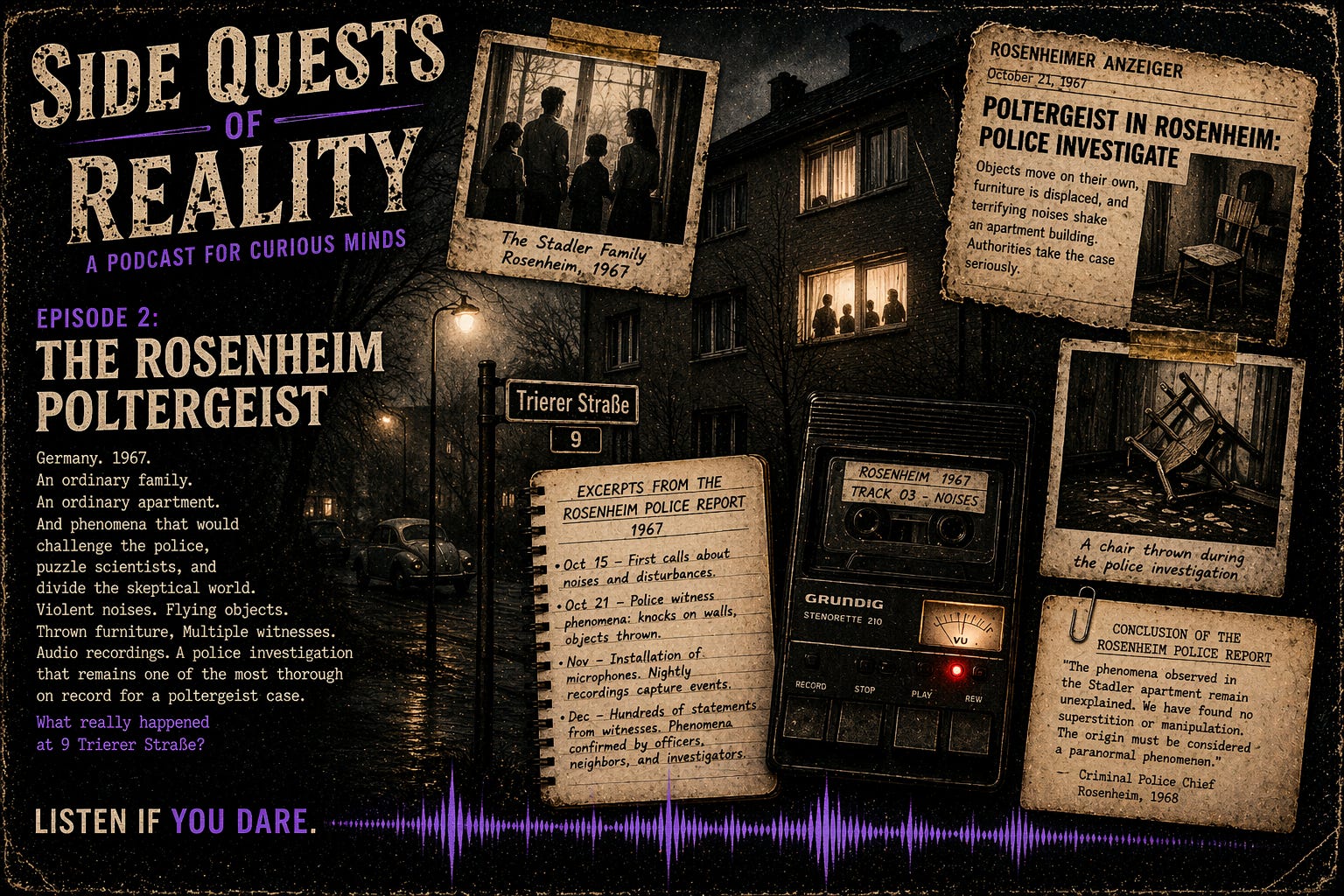
The Enfield case had police officers, journalists, and paranormal investigators.
The Rosenheim case had physicists from the Max Planck Institute.
That distinction matters. The Max Planck Institute is one of the most respected scientific research organizations in the world. Its physicists do not investigate law offices in small Bavarian towns as a matter of routine. They were called to Rosenheim in 1967 because what was happening in that office had already exhausted every conventional technical explanation available to the electrical company, the telephone authority, and the local engineers who had been trying to fix it for weeks.
What the physicists found, and what they concluded, and what happened the day the nineteen-year-old secretary left her job, is the case.
The Setting
Rosenheim is a small city in southern Bavaria, situated on the banks of the Inn River in the foothills of the Alps. In 1967 it was an ordinary provincial town, known for nothing remarkable. The law offices of attorney Sigmund Adam occupied a building in the city center. The office had four telephone lines, standard electrical infrastructure, a small staff of secretaries, and nothing in its history to suggest it would become the most scientifically examined poltergeist case in European history.
The disturbances began in the autumn of 1967. They began, as disturbances often do, with things that looked like technical problems.
What Began as Technical Problems
The first signs were electrical. Neon ceiling lights flickered repeatedly and without identifiable cause. Fuses blew at a rate that the building’s electrical system could not account for. Developing fluid leaked spontaneously from the office photocopier, an expensive and disruptive problem that occurred repeatedly despite technical inspection finding nothing wrong with the machine.
The telephone system was stranger. All four of the office’s telephone lines began behaving in ways that the telephone company could not initially explain. Calls were cut off mid-conversation. Calls came in with no one on the other end. And then the bills arrived.
The telephone company’s records showed an extraordinary volume of outgoing calls to the speaking clock, the automated time service reached by dialing 0119 in Germany. The calls were being made from the office’s own lines. The problem was that the office staff denied making them, and the volume was impossible to account for through normal use. Within a five-week period, the instruments recorded approximately 600 calls to the speaking clock. In one fifteen-minute period, the speaking clock had been called 46 times. The mechanical dialing system of the era made that rate of calling physically impossible through normal use of the handset.
The telephone company installed monitoring equipment to track the calls. The calls continued. The monitoring equipment confirmed they were originating from within the office. No one was touching the phones when the calls registered.
The electric company sent engineers. They installed instruments to monitor the power supply. What they recorded were substantial surges in the electrical system with no identifiable external cause. The surges preceded the flickering and the blown fuses. They were not the result of a fault in the building’s wiring. They appeared to originate from within the office itself.
The engineers could not explain what they were measuring. They escalated.
The Investigation Assembles
By December 1967, the case had attracted the attention of Hans Bender, director of the Institut für Grenzgebiete der Psychologie und Psychohygiene at the University of Freiburg, Germany’s foremost parapsychological research institution. Bender was a serious researcher with decades of experience in the systematic investigation of anomalous phenomena. He arrived in Rosenheim with a team and began a methodical examination of the office.
What he found in the first days of investigation went considerably beyond electrical anomalies.
Light fixtures were not merely flickering. They were swinging. Ceiling lamps moved back and forth with no air current or vibration to account for the motion. Light bulbs unscrewed themselves from their fittings. Paintings hanging on the walls rotated on their hooks, sometimes captured on the video equipment Bender had brought specifically to document physical phenomena. Desk drawers opened without being touched. A heavy storage shelf weighing approximately 180 kilograms was reported to have moved away from the wall with no one near it.
The phenomena, Bender and his team observed, were not random. They appeared to correlate with the presence of a specific person in the office.
Her name was Annemarie Schneider.
Annemarie Schneider
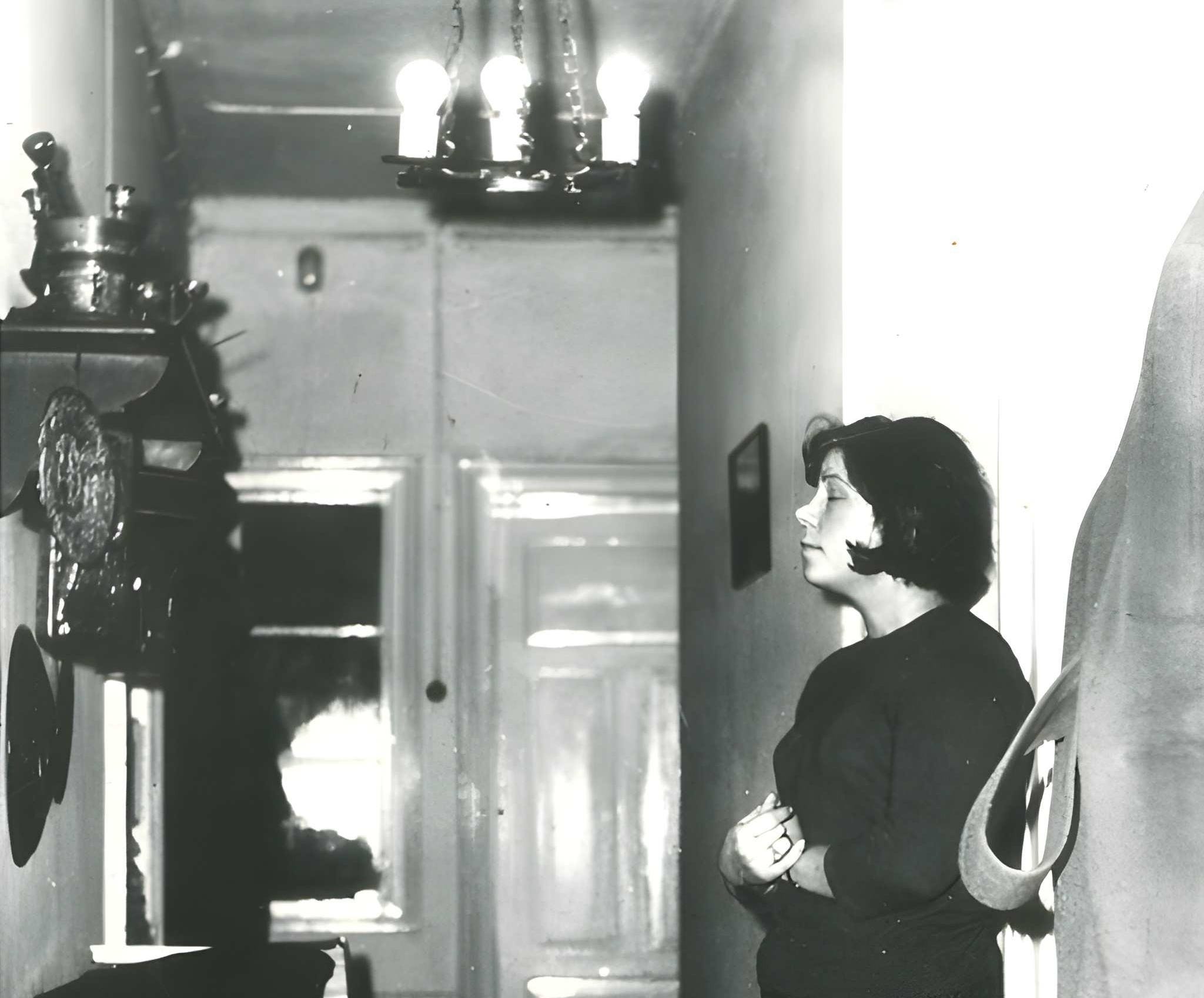
Annemarie Schneider was nineteen years old. She was a secretary at the Adam law firm. She had recently gone through a broken engagement and, by her own account to investigators, was frustrated with her job and unhappy in her professional situation.
She was, in the language that Bender and his colleagues would use in their formal reports, the focal agent.
The correlation between Schneider’s presence and the occurrence of phenomena was observed consistently across the investigation. When she walked down the hallway, light fixtures began to swing behind her. The intensity of phenomena decreased the farther she was from any given location. When she left the building, the disturbances subsided. When she returned, they resumed. On the occasions when she was removed from the office during the investigation and then brought back, the pattern held.
Bender documented on video the lights beginning to flicker immediately upon Schneider entering the office. The footage was not conclusive proof of anything. It was documentation of a correlation that Bender and his team observed repeatedly over weeks of investigation.
The phenomena, Bender’s team noted, seemed to be performed by what they described as intelligently controlled forces that had a tendency to evade investigation. Phenomena would occur at the edges of camera frames, or in moments between monitoring periods, or in positions that made precise measurement difficult. This evasiveness was itself a data point that Bender found significant, though skeptics noted it was equally consistent with deliberate human manipulation of the kind that intelligent people performing hoaxes would employ.
The Max Planck Physicists
The involvement of physicists Friedbert Karger and Gerhard Zicha from the Max Planck Institute is the element of the Rosenheim case that most clearly distinguishes it from the majority of poltergeist investigations.
Karger and Zicha were not parapsychologists. They were physicists from one of the world’s most prestigious scientific institutions, brought in specifically because the electrical anomalies in the office required expertise beyond what Bender’s team could provide. They conducted formal technical examinations of the electrical system, the telephone monitoring equipment, and the physical environment of the office.
Their conclusion, delivered in a formal report, was that some unknown form of energy was at work.
This is a precise and deliberately careful formulation. Karger and Zicha did not conclude that a poltergeist was present. They concluded that the phenomena they measured and observed could not be accounted for by the physics they knew. Unknown form of energy is the language scientists use when the measurements do not fit any available model and intellectual honesty requires acknowledging that.
Police officers who were present during the investigation also gave official statements confirming they had witnessed unexplained object movements. Their accounts, combined with the formal scientific report from the Max Planck physicists, gave the Rosenheim case an institutional credibility that few poltergeist investigations have ever approached.
The Telephone Records
The telephone monitoring documentation deserves particular attention because it is the most technically verifiable element of the case.
The Deutsche Post, Germany’s national postal and telecommunications authority, installed their own monitoring instruments in the office. This was not Bender’s equipment or the electric company’s equipment. This was the official government telecommunications authority installing official measurement systems to track anomalous call patterns from a private telephone account.
What the Deutsche Post instruments recorded was consistent with what had been reported: a volume and pattern of outgoing calls to the speaking clock that could not be accounted for by conventional use of the office telephones. The calls registered on the monitoring equipment. They were billed to the office account. They occurred at rates mechanically impossible with the dialing technology of the era. And they continued even during periods when investigators were present and watching the telephones.
The Deutsche Post’s formal documentation of these anomalies is archived and has been examined by subsequent researchers. It is not anecdotal testimony. It is official telecommunications authority records showing that something was generating outgoing calls from those lines that the people in the office were not making.
What was making them has not been established.
The Skeptical Case
The skeptical case against the Rosenheim poltergeist is serious and requires full presentation.
The primary criticism of the investigation is methodological. Dutch journalist and skeptic Piet Hein Hoebens, who examined the case extensively, observed that no full report of the investigations was ever published, making it impossible to verify to what extent naturalistic explanations had been genuinely excluded. Hoebens argued that Bender’s accounts showed he may not have made a sufficiently rigorous examination of the evidence, and that his stated beliefs in the paranormal were incompatible with fully objective scientific inquiry.
More specifically, Hoebens noted that Bender omitted from his published accounts the fact that Annemarie Schneider was caught in an act of fraud by a police officer during the investigation. The nature and significance of this incident is disputed: Bender’s defenders argued it was a minor isolated incident that did not account for the overall pattern of phenomena, while skeptics argued it was precisely the kind of evidence of deliberate manipulation that explained the entire case.
The filmed footage of a painting rotating on its hook was also contested. Bender’s initial report described the painting rotating 320 degrees. Subsequent analysis of the Ampex film showed rotation of approximately 120 degrees, a substantial discrepancy that raised questions about the accuracy of the reporting.
Physicist John Taylor argued that the measurements shown by the chart recorder used to track the electrical current meter were likely fraudulently produced, and that the overall explanation for the alleged phenomena was a mixture of expectation, hallucination, and trickery.
The evasiveness of the phenomena, the tendency to occur at the edges of camera frames or between monitoring periods, is consistent with both Bender’s interpretation of intelligently controlled forces evading investigation and the skeptical interpretation of a person performing deliberate fraud who had learned where the cameras were and when the monitors were watching.
These are legitimate objections. They are particularly strong objections given the absence of a complete published investigation record that would allow independent researchers to evaluate the methodology directly.
What the Records Cannot Explain
The skeptical case is strongest on the question of methodology and weakest on the question of the telephone records.
The Deutsche Post monitoring equipment was not installed by Bender. It was not operated by parapsychologists. It was installed and operated by the national telecommunications authority of Germany, using standard official instruments, to measure outgoing calls from a private account because the volume of calls to the speaking clock had generated billing irregularities that required official investigation.
The records those instruments produced showed call patterns that remain unexplained. The rate of calls to the speaking clock during specific periods exceeded what was mechanically possible with the dialing technology available. The calls registered when investigators were present and watching the phones. They registered before Bender arrived and before any parapsychological investigation began, which is to say they preceded any possibility of confirmation bias or methodological contamination by researchers sympathetic to paranormal explanations.
Whatever explanation accounts for those telephone records must account for them in the context of standard government telecommunications monitoring, not anecdotal testimony from interested parties.
No such explanation has been provided.
The Max Planck physicists’ conclusion of some unknown form of energy must also be addressed by any complete skeptical account. Karger and Zicha examined the electrical anomalies with the tools and expertise of professional physicists. Their conclusion was not that they had found evidence of paranormal activity. It was that they could not account for what they measured using the physics available to them. The distinction is important and is precisely the kind of careful formulation that distinguishes genuine scientific uncertainty from credulous endorsement.
What Happened When She Left
On January 1968, Annemarie Schneider left her job at the Adam law firm.
Almost immediately, all activity in the office ceased.
The phones stopped generating unexplained calls. The lights stopped flickering and swinging. The fuses stopped blowing. The photocopier stopped leaking. The paintings stayed on their hooks. The furniture stayed against the walls.
The office of Sigmund Adam returned to being a normal law office in a small Bavarian city.
It has remained one ever since.
The cessation of all phenomena simultaneously with Schneider’s departure is the structural fact of the Rosenheim case in the same way that the cessation of Mothman sightings on December 15, 1967 is the structural fact of that case. It is a temporal boundary that defines the phenomenon and that any complete explanation must account for.
The skeptical explanation is straightforward: Schneider was responsible for the phenomena, either alone or in coordination with other office staff, and when she left she stopped producing them. This is coherent and may be correct.
What it requires is that a nineteen-year-old secretary, with no documented technical expertise, managed to deceive not only parapsychological investigators but also engineers from the electrical company, officials from the Deutsche Post telecommunications authority, police officers who filed official statements, and physicists from the Max Planck Institute, across several weeks of sustained investigation during which monitoring equipment from multiple independent agencies was operational throughout the office.
That is a more complex claim than it initially appears.
What Rosenheim Is
The Rosenheim case is different from Enfield in one fundamental respect.
Enfield’s strongest evidence is testimonial: sworn statements from police officers, audio recordings, the confirmation of Bill Wilkins’ details by his son. The testimony is extraordinary but it is testimony.
Rosenheim’s strongest evidence is instrumental: official telephone monitoring records from the Deutsche Post, electrical measurement data from the power company’s own instruments, and the formal written conclusion of Max Planck physicists who examined the phenomena with professional equipment.
Instruments do not have confirmation bias. They do not want to believe in poltergeists. They do not misremember what they measured. The Deutsche Post monitoring equipment recorded what it recorded, and what it recorded was a pattern of telephone calls that the mechanical telephone system of the era could not have produced through normal use.
That record exists. It has been examined. No conventional explanation has been offered for it that accounts for the full documented pattern under the conditions of official telecommunications monitoring.
What produced those calls has not been established.
Annemarie Schneider left in January 1968.
The calls stopped.
She has denied, in every interview she gave thereafter including a television appearance, having any special abilities or knowledge of how the phenomena were produced.
Whether she was telling the truth is the question the record leaves open.
The office is still there. The telephone company’s records still exist. The Max Planck physicists’ report is still archived.
And nobody has explained the calls.
Frequently Asked Questions
What makes the Rosenheim case different from other poltergeist cases? The involvement of physicists from the Max Planck Institute and official monitoring equipment from the Deutsche Post telecommunications authority distinguishes it from most poltergeist investigations, which rely primarily on witness testimony. The anomalous telephone records were documented by government instruments before any parapsychological investigation began.
Who was Annemarie Schneider? Annemarie Schneider was a nineteen-year-old secretary at the Adam law firm who was identified by investigators as the focal agent of the phenomena. She had recently gone through a broken engagement and was described as emotionally stressed. When she left her job in January 1968, all activity in the office ceased immediately. She has denied in subsequent interviews having any special abilities or knowledge of how the phenomena occurred.
Did the Max Planck physicists conclude there was a poltergeist? No. Physicists Friedbert Karger and Gerhard Zicha concluded that some unknown form of energy was at work. This is a precise formulation indicating they could not account for what they measured using the physics available to them. They did not endorse a supernatural explanation. They acknowledged they could not provide a natural one.
Was Annemarie Schneider caught faking the phenomena? According to Dutch skeptic Piet Hein Hoebens, she was caught in an act of fraud by a police officer, a fact that investigator Hans Bender did not include in his published reports. The significance of this incident is disputed. Bender’s defenders argued it was an isolated minor incident. Skeptics argued it was evidence of deliberate manipulation that explained the entire case.
What happened to the telephone records? The Deutsche Post monitoring records documenting the anomalous call patterns are archived and have been examined by subsequent researchers. They remain the most technically verifiable element of the case and have not been given a complete conventional explanation.
Why did everything stop when Schneider left? The skeptical explanation is that she was responsible for the phenomena and stopped producing them when she left. The case for this is coherent. What it requires is that she deceived electrical engineers, postal telecommunications officials, police officers, and Max Planck physicists across several weeks of investigation using monitoring equipment from multiple independent agencies. Whether that is more or less plausible than the alternative has not been settled.
This case is filed as SQR-PAR-002.
If you want to be notified when SQR-PAR-003 drops, and when the cases start talking to each other in ways that are difficult to explain, subscribe below.
That’s all this is. Careful attention. Sustained over time. Welcome to Side Quests of Reality.