
Case Study SQR-AMY-001: The Great Pyramid of Giza
SQR-AMY-001 | Side Quests of Reality | Ancient Mysteries


Stand at the foot of the Great Pyramid at dawn, when the limestone radiates the cold of a desert night, and one thought arrives with the light: no one alive knows exactly how this was built. Not archaeologists. Not engineers. Not anyone.
What follows is the record of what we know, what we can measure, what we cannot explain, and what four thousand five hundred years of human curiosity has failed to settle.
The Great Pyramid of Giza is the oldest of the Seven Wonders of the Ancient World and the only one still standing. It was built as the tomb of the pharaoh Khufu, fourth dynasty, Old Kingdom Egypt. Construction is believed to have begun around 2560 BCE and to have taken approximately twenty years. These are the facts that textbooks provide. They are accurate, as far as they go, and they do not go very far at all.
The pyramid sits on the Giza plateau on the outskirts of modern Cairo, alongside two smaller pyramids built for the pharaohs Khafre and Menkaure, and the enigmatic Sphinx that faces due east, watching the sunrise across millennia of human history. For roughly 3,800 years after its completion, the Great Pyramid was the tallest structure on earth. It held that record until the spire of Lincoln Cathedral in England surpassed it in 1311 CE. It was never matched in the ancient world. Nothing came close.
Its dimensions alone are staggering. The base covers approximately 53,000 square metres — an area large enough to contain the cathedrals of Florence, Milan, St. Peter’s in Rome, Westminster Abbey, and St. Paul’s in London, simultaneously, with room left over. Its original height was 146.5 metres, its current height 138.8 metres, the casing stones having been stripped away during the medieval period to build the mosques and palaces of Cairo. Each of its four base sides measures approximately 230 metres. The four corners meet at angles deviating from a perfect right angle by less than one-fiftieth of a degree.
These numbers have a way of not landing until you do the arithmetic yourself.
The Stone Arithmetic
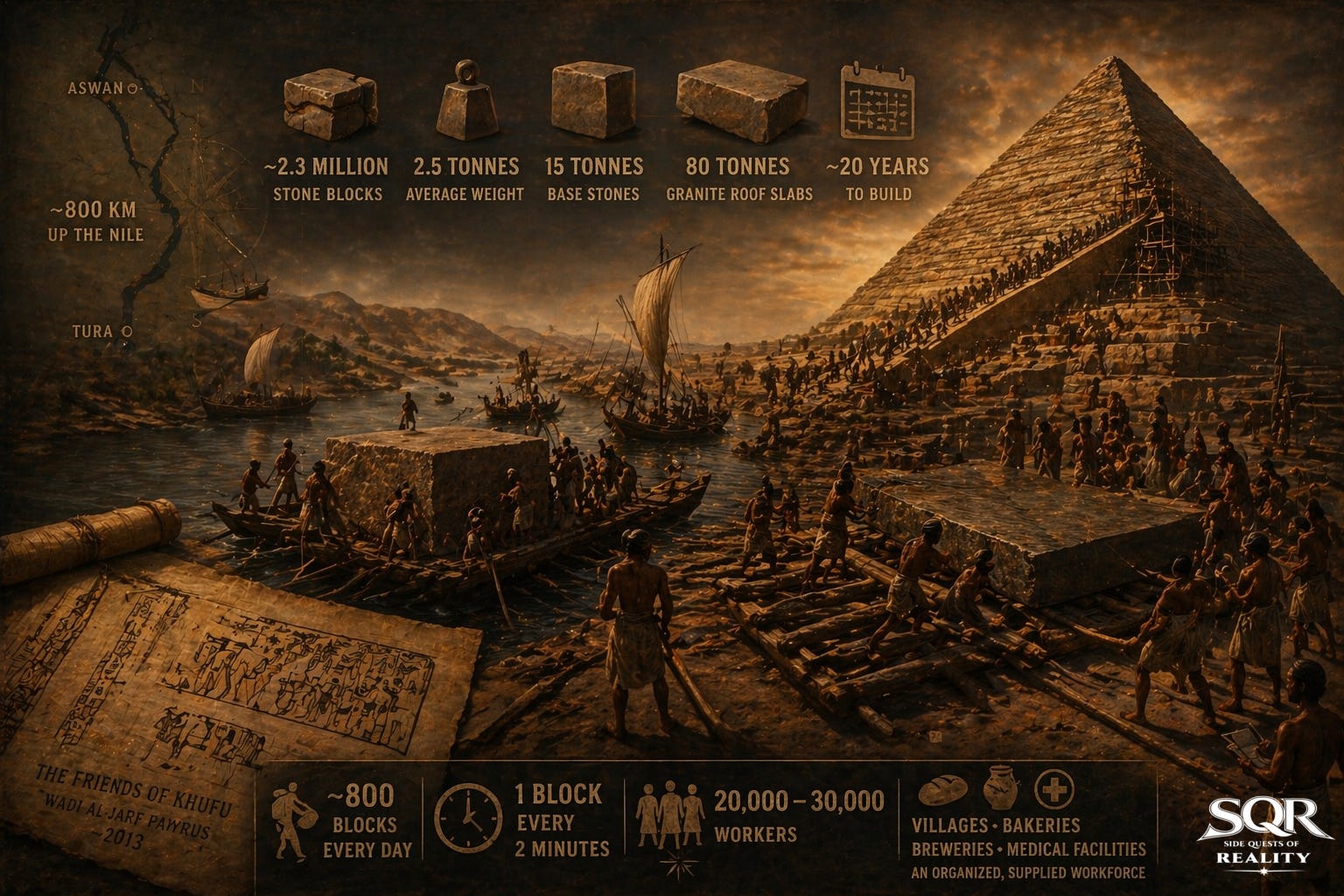
The pyramid contains approximately 2.3 million blocks of limestone, granite, and basalt. The limestone came primarily from quarries at Tura, on the opposite bank of the Nile, and from local sources on the Giza plateau itself. The granite came from Aswan, more than 800 kilometres upstream. The average block weighs around 2.5 tonnes, though the stones at the base can reach 15 tonnes, and the granite slabs used to roof the King’s Chamber — the burial chamber at the pyramid’s heart — weigh up to 80 tonnes each.
Those roofing slabs were transported from Aswan. Across 800 kilometres of Nile, and then hauled up a structure rising more than 40 metres from the ground, and set with a precision that has maintained structural integrity for four and a half thousand years. On the question of how this was done, there is no consensus, no surviving manual, and no intact tool or mechanism that accounts for the full operation.
The timeline makes the numbers harder still. To have completed the pyramid in twenty years — the standard estimate, based on Khufu’s reign length — workers would have had to place approximately 800 blocks every single day. That is one block every two minutes, continuously, for twenty years, without a day off.
The workforce required to achieve this is estimated at between 20,000 and 30,000 people. Evidence found at the site — workers’ villages, bakeries, breweries, medical facilities — indicates this was an organized, fed, and housed professional operation, not a slave army of popular imagination. A papyrus discovered in 2013 at the port of Wadi al-Jarf, the oldest papyrus ever found, records a work gang called the Friends of Khufu transporting limestone blocks from Tura by boat. It describes their schedules, their rations, and the logistical chain that supplied the Giza site. It is the closest thing to a construction diary that survives, and it raises as many questions as it answers.
The Precision That Shouldn’t Exist
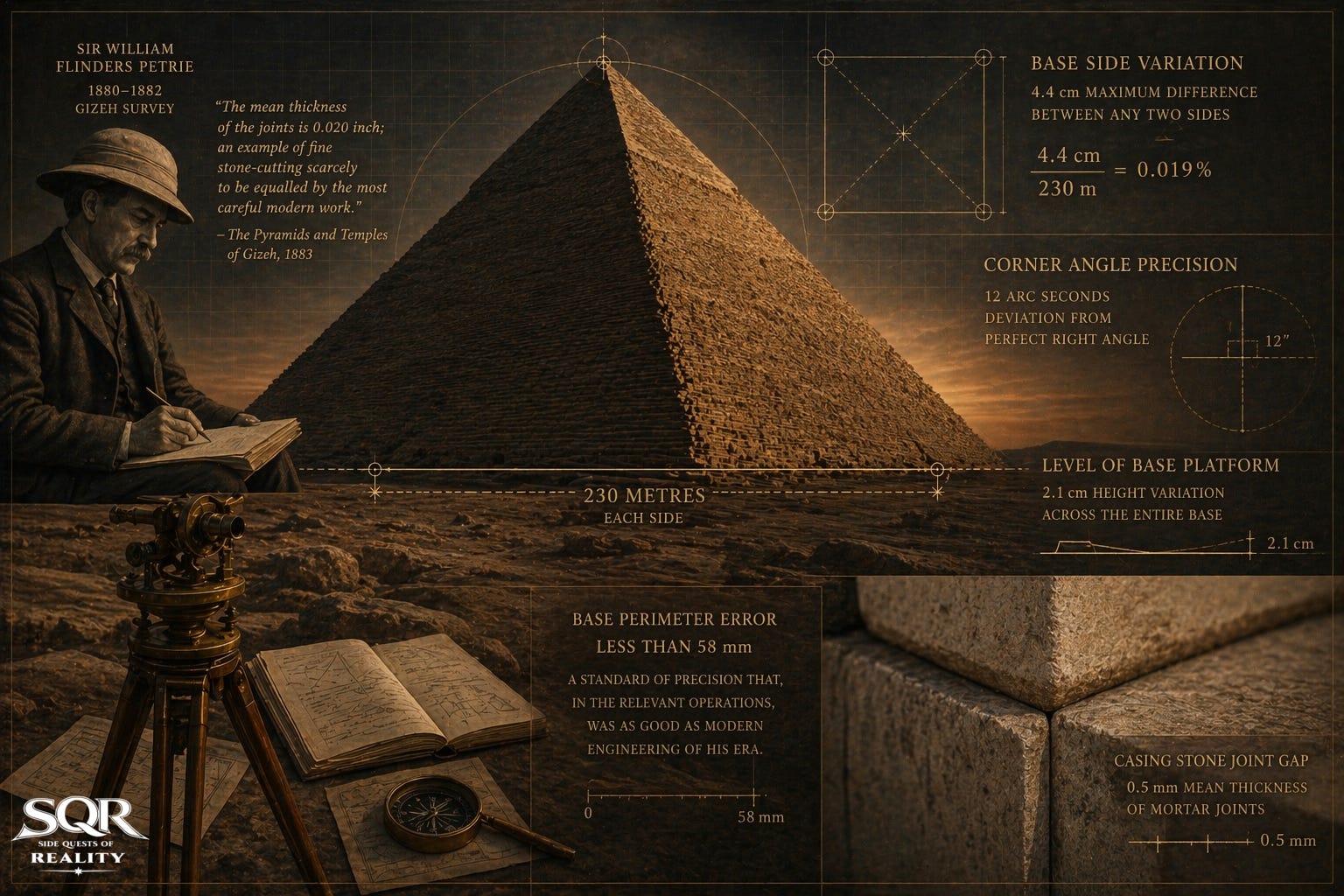
The dimensions of the Great Pyramid were surveyed in extraordinary detail by Sir William Flinders Petrie between 1880 and 1882. Petrie arrived at Giza a believer in the theory that the pyramid embodied mathematical codes and sacred ratios. He left having measured the structure so precisely that he demolished most of those theories himself — and replaced them with something more troubling: the actual numbers.
The four base sides of the pyramid differ from each other in length by a maximum of 4.4 centimetres. Across a base measuring 230 metres, that is a proportional error of less than 0.02 percent. The four corners deviate from perfect right angles by at most 12 arc seconds — one three-hundredth of a degree. The difference in height across the base, from the lowest corner to the highest, is 2.1 centimetres across 230 metres of desert plateau.
Petrie’s conclusion, published in his 1883 report, was that the work had been executed to a standard of precision that, in the relevant operations, was as good as modern engineering of his era could achieve. That was 1883. His measurement of the base perimeter error of less than 58 millimetres has not been significantly improved upon in the century and a half since, despite the use of laser surveying technology and GPS ground-truthing.
The casing stones — the polished white Tura limestone that once covered the entire exterior, now almost entirely stripped away — were fitted with gaps between them of half a millimetre or less, filled with a mortar so thin that it served more as a lubricant for final placement than as structural adhesive. Petrie recorded that the mean thickness of the joints was less than 0.5 millimetres across surfaces averaging 1.2 square metres — an area the size of a large desk, joined to its neighbour with an accuracy that opticians today would recognize as fine work.
“The mean thickness of the joints is 0.020 inch; an example of fine stone-cutting scarcely to be equalled by the most careful modern work.”
— Sir William Flinders Petrie, The Pyramids and Temples of Gizeh, 1883
Base side variation: 4.4 cm maximum difference between any two base sides across a 230-metre span — a proportional error of 0.019%.
Corner angle precision: 12 arc seconds deviation from a perfect right angle — one three-hundredth of one degree.
Level of base platform: 2.1 cm height variation across the entire base, achieved by quarrying the bedrock itself to a flat surface.
Casing stone joint gap: 0.5 mm mean thickness of mortar joints between casing stones, on surfaces the size of a large desk.
The Compass That Points to Nothing
Of all the pyramid’s unsettling properties, the one that most quietly resists explanation is its orientation.
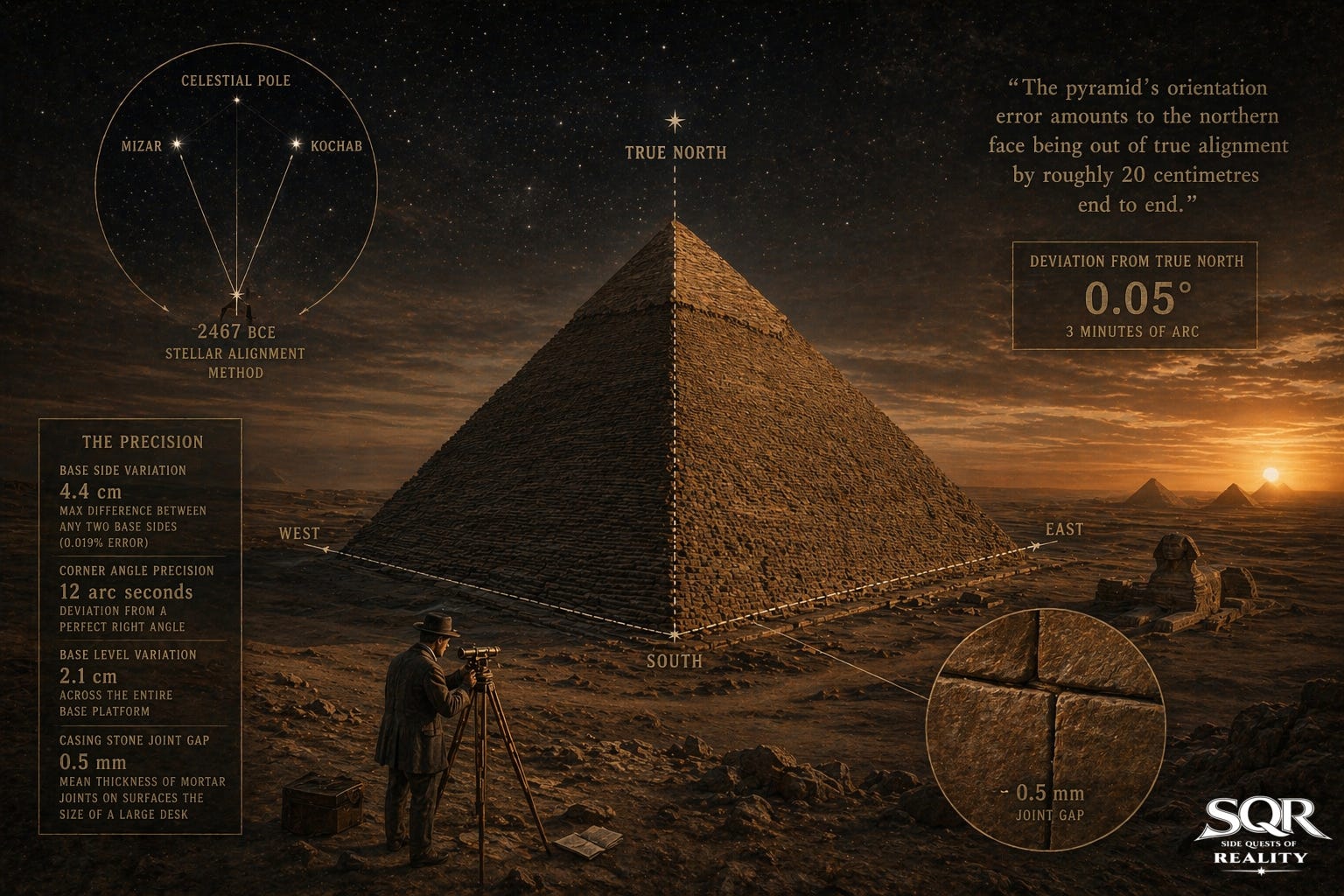
The pyramid’s four sides face very nearly true north, true south, true east, and true west. Not magnetic north — magnetic north changes over time and was not what the Egyptians would have had access to reliably. True geographic north: the direction toward the Earth’s rotational axis. The deviation from true north is 0.05 degrees, or three minutes of arc.
To understand what this means, consider that one degree of arc represents roughly 110 kilometres at the equator. Three minutes of arc — the pyramid’s entire error in orientation — represents approximately 5.5 kilometres at the equator. Translated to the scale of the pyramid’s 230-metre base, the orientation error amounts to the northern face being out of true alignment by roughly 20 centimetres end to end.
There is no magnetic compass reading that would have given the ancient Egyptians this result. Magnetic north in Egypt’s Old Kingdom period was several degrees off from true north, and the deviation varies unpredictably. The only reliable method for finding true north without modern instruments is astronomical observation: specifically, tracking the motion of stars around the celestial pole.
The leading theory, advanced by Egyptologist Kate Spence in a 2000 paper in the journal Nature, proposes that builders used two circumpolar stars — Mizar and Kochab — which straddled the celestial pole in 2467 BCE. When these two stars were simultaneously aligned with a vertical plumb line, the line they defined pointed almost exactly to true north. The method would have worked with stunning precision for a period of a few decades around that date, and the orientation error of the pyramid is consistent with a small drift in that stellar alignment over the years of construction.
Spence’s theory is compelling and widely respected. It is not universally accepted. Alternative proposals include shadow-bisection methods using the sun, in which the equal-length shadows of morning and afternoon are bisected to find the north-south meridian. A third proposal involves a single bright circumpolar star, tracked over many hours and its arc bisected geometrically. A fourth, proposed in 2001 by astronomers Rawlins and Pickering, identifies different candidate stars.
What all of these theories share is that they are computationally plausible and archaeologically unconfirmed. No surviving instrument, gnomon, alignment stake, or observational record has been found that tells us what the builders actually did. The accuracy is documented. The method is not.
What Was Inside
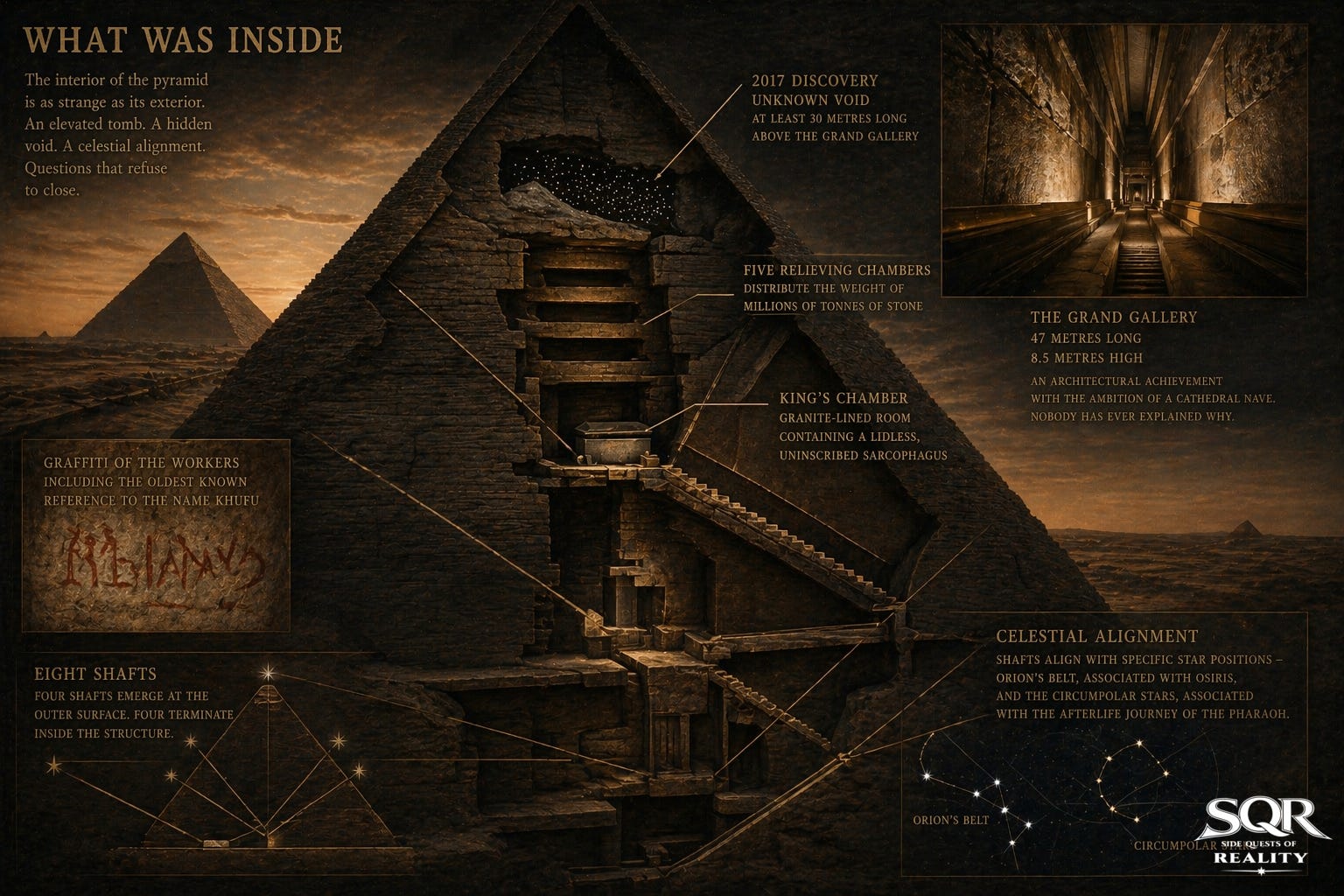
The interior of the pyramid is as strange as its exterior. Where most royal tombs of the era are cut into bedrock and hidden, the pyramid’s burial chamber is elevated high inside the structure itself, reached by a corbelled grand gallery 47 metres long and 8.5 metres high — an architectural achievement that has never been satisfactorily explained in terms of construction necessity. The gallery serves as a passage, but it is built with the ambition of a cathedral nave. Nobody has ever explained why.
Above the King’s Chamber — the granite-lined room at the top of the gallery, containing a lidless, uninscribed sarcophagus — are five chambers stacked one above another, known as relieving chambers. They distribute the weight of the millions of tonnes of stone pressing down from above. They were not intended to be seen; they contain only graffiti left by the workers who built them, including the oldest known reference to the name Khufu, scrawled in red ochre. The engineering of these chambers is sophisticated. The reason they needed to be so sophisticated — why the burial chamber was placed so high in the structure, requiring such an elaborate weight-distribution solution — has never been adequately explained.
The pyramid also contains eight narrow shafts, four of which emerge at the outer surface and four of which terminate inside the structure. For much of the twentieth century they were assumed to be ventilation shafts. Their orientation has since been analyzed and found to align with specific star positions significant in Egyptian religion — Orion’s Belt, associated with Osiris, and the circumpolar stars, associated with the afterlife journey of the pharaoh. Whether the alignment is intentional or coincidental is a question that has generated significant scholarly disagreement and no resolution.
In 2017, the ScanPyramids project — an international team using muon tomography, a technique that uses cosmic-ray particles to see through stone the way X-rays see through flesh — announced the discovery of a previously unknown void inside the pyramid. It sits above the Grand Gallery and is at least 30 metres long. It has not been excavated. Its purpose, if it has one, is unknown. It is simply there, inside one of the most studied structures on earth, waiting to be explained.
The 2017 Void
A previously unknown cavity was detected above the Grand Gallery using muon tomography — the same technique used to image the interior of volcanoes and nuclear reactors. The void is at least 30 metres long and appears to be roughly the same cross-sectional area as the Grand Gallery itself.
It does not appear on any ancient design or survey. No passage connects it to any known interior space. It has not been entered, and as of this writing, no consensus has emerged on what it is, why it was built, or whether it represents an architectural feature, an abandoned construction chamber, or something else entirely.
The pyramid has been intensively studied for more than two centuries. The void was invisible to all of it until 2017.
The Theories
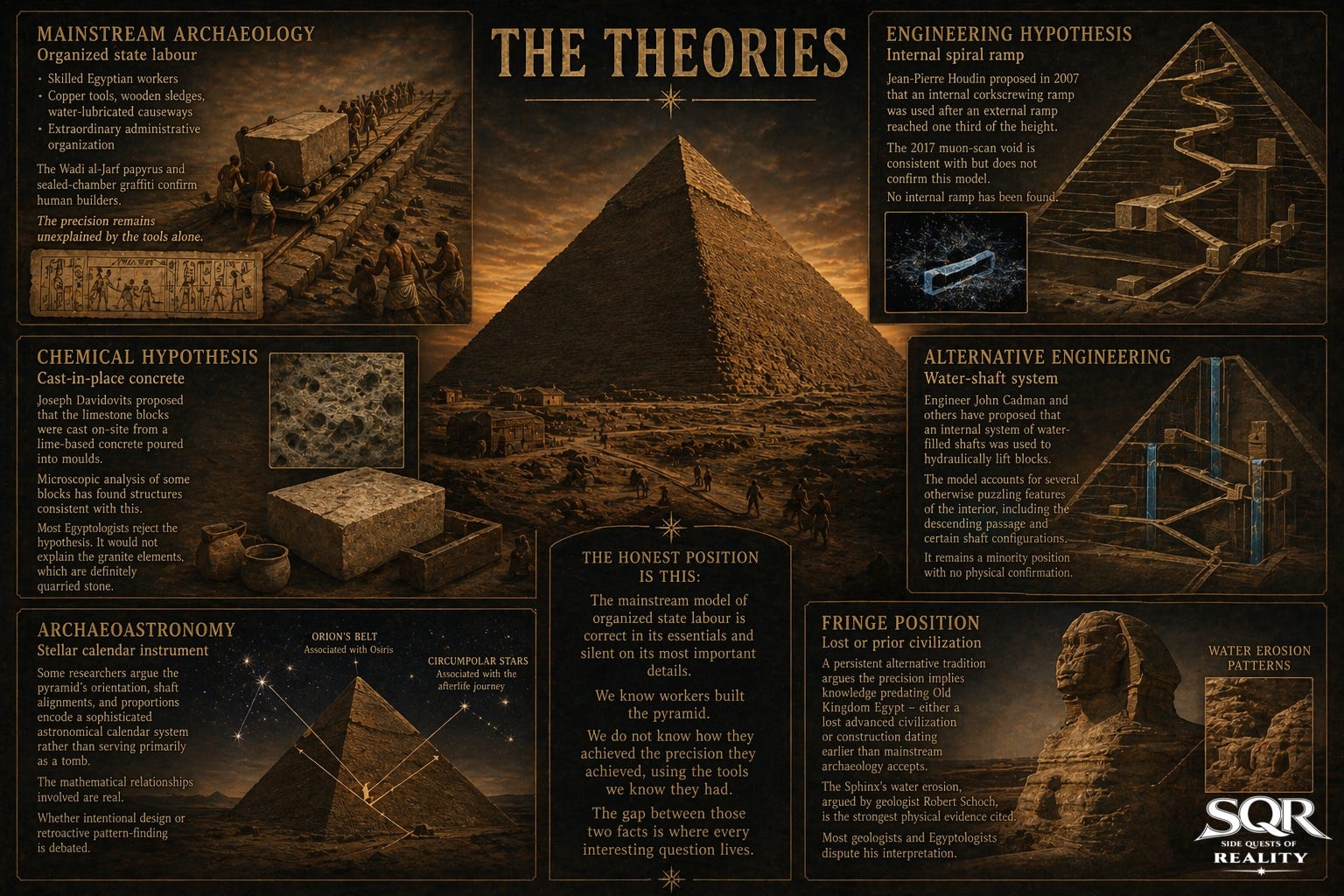
Every generation produces its own explanation for the pyramid, and every explanation is at least partially right and almost entirely incomplete.
Mainstream archaeology: Organized state labour
Skilled Egyptian workers using copper tools, wooden sledges, water-lubricated causeways, and extraordinary administrative organization. The Wadi al-Jarf papyrus confirms this model in its broad outline. The graffiti of named work gangs in sealed chambers confirms human builders. The precision remains unexplained by the tools alone.
Engineering hypothesis: Internal spiral ramp
Architect Jean-Pierre Houdin proposed in 2007 that an internal corkscrewing ramp was used for upper-level construction, after an external ramp carried material to a third of the pyramid’s height. The 2017 muon scan void is consistent with but does not confirm this model. No internal ramp has been found.
Alternative engineering: Water-shaft system
Engineer John Cadman and others have proposed that an internal system of water-filled shafts was used to hydraulically lift blocks. The model accounts for several otherwise puzzling features of the interior, including the descending passage and certain shaft configurations. It remains a minority position with no physical confirmation.
Chemical hypothesis: Cast-in-place concrete Geopolymer chemist Joseph Davidovits proposed that the limestone blocks were not quarried and hauled but cast on-site from a lime-based concrete poured into moulds. Microscopic analysis of some blocks has found structures consistent with this. Most Egyptologists reject the hypothesis. It would not explain the granite elements, which are definitely quarried stone.
Archaeoastronomy: Stellar calendar instrument Some researchers argue the pyramid’s orientation, shaft alignments, and proportions encode a sophisticated astronomical calendar system rather than serving primarily as a tomb. The mathematical relationships involved are real. Whether they are intentional design or retroactive pattern-finding is debated.
Fringe position: Lost or prior civilization A persistent alternative tradition argues the precision implies knowledge predating Old Kingdom Egypt — either a lost advanced civilization or construction dating earlier than mainstream archaeology accepts. The Sphinx’s water erosion, argued by geologist Robert Schoch, is the strongest physical evidence cited. Most geologists and Egyptologists dispute his interpretation of the erosion.
The honest position is this: the mainstream model of organized state labour is correct in its essentials and silent on its most important details. We know workers built the pyramid. We do not know how they achieved the precision they achieved, using the tools we know they had. The gap between those two facts is where every interesting question lives.
The Mathematics That Won’t Go Away
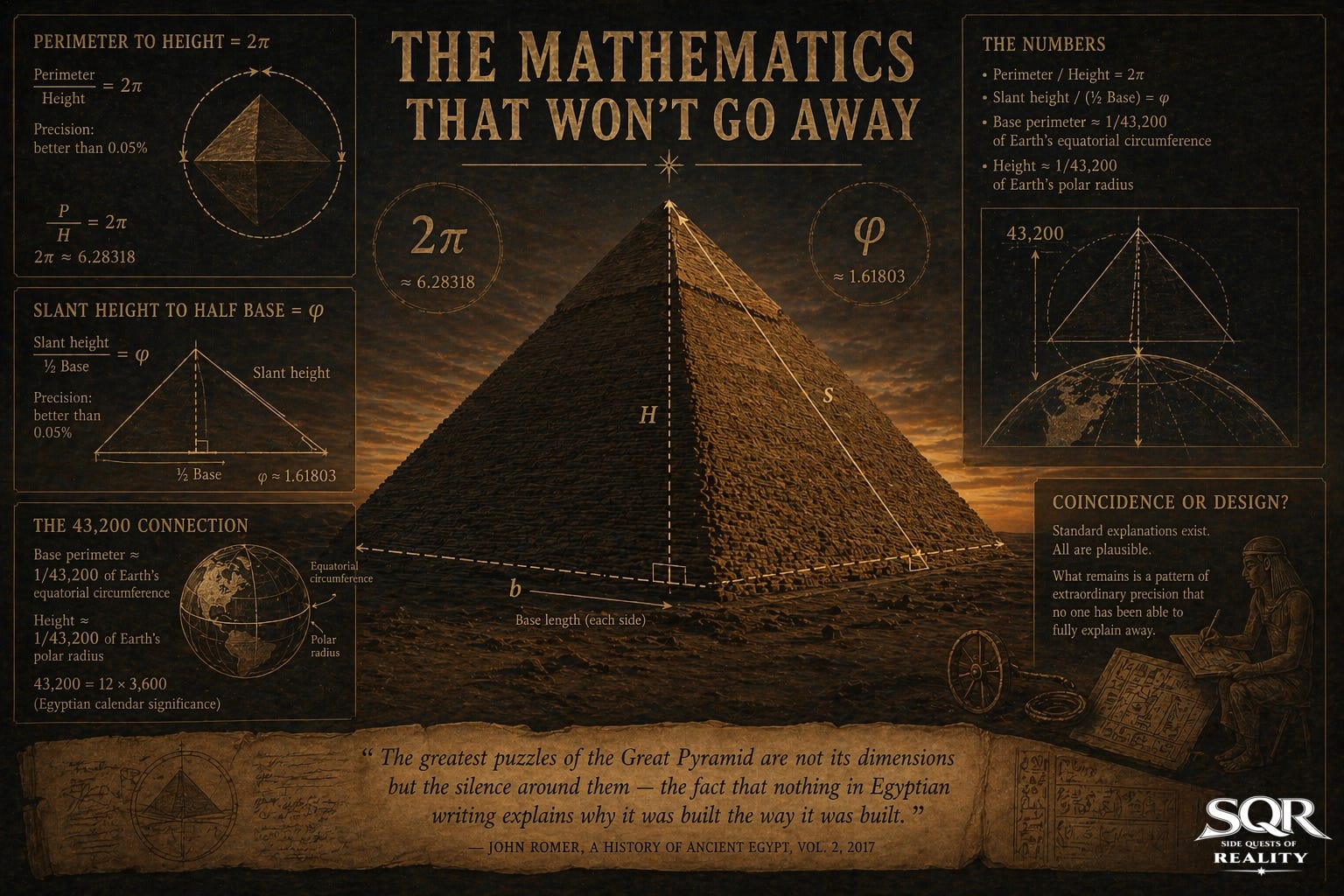
For as long as people have been studying the pyramid, they have been finding mathematical relationships embedded in its proportions. Some of them are real. Some of them are artifacts of how human beings find patterns in numbers. The challenge — and it is a genuine intellectual challenge — is telling the difference.
The relationship that is hardest to dismiss is pi. The ratio of the pyramid’s perimeter to its height is 2π, with a precision of better than 0.05 percent. The standard explanation is that this is a coincidence arising from the use of a practical unit of measurement: if builders used a wheel of known circumference to measure distances, rolling it along the base would naturally encode a pi relationship. This explanation is plausible. It requires a wheeled measuring device that has not been found.
The ratio of the pyramid’s slant height to half its base — its seked, in Egyptian terminology — is approximately phi, the golden ratio, with similar precision. The standard explanation is that this too emerges naturally from the use of practical measurement ratios without any conscious intention to encode the golden ratio. This explanation is also plausible.
The pyramid’s base perimeter is approximately 1/43,200th of Earth’s equatorial circumference, accurate to better than 0.1 percent. Its height is approximately 1/43,200th of Earth’s polar radius, to similar accuracy. 43,200 is 12 multiplied by 3,600 — meaningful numbers in the Egyptian calendar. The standard explanation is that this is coincidence. This explanation is harder to sustain without acknowledging that it requires a very particular kind of coincidence to have produced so many accurate ratios simultaneously.
None of this constitutes proof of anything. It constitutes a pattern that has never been definitively explained either as accident or as design, and that has therefore refused to go away.
“The greatest puzzles of the Great Pyramid are not its dimensions but the silence around them — the fact that nothing in Egyptian writing explains why it was built the way it was built.”
— John Romer, A History of Ancient Egypt, Vol. 2, 2017
A Timeline of Discovery
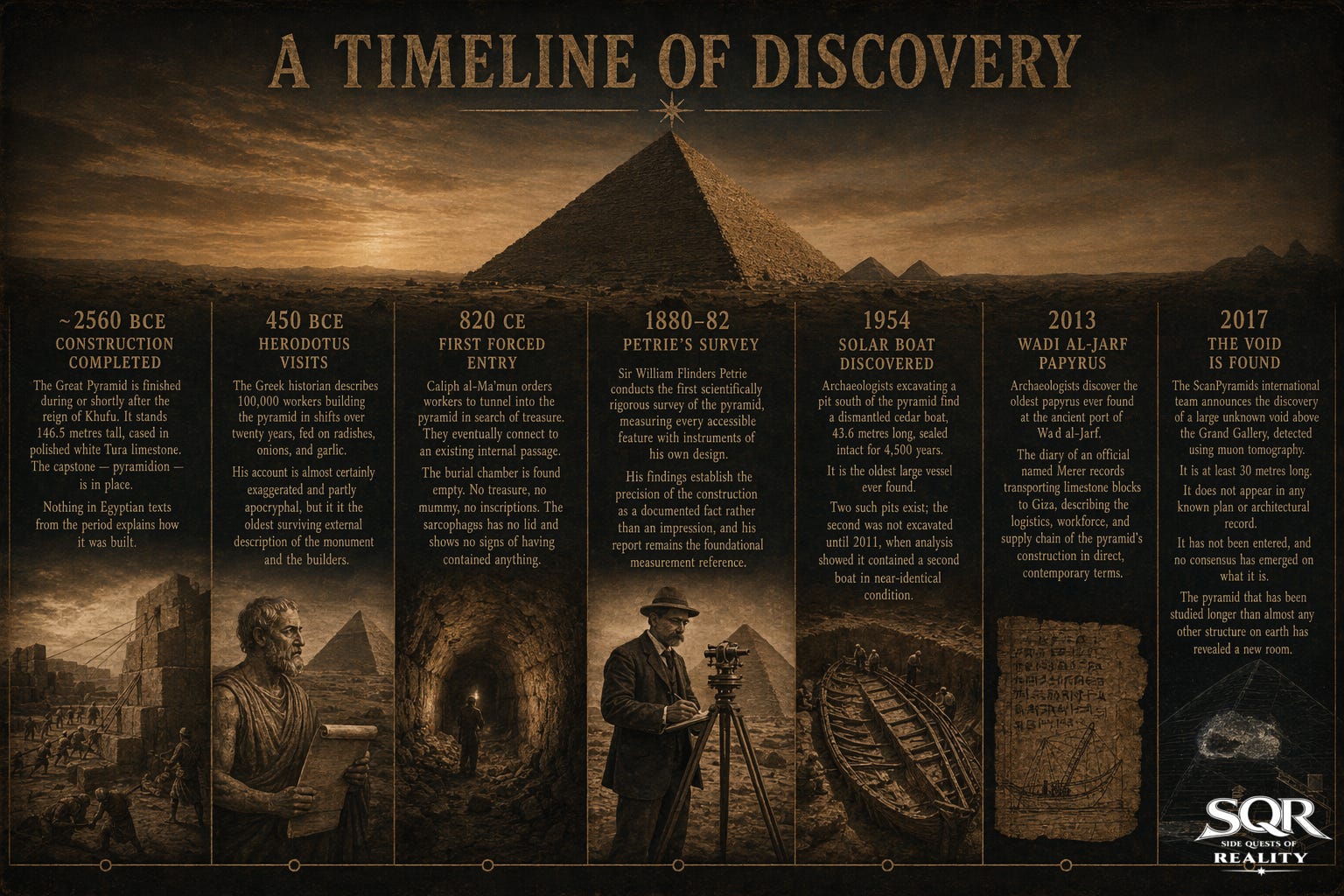
~2560 BCE — Construction completed The Great Pyramid is finished during or shortly after the reign of Khufu. It stands 146.5 metres tall, cased in polished white Tura limestone. The capstone — pyramidion — is in place. Nothing in Egyptian texts from the period explains how it was built.
450 BCE — Herodotus visits The Greek historian describes 100,000 workers building the pyramid in shifts over twenty years, fed on radishes, onions, and garlic. His account is almost certainly exaggerated and partly apocryphal, but it is the oldest surviving external description of the monument and the builders.
820 CE — First forced entry Caliph al-Ma’mun orders workers to tunnel into the pyramid in search of treasure. They eventually connect to an existing internal passage. The burial chamber is found empty. No treasure, no mummy, no inscriptions. The sarcophagus has no lid and shows no signs of having contained anything.
1880–82 — Petrie’s survey Sir William Flinders Petrie conducts the first scientifically rigorous survey of the pyramid, measuring every accessible feature with instruments of his own design. His findings establish the precision of the construction as a documented fact rather than an impression, and his report remains the foundational measurement reference.
1954 — Solar boat discovered Archaeologists excavating a pit south of the pyramid find a dismantled cedar boat, 43.6 metres long, sealed intact for 4,500 years. It is the oldest large vessel ever found. Two such pits exist; the second was not excavated until 2011, when analysis showed it contained a second boat in near-identical condition.
2013 — Wadi al-Jarf papyrus Archaeologists discover the oldest papyrus ever found at the ancient port of Wadi al-Jarf. The diary of an official named Merer records transporting limestone blocks to Giza, describing the logistics, workforce, and supply chain of the pyramid’s construction in direct, contemporary terms.
2017 — The void is found The ScanPyramids international team announces the discovery of a large unknown void above the Grand Gallery, detected using muon tomography. It is at least 30 metres long. It does not appear in any known plan or architectural record. It has not been entered, and no consensus has emerged on what it is. The pyramid that has been studied longer than almost any other structure on earth has revealed a new room.
What the Explanations Leave Out
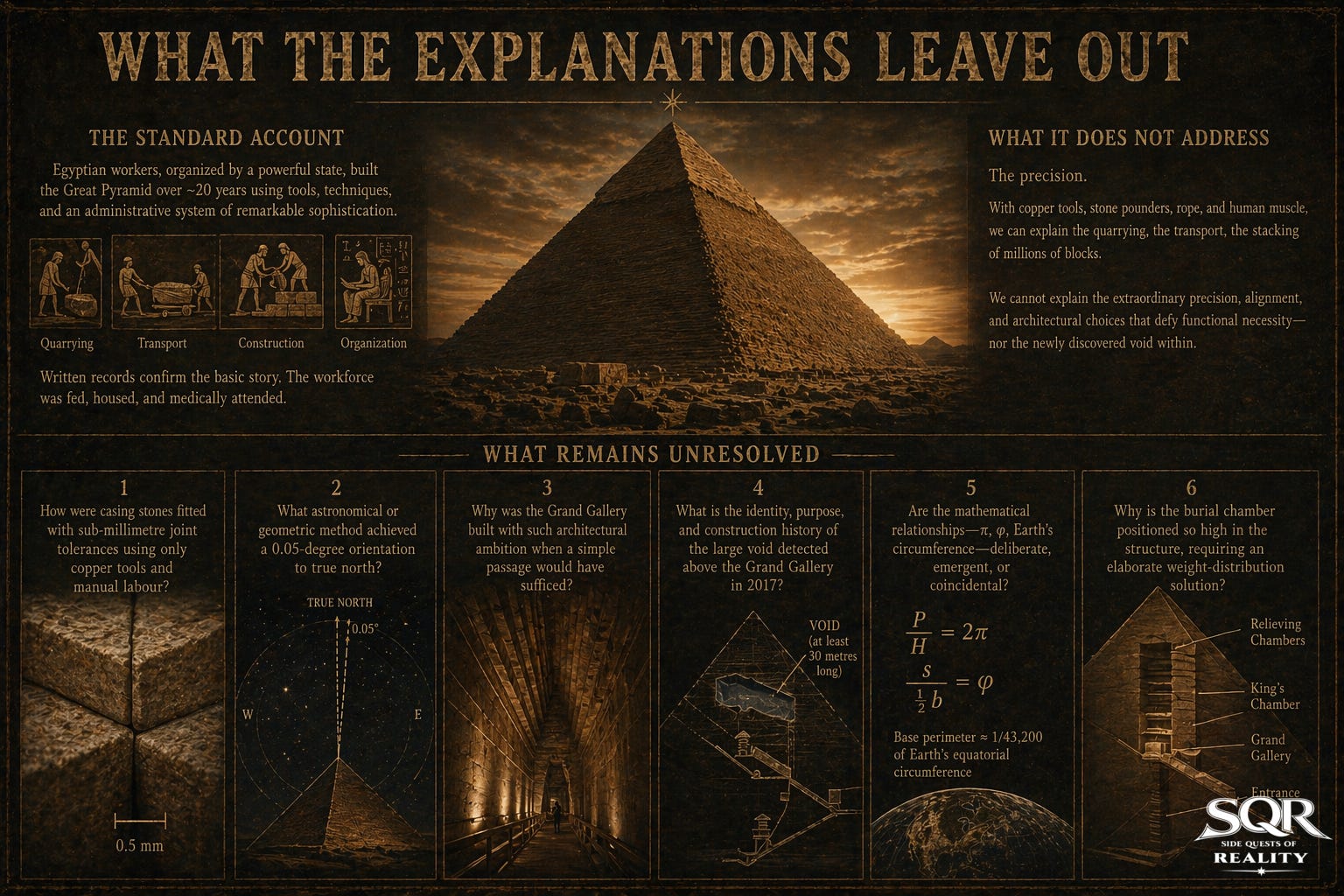
The standard account of the Great Pyramid is comfortable and, in its broad structure, almost certainly right. Egyptian workers, organized by an enormously capable state apparatus, built it over approximately twenty years using techniques of quarrying, transport, and masonry that we partially understand. The workforce was fed, housed, and medically attended. The project was managed by an administrative system sophisticated enough to have left written records, and those records confirm the basic story.
What the standard account does not address is the precision.
The tools available to Old Kingdom Egyptian builders were copper chisels, granite pounders, wooden sledges, rope, and human muscle. With those tools, we can explain the quarrying. We can explain the transport, roughly — experiments have confirmed that wet sand significantly reduces friction for sledge haulage, and water-craft on the Nile and a now-buried canal system connected the quarries to the site. We can explain the stacking of blocks in a general sense.
We cannot explain, with those tools and what we know of their use, how the casing stones were fitted with half-millimetre gaps across surfaces the size of desks. We cannot explain how the base was leveled to within 2.1 centimetres across 53,000 square metres of desert plateau. We cannot explain how an orientation to within three arc minutes of true north was established and maintained across twenty years of construction. We cannot explain why the Grand Gallery was built with the architectural ambition of a cathedral when a simple passage would have served its function. We cannot explain what is in the newly discovered void.
These are not small omissions. They are the most interesting parts of the problem, and they remain open.
What remains unresolved:
The specific technique by which casing stones were fitted with sub-millimetre joint tolerances using only copper tools and manual labour.
The astronomical or geometric method that achieved a 0.05-degree orientation to true north — proposed theories exist; confirmed evidence does not.
The purpose and method of construction of the Grand Gallery, whose architectural elaboration exceeds any functional explanation so far offered.
The identity, purpose, and construction history of the large void detected above the Grand Gallery in 2017.
Whether the mathematical relationships encoded in the pyramid’s proportions — pi, phi, Earth’s circumference — are deliberate, emergent from measurement conventions, or coincidental.
Why the burial chamber is positioned so high in the structure, requiring an elaborate weight-distribution solution, when lower placement would have been architecturally simpler.
What the Pyramid Is
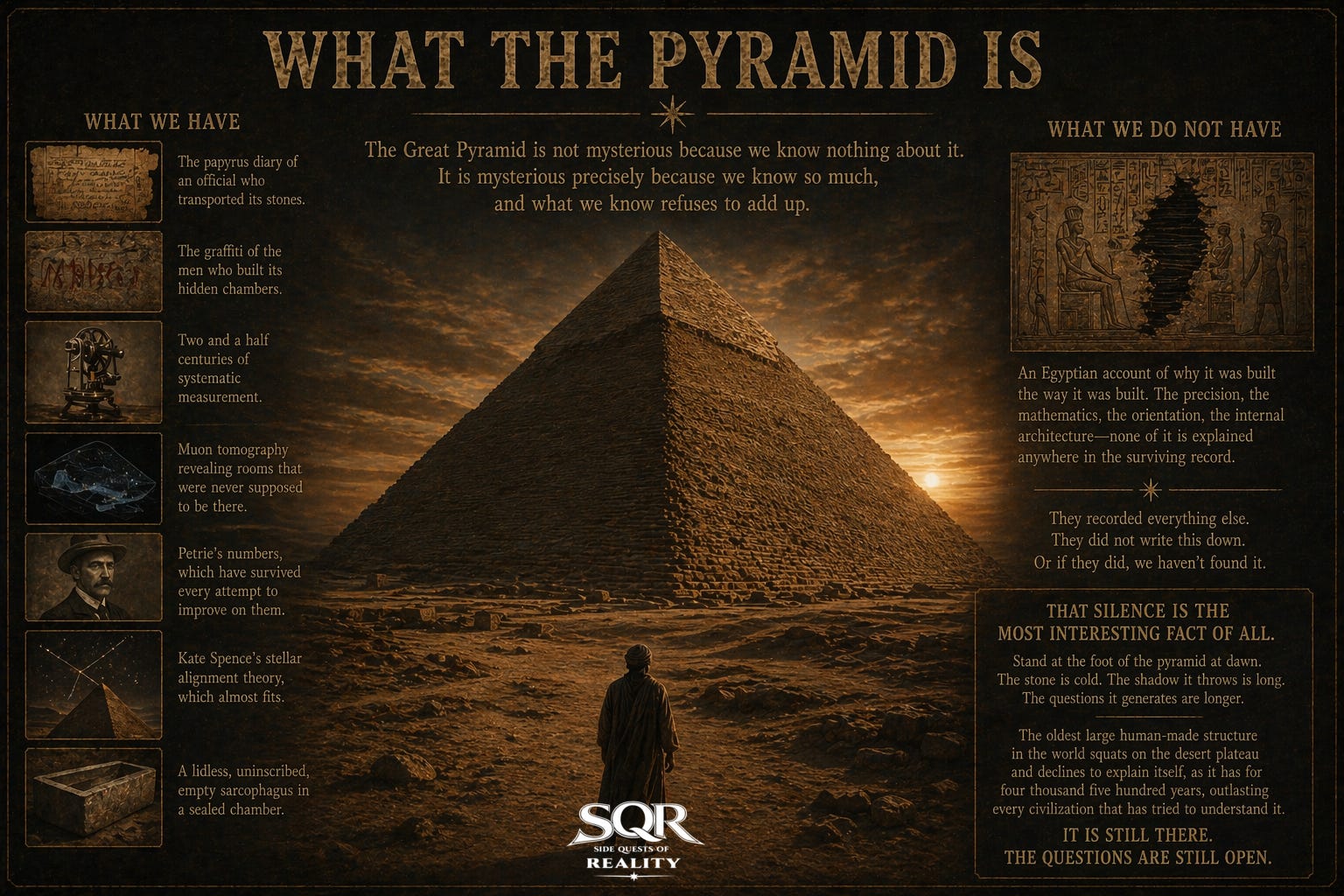
The Great Pyramid is not mysterious because we know nothing about it. It is mysterious precisely because we know so much, and what we know refuses to add up.
We have the papyrus diary of a middle-ranking official who transported its stones. We have the graffiti of the men who built its hidden chambers. We have two and a half centuries of systematic measurement. We have muon tomography revealing rooms that were never supposed to be there. We have Petrie’s numbers, which have survived every attempt to improve on them. We have Kate Spence’s stellar alignment theory, which almost fits. We have a lidless, uninscribed, empty sarcophagus in a chamber that was sealed for four thousand years before anyone opened it.
What we do not have is the thing that would make all of this coherent: an Egyptian account of why it was built the way it was built. The precision, the mathematics, the orientation, the internal architecture — none of it is explained anywhere in the surviving record. The pyramid was built by a civilization that recorded vast amounts of information: religious texts, medical manuals, astronomical observations, administrative correspondence. They did not write down how they built it. Or if they did, we haven’t found it.
That silence is the most interesting fact of all.
Stand at the foot of the pyramid at dawn. The stone is cold. The shadow it throws is long. The questions it generates are longer. The oldest large human-made structure in the world squats on the desert plateau and declines to explain itself, as it has for four thousand five hundred years, outlasting every civilization that has tried to understand it.
It is still there.
The questions are still open.
This case is filed as SQR-AMY-001. If you want to be notified when SQR-AMY-002 drops, and when the cases start talking to each other in ways that are difficult to explain, subscribe below.
The next case in the Ancient Mysteries series will examine a structure equally precise, equally unexplained, and built five thousand years before anyone was supposed to know how.