
Case Study SQR-CRP-001: Bigfoot, Sasquatch, and what survives after you strip away every hoax
SIDE QUESTS OF REALITY | SQR-CRP-001 | BIGFOOT & SASQUATCH
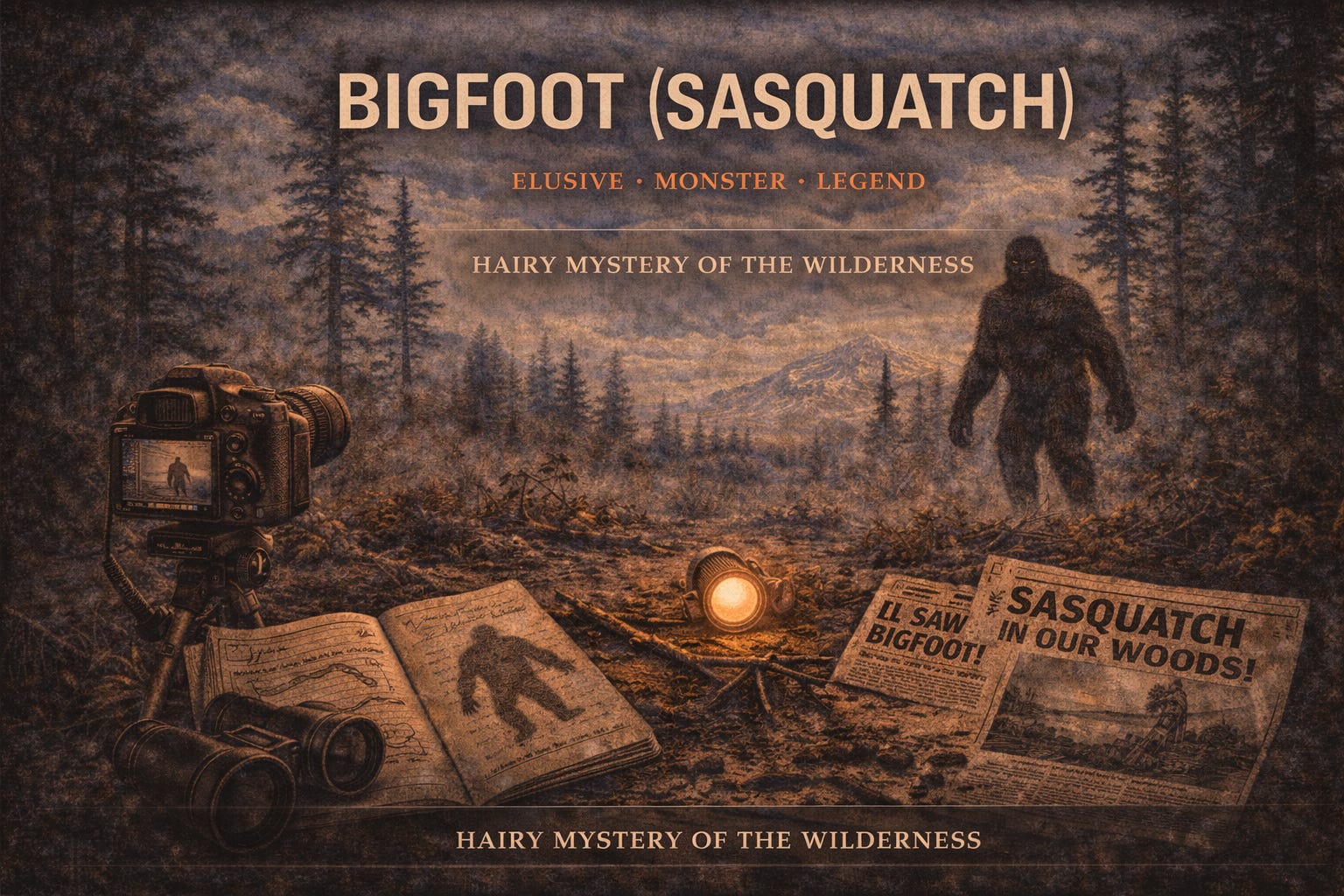
Before the name existed, the observations did.
The word Bigfoot is recent. It was coined in 1958, when a construction worker named Jerry Crew found enormous humanoid tracks near Bluff Creek in Northern California and brought the story to the Humboldt Times. The paper named the creature. The name spread within days and has not retreated since.
But the traditions the name attached itself to were already ancient.
Indigenous peoples across North America had been describing large, hairy, bipedal beings in the forests for as long as their oral traditions extended. The word Sasquatch derives from Sasq’ets in Halq’emeylem, spoken by the Sts’ailes people of British Columbia, meaning roughly the hairy man. The Lummi people of the Pacific Northwest called them Ts’emekwes. The Plateau tribes of the Columbia River knew them as Istiyehe. The Shoshone spoke of Seeahtlk. The Lakota described Chiye-tanka. Variations of the same figure appeared in the oral traditions of tribes from the Pacific coast through the Appalachians, each with local names and local characteristics.
Anthropologist David Daegling noted that these legends existed long before contemporary reports of the creature described as Bigfoot. The traditions were not inspired by the modern phenomenon. The modern phenomenon encountered them.
Before the Cameras
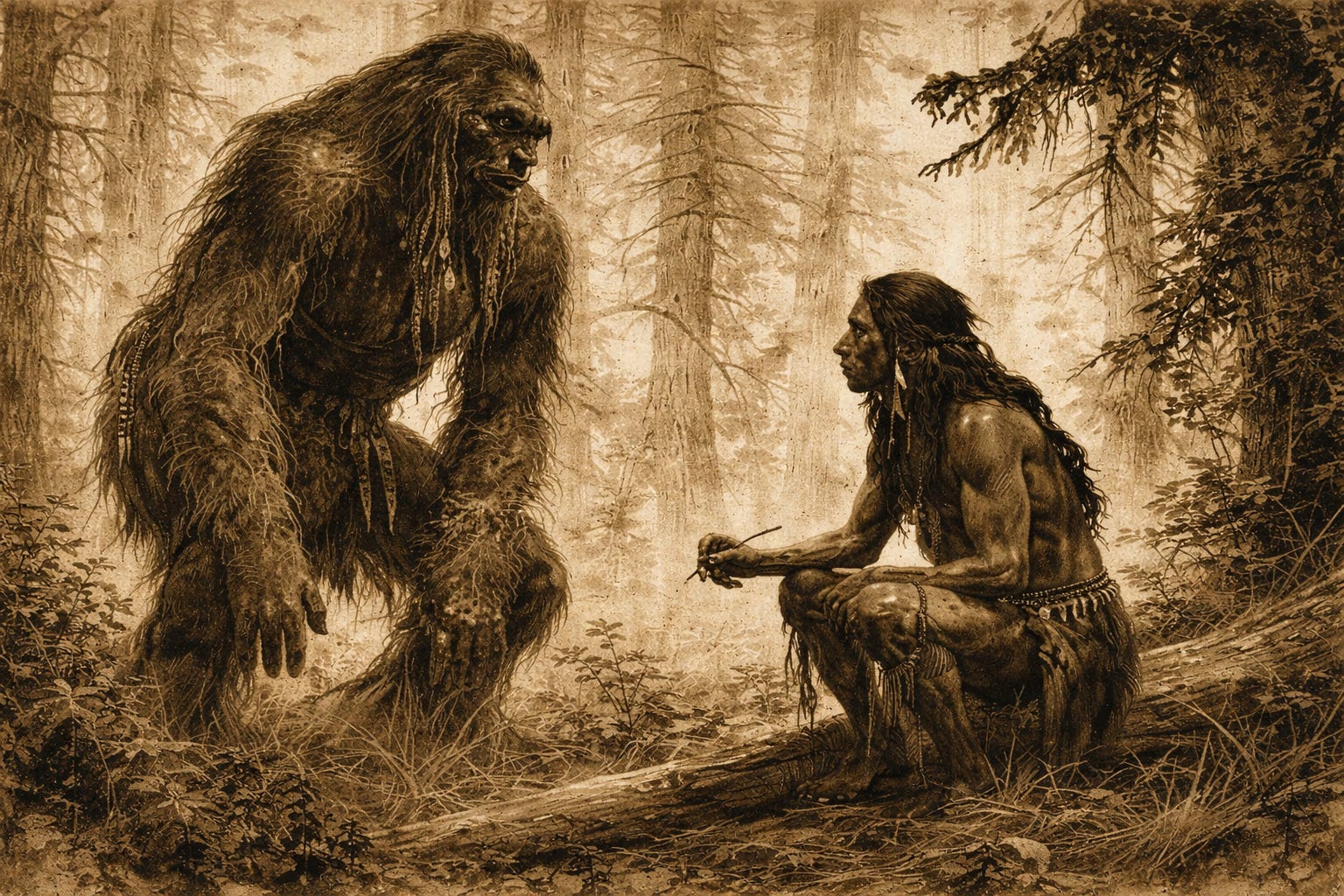
What matters about the indigenous record, for the purposes of serious examination, is not that it proves the creature exists. It is that it represents an unbroken line of observation across a continent, over centuries, by peoples whose relationship with the forest and its inhabitants was intimate and professional in a way that most contemporary observers cannot match.
Indigenous hunters and forest-dwellers were not casual witnesses. They were trained observers whose survival depended on accurate identification of everything that moved in the environment they inhabited.
They described something. That something was described consistently enough across independent cultures that it earned names in dozens of languages.
For many indigenous communities, the question of whether Sasquatch is real does not arise in the way it does in Western scientific discourse. The being exists. It has been encountered. The more interesting questions concern its nature, its relationship to the human world, and the appropriate way to behave when the two worlds intersect.
The Sts’ailes people of British Columbia, whose name for the creature gave English the word Sasquatch, do not describe Bigfoot as an animal to be found. They describe it as a being with spiritual dimensions, capable of moving between the physical world and other registers of reality, not entirely bound by the rules that govern ordinary wildlife. The scholar Phil Cash Cash of the Cayuse and Nez Perce nations has noted that some communities may have a very deep ongoing relationship to this being.
These accounts are sometimes used carelessly to romanticize indigenous traditions or to reduce them to convenient support for particular theories. What they actually represent, approached seriously, is a tradition of witness that is older and more consistent than the modern Western record, held by peoples with generations of direct engagement with the forests where the creature is most commonly described.
Indigenous traditions do not settle the question of what Bigfoot is. They establish that the question is much older than the word.
The Modern Record and Its Problems
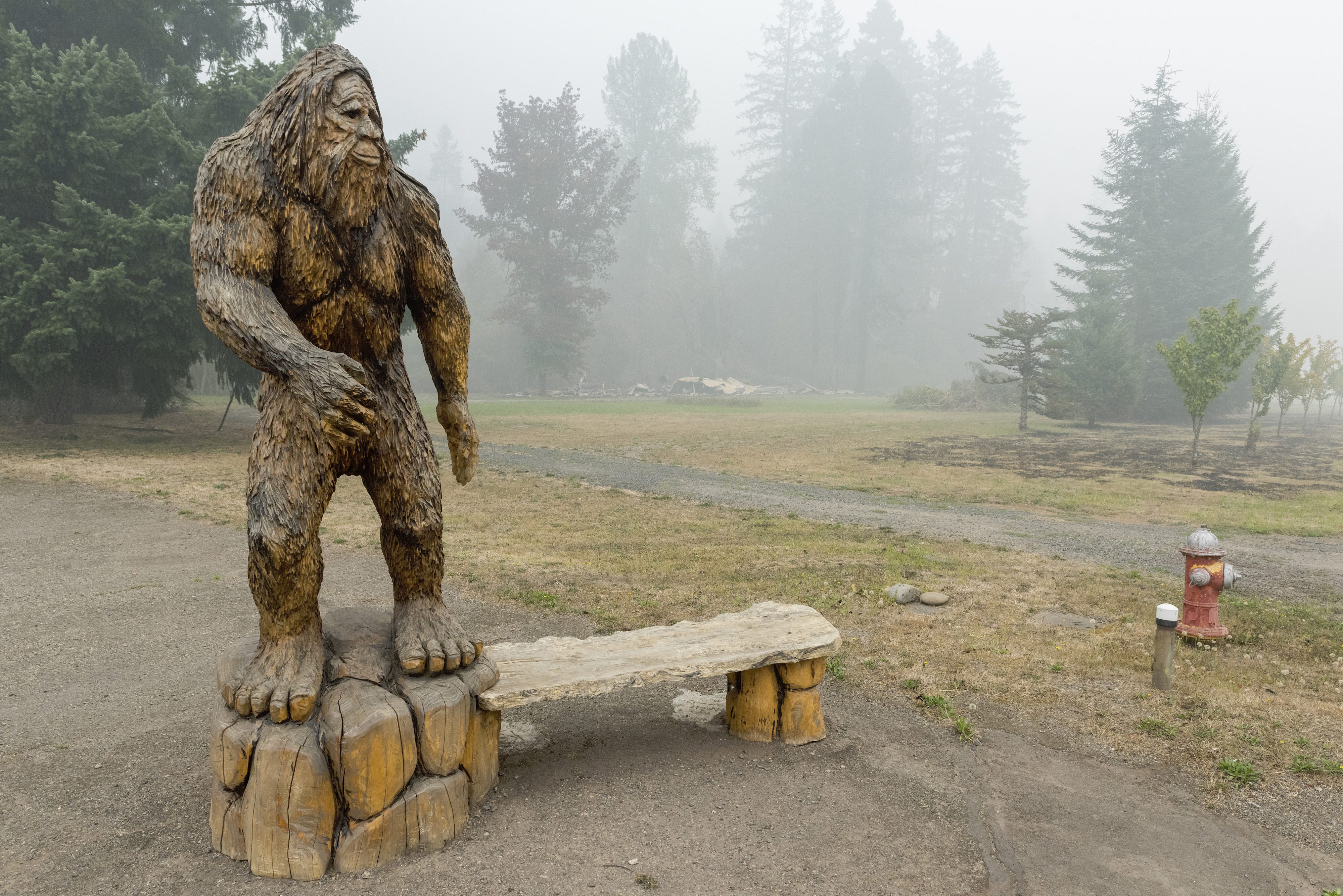
The modern Bigfoot phenomenon begins in earnest in the 1950s and has generated, in the seventy years since, an enormous and largely contaminated record.
The contamination is severe and needs to be stated plainly.
A significant number of Bigfoot tracks are hoaxes. After logger Ray Wallace died in 2002, his family revealed that he had spent decades carving large wooden feet and using them to create tracks in the forests of the Pacific Northwest. Wallace was active in the Bluff Creek area around the time of the original 1958 media event. The extent of his fakery is uncertain but substantial.
A significant number of sightings are misidentified bears. Black bears are common throughout the Pacific Northwest and can walk bipedally for short distances. At a distance, in poor light, through trees, a bear on two legs can produce an impression of a large dark bipedal figure that does not resolve clearly before disappearing.
A significant number of reports are fabrications. The ease of submitting accounts to databases without verification, the cultural rewards of being a Bigfoot witness, and the commercial infrastructure that has grown around the phenomenon all create incentives for invention that do not exist in other domains of anomalous reporting.
The Bigfoot Genome Project of 2012 claimed to have sequenced Sasquatch DNA and concluded the creature was a human hybrid. It was rejected by every peer-reviewed journal and eventually published in a journal its lead researcher created specifically to publish her own work.
None of this is comfortable to say about a phenomenon being examined seriously. But taking it seriously requires saying it. The hoax rate in the Bigfoot record is very high. The signal-to-noise ratio is very low. Anyone approaching this subject honestly has to begin by acknowledging that most of what has been presented as evidence is not evidence.
What remains after that acknowledgment is what matters.
The Film
On October 20, 1967, Roger Patterson and Bob Gimlin were riding on horseback along Bluff Creek in Northern California’s Six Rivers National Forest. Patterson was a Bigfoot enthusiast who had spent years on the subject, published a book about it, and rented a 16mm camera specifically for this expedition.
At approximately 1:30 in the afternoon, rounding an overturned tree at a turn in the creek, they saw a figure.
Patterson grabbed the camera, dismounted, and ran toward it while filming. The resulting footage runs for 59.5 seconds. It shows a large, dark, bipedal figure walking away from the camera, turning once to look back over its right shoulder, and disappearing into the trees.
What happened next is the history of the film in miniature. It was shown widely, examined by scientists, debated continuously, and has resisted clean resolution for nearly six decades.
The case for hoax is substantial. Patterson was already in the business of Bigfoot before the film. He had financial incentive. The filming occurred under circumstances that made independent verification impossible. Multiple individuals have claimed over the years to have been the person in the suit, though none of these claims have been substantiated with verifiable evidence. Costume makers Philip and Amy Morris claimed Patterson commissioned an ape suit from them. A documentary premiering at SXSW in 2026 claimed to present evidence of hoax, though the strength of that evidence remains contested.
The case against hoax is also substantial. No one who claims to have been in the suit has produced the suit or demonstrated credibly that they made it. The figure’s proportions, particularly arm length relative to leg length, are inconsistent with a human in a costume. The biomechanics of the figure’s walk, including a double-stride length and bent-knee gait that produces specific muscle group movements visible beneath the surface, have been analyzed by specialists in primate locomotion who found features difficult to replicate in a human subject. Primatologist John Napier, no Bigfoot enthusiast, conceded after examining the evidence that there must be something in northwest America that needs explaining.
The honest position is this. The Patterson-Gimlin film has not been definitively debunked in fifty-eight years of intensive scrutiny by people with strong incentives to debunk it. It has also not been verified. It is the most examined short film in cryptozoological history and continues to resist clean resolution in either direction.
It is not proof. It is not nothing.
The Footprints
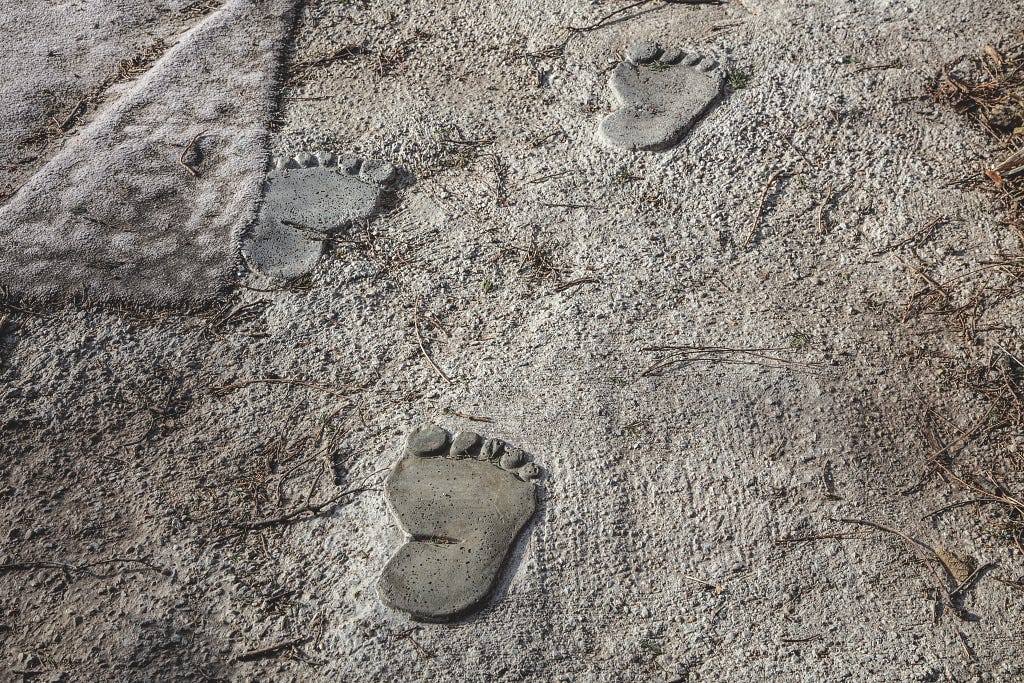
The physical evidence that serious researchers find most compelling is not the film. It is the footprints.
Not all footprints. Most cast tracks in the Bigfoot literature are easily explained by hoax, misidentification of known animals, or natural deformation of the substrate. The Wallace carvings alone account for a significant portion of the northern California record.
What is harder to explain are the tracks that exhibit dermal ridges.
Human feet have dermal ridges. Every fingerprint is a dermal ridge pattern. The ridges are a feature of primate skin and they are extraordinarily difficult to fake convincingly because their scale, pattern, and distribution follow biological rules that are not easy to replicate artificially.
In the 1980s, a United States Forest Service employee discovered tracks in the Blue Mountains of northeastern Oregon that showed apparent dermal ridges in fine detail. The tracks were analyzed by Dr. Jeffrey Meldrum, a professor of anatomy and anthropology at Idaho State University who specializes in primate bipedalism, and by others with relevant expertise. The dermal ridge patterns were found to be consistent with a biological foot rather than a carved wooden fake.
Meldrum has accumulated over 300 footprint casts across his career, a subset of which he maintains could not have been created by known means of fabrication. He is one of very few mainstream academic scientists willing to attach his professional reputation to the serious study of the subject.
The dermal ridge tracks have not been explained away. They have been largely ignored by the scientific mainstream, which is a different thing.
The Absence
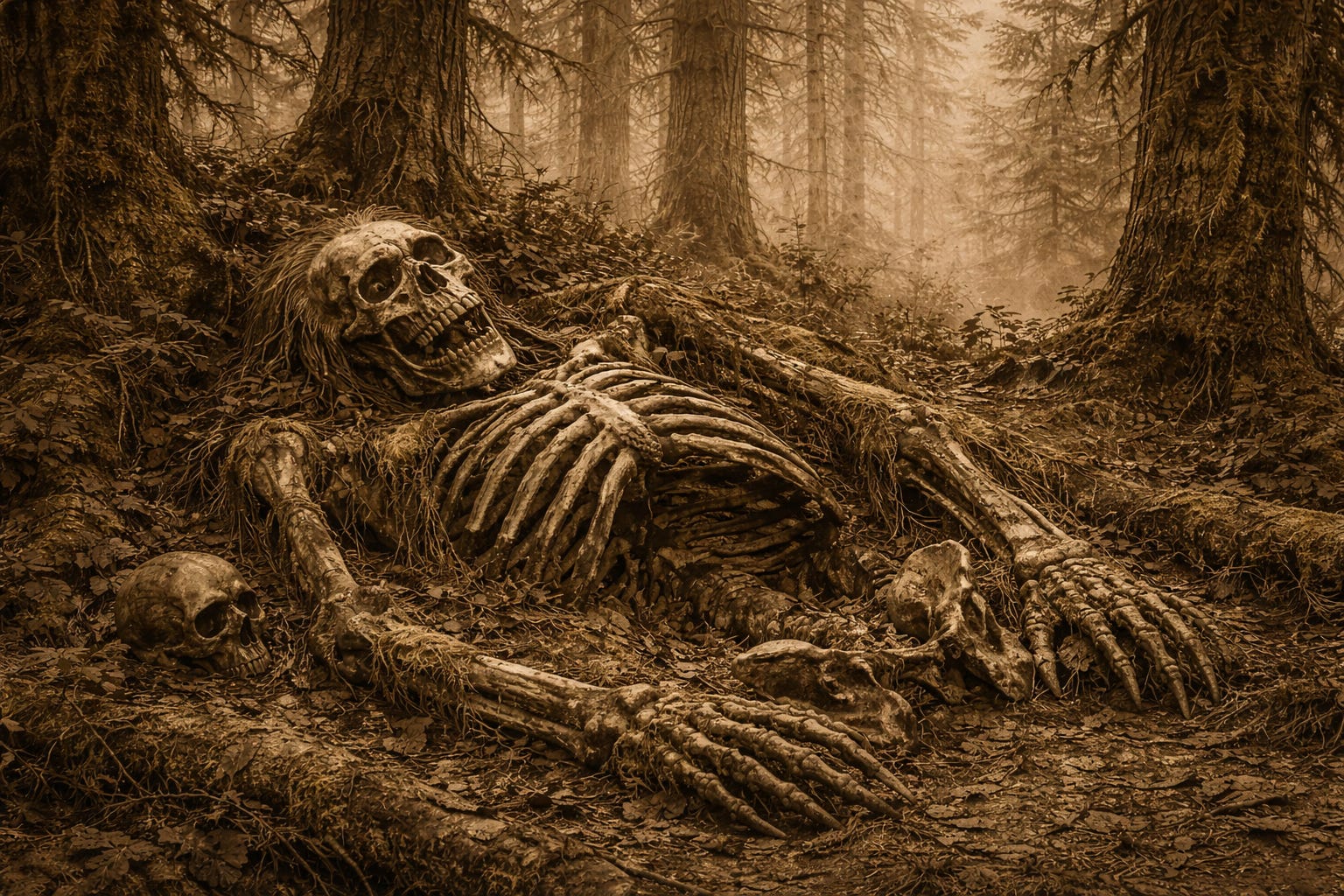
The strongest argument against Bigfoot’s existence as a biological organism is not the hoaxes or the bad evidence. It is the silence of the physical record.
Large animals die. They leave remains. Bears die in the forest. Deer die. Mountain lions die. Their bones accumulate. Their carcasses are found by hunters, hikers, and scavengers. The archaeological and paleontological record contains the physical evidence of animals that lived and died across North America over millennia.
Not a single confirmed Bigfoot bone, tooth, hair sample, or biological tissue has been definitively identified and verified by mainstream science.
This is not a small problem. It is the central problem. A breeding population of large primates capable of sustaining itself across centuries, generating thousands of sightings across the continent, should leave biological remains in the archaeological record. The absence is not just puzzling. For a strictly biological explanation of the phenomenon, it is the most serious objection available.
This is why some researchers have moved toward explanations that do not require Bigfoot to be a conventional biological organism. The indigenous traditions that describe the creature as capable of moving between physical and non-physical registers, that attribute to it a kind of intentional hiddenness or interdimensional quality, may be describing something that the standard biological framework does not fully accommodate.
This is speculation. It has no evidentiary weight on its own. But the absence of physical remains, combined with the persistence and consistency of the witness record, creates a logical space that the standard explanation, unknown primate surviving undetected in North American forests, does not comfortably fill.
The Distribution
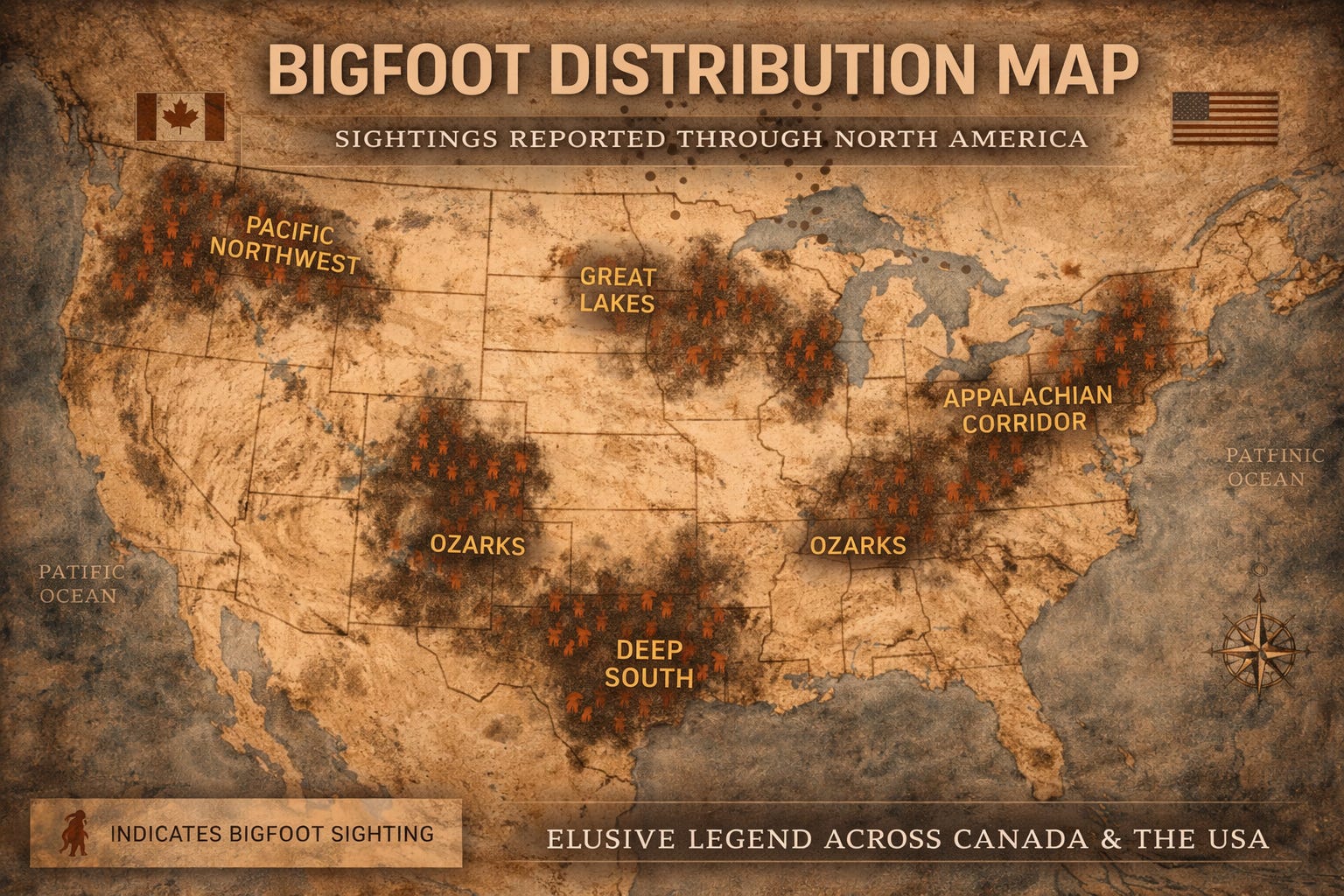
Bigfoot sightings are reported across the entire continental United States and much of Canada, with notable concentrations in the Pacific Northwest, the Great Lakes region, the Appalachian corridor, the Ozarks, and the swampy forests of the Deep South.
This distribution has been used both against and in favor of the creature’s existence.
Against: a breeding population of large primates cannot plausibly range from California to Florida, at population densities sufficient to generate thousands of sightings annually, while leaving no carcass, no bone, no roadkill, no biological trace of any kind in the verified record. The geographic breadth of sighting reports, taken at face value as evidence of a real animal, requires a population so large and so widespread that its absence from the physical record becomes inexplicable.
In favor: the consistency of description across independent regional traditions is striking. The Appalachian creature described by witnesses in West Virginia is physically similar to the creature described by witnesses in British Columbia. These descriptions have not converged through cultural transmission in the way that, for instance, alien descriptions have been shaped by science fiction. Regional variations exist, but the core features remain consistent across thousands of miles of independent witness tradition.
What produces consistent descriptions of the same basic creature across a continent, over centuries of indigenous oral history, and into the contemporary sighting record?
The simplest answer is that the same creature is being described. The next simplest answer is that the same cognitive template, a large bipedal dark figure at the edge of the trees, is being activated across cultures by different stimuli. These two answers produce identical sighting records and cannot be distinguished from each other on the basis of testimony alone.
What Remains
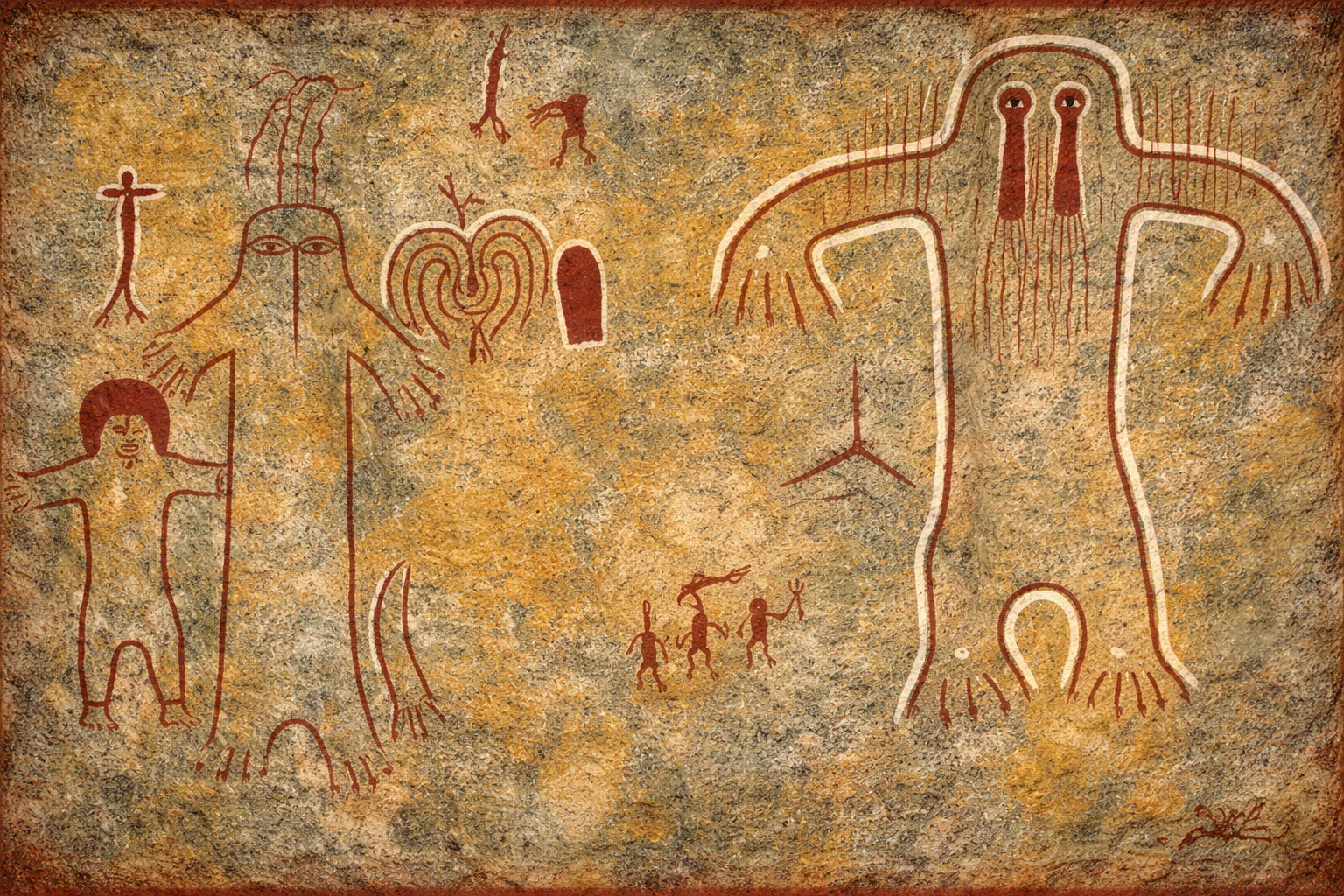
Strip away the Wallace tracks. Strip away the costumed hoaxers, the fabricated reports, the reality television, the commercial exploitation, the bad DNA studies. Strip away every account that can be explained by misidentified bears or wishful thinking or attention-seeking.
What remains is this.
A record of indigenous observation, maintained across centuries by peoples with intimate knowledge of the forests, consistently describing a large bipedal being with characteristics no known North American animal matches.
A subset of footprint casts, including some with apparent dermal ridges, that specialists in primate anatomy have found inconsistent with known fabrication methods.
A 59.5-second film that has survived nearly six decades of scrutiny by people strongly motivated to expose it as a hoax, and has not been definitively exposed.
A witness record, once the obvious fabrications are removed, containing accounts from hunters, loggers, and outdoor professionals with decades of forest experience, who had strong practical reasons not to report a large bipedal creature, who reported one anyway, and who have maintained their accounts under social cost for years.
These things do not prove Bigfoot exists.
They establish that something has been seen in the forests of North America for a very long time, that the something has been consistent enough in its description to earn names in dozens of languages across independent cultures, and that the available explanations, whether biological, psychological, or cultural, do not quite account for the full record.
What is making the tracks. What the cameras have come close to and not resolved. What the indigenous elders have been describing since before the Europeans arrived with their categories and their cameras and their demand for a body.
That is the question.
It is older than anyone currently living.
It has not been answered.
This case is filed as SQR-CRP-001.
If you want to be notified when SQR-CRP-002 drops, and when the cases start talking to each other in ways that are difficult to explain, subscribe below.
That’s all this is. Careful attention. Sustained over time. Welcome to Side Quests of Reality.